
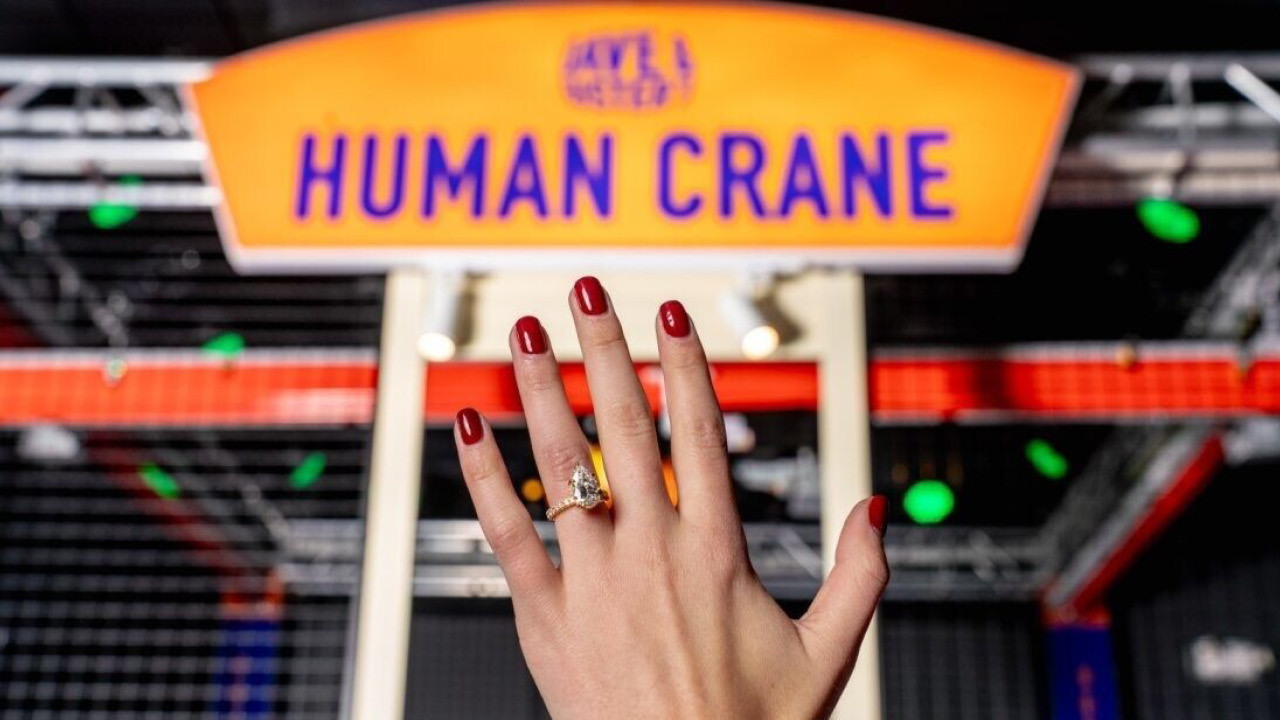
A game promotion from entertainment company Dave & Buster’s featuring five 3-carat “diamond” engagement rings worth $15,000 each has raised questions about the requirements for lab-grown disclosure.
In a recent press release, the company advertised a special Valentine’s Day promotion at select stores, in which it would place the rings inside its Human Crane game to create a “one-of-a-kind engagement moment.” The Human Crane involves strapping customers into a harness and lowering them into a pool of prizes, similar to a claw arcade game. Rides start at $20 per person.
While the entertainment company stated outright how many rings would be available, how many carats each weighed, how much each was worth, and even what jewelry store designed them, it referred to them only as “diamonds,” leading to the assumption they were natural. However, a follow-up email to Dave & Buster’s revealed they were, in fact, lab-grown.
This led to several questions about disclosure: When a diamond that is not mined is offered for sale, Federal Trade Commission (FTC) guidelines clearly state it must be sold or advertised only with clarifying descriptors, including “laboratory-grown,” “lab-grown,” or “synthetic.” The word “diamond” on its own refers to natural.
If a company is outside the diamond industry, do the same rules of disclosure still apply? What if the vendor offers the diamond as a prize, or a giveaway, and not a direct sale to a consumer who could be confused about wording and origin when making a purchase?
Understanding the rules
“The purpose of the FTC regulations is to prevent consumer deception,” Liz Fraccaro, assistant counsel at the Jewelers Vigilance Committee (JVC), told Rapaport News. “The regulations apply to any person, partnership or corporation engaged in the business of offering for sale, selling, or distributing laboratory-grown diamonds. The regulations make clear that they apply to the products themselves. The fact that the prize is a diamond is the reason why the gaming company must comply with the regulations.”
Kristina Buckley Kayel, managing director of the Natural Diamond Council (NDC), agreed, pointing out that the FTC’s disclosure requirements “are not limited to sales transactions, but also apply to advertising, marketing and promotional representations, including giveaways, contests or prizes, where a material representation is made to consumers.” If the promotion describes a prize as a “diamond,” that claim carries the same disclosure obligations, regardless of whether the diamond is being sold or awarded at no cost, she added.
“To fail to clearly and conspicuously disclose that the stone is ‘laboratory-grown’ or ‘laboratory-created’ in advertising and promotions for giveaway may be considered deceptive advertising, because consumers might assume the diamonds are natural. It does not matter that the lab-grown diamond is not for sale.”
However, the FTC guidelines may be challenging for companies outside the industry. Dave & Buster’s indicated it had no previous awareness of any rules concerning lab-grown disclosure.
“Thank you for informing us of this law,” Dave & Buster’s said. “We are making a clarification on the press release now and it should be updated shortly.”
Rules of engagement
- The Federal Trade Commission (FTC) jewelry guides apply to any business or individual that markets, advertises, promotes or describes diamonds to US consumers, regardless of their primary industry.
- When running a promotion, issuing a press release, advertising a prize or marketing a giveaway, companies that use the word “diamond” are subject to the same truth-in-advertising standards.
- When deciding whether disclosure is necessary, the key test the FTC uses is: Would a reasonable consumer be misled?
- The word “diamond” by itself refers only to a natural diamond under FTC guidance.
- The FTC explicitly says disclosures must be clear, prominent, unavoidable and not hidden in fine print.
- According to the rules, intent does not matter — only consumer perception.
Image: The Human Crane game. (Dave & Buster’s)