
Botswana President Duma Boko endorsed the Global Diamond Consortium (GDC) as the preferred bidder for Anglo American’s De Beers stake on Monday, allowing the group to move ahead with the acquisition and publicly setting out the country’s demand for a 30% holding.
“Government has selected the Global Diamond Consortium as its preferred bidder for Anglo American’s interest in De Beers,” Boko said in his annual State of the Nation address in Gaborone.
Anglo already viewed the consortium, led by former De Beers CEO Gareth Penny, as its preferred bidder, Rapaport News understands. Botswana’s backing removes a key hurdle, as the government, which owns the remaining 15% of De Beers, holds the right of refusal over any sale of Anglo’s stake. Anglo owns 85% of De Beers and has been trying to sell it for more than two years.
Boko had been expected to name the GDC at the address, as Rapaport News reported earlier on Monday.
‘Single largest shareholder’
Boko used the speech to stake a public claim on the size of Botswana’s holding. “When this transaction is complete, Botswana’s shareholding in De Beers will double from the current 15% to 30%,” he said. “Botswana will become the single largest shareholder in De Beers, and with that comes greater influence in the strategic decisions for decades.”
Botswana still needs to thrash out that figure with the GDC, which has so far agreed to a deal that has only 25% going to the country, a source close to the matter said. “[Boko’s] negotiation has started, because Gareth [Penny] is at 25%,” the source said on condition of anonymity.
The GDC’s statement after the speech did not mention the size of Botswana’s stake. A spokesperson for the consortium declined to comment further.
The 30% is also short of the “controlling stake” Boko had promised when the sale process began, a pledge he acknowledged in the speech had drawn criticism. He said being the largest individual shareholder still gave it “all the attendant rights and protections.”
Neither Boko nor the GDC gave financial terms. Under the consortium’s offer, Anglo would receive $750 million up front and $250 million in deferred payments, a source told Rapaport News, while a $500 million capital injection into De Beers is still under discussion.
Angola and Namibia will take part in the deal alongside Botswana, Boko said.
Consortium members
In its first public statement, issued after the speech, the GDC welcomed Boko’s comments and thanked “the governments of Botswana, Angola, Namibia and Oman, for their support and partnership as we work together towards becoming co-owners of De Beers.” Boko had named only Angola and Namibia as partners in the deal.
“Botswana’s support represents a significant endorsement of our vision for the industry’s future,” said Penny. “We remain focused now on finalizing agreements with Anglo American as soon as possible.”
The statement named the GDC’s founders as Penny, Saurin Parikh of Antwerp-based Diarough and Moshe Klein of New York-based Grandview Klein, both De Beers sightholders. It also referred to unnamed “world-leading midstream and downstream partners.”
It did not mention Pluczenik, which Rapaport News had reported as one of the consortium’s main trade backers, or Signet Jewelers and Richemont, which had been expected to join. Rapaport News understands all three are still involved in the bid to different degrees. Signet declined to comment, while Richemont did not immediately respond to a request for comment.
‘Lost sight’
Boko said the government’s advisers had assessed the bids against five principles: sustainable profitability under “an experienced, well-funded operator with a clear plan”; greater strategic influence for Botswana; broader participation along the value chain, including local beneficiation; limiting the call on public money; and a deal that can be completed under global regulations.
He was somewhat critical of De Beers. “At some point, De Beers seemed to have lost sight of what gives a natural diamond its value,” he said. “It stopped telling the natural diamond’s story. And the demand it had once done so much to create began to fade.”
Boko also pitched the investment as a technology play through Element Six, De Beers’ synthetic-diamond unit, which he called “the world leader in synthetic-diamond technology.” As the world builds “superintelligence and vast data centers,” demand for high-technology synthetic diamonds will surge, he said.
He said the US government had asked Element Six to partner in the technology, citing a $600 million joint facility in Georgia US President Donald Trump announced, and that he had agreed with US Commerce Secretary Howard Lutnick that Element Six “must stand at the heart of a new technology partnership between Botswana and the United States.”
“Synthetics don’t belong around a beautiful woman’s finger,” Boko said. “They belong at the end of a drill bit.”
Anglo reaction
“We are encouraged by the progress we have made to date, and we continue to work with the government of the Republic of Botswana, other governments and the Global Diamond Consortium towards agreeing binding transaction documents,” a spokesperson for Anglo American said. “Anglo American will provide further updates as appropriate.”
De Beers CEO Al Cook said in a statement on Monday: “Botswana acquired its 15% shareholding in De Beers 25 years ago and has been integral to shaping the company that we are today. I am delighted that the country now intends to increase its position in our iconic business. De Beers has led the diamond industry since 1888, and we welcome owners that share both deep experience of diamonds and high ambitions for what we can achieve.
“Consumers take more and more of an interest in the places their diamonds come from, and I am sure that such new ownership of De Beers will give them confidence that the diamonds they acquire are as responsible as they are beautiful.”
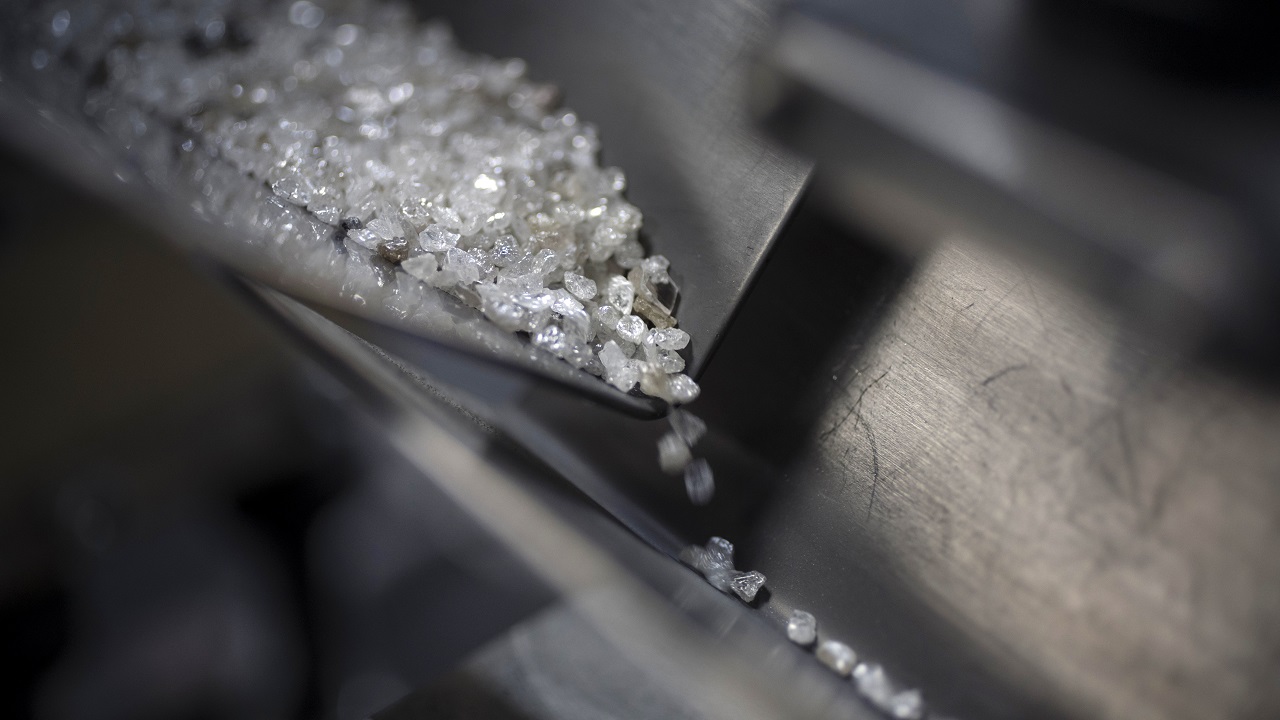
Image: Diamonds at DTC Botswana, a De Beers-government joint venture that sorts and values rough. (Ben Perry/Armoury Films/De Beers)