 WhatsApp
 Email
Email
 Facebook
 Twitter
 LinkedIn
RAPAPORT… Perhaps one of the most frequently asked questions is “What trends are you seeing?” To answer that perennially popular question, Rapaport Diamond Report went to the experts, starting with Hollywood stylist-to-the-stars and editor-at-large for Genlux magazine, George Blodwell, whose A-list clients include Eva Longoria and Helen Mirren. Also weighing in is Karo Vartanian, costume supervisor for the ABC primetime dramedy “Desperate Housewives.” Color plays a hugely important role in all levels of our lives. Leslie Harrington, executive director, The Color Association of the United States (CAUS), tells what shades are on point for the coming year. On a more serious note, everything that we do is affected by the big picture and to fill us in on the overall social trends are futurists Gerald Celente, publisher of the Trends Journal, and Arnold Brown, chairman, Weiner, Edrich, Brown, a trend consulting firm. Here’s what they have to say about 2011.
Arnold Brown
Chairman, Weiner, Edrich, Brown
More and more people are concerned with how they will protect their assets. More and more people will put money in commodities, similar to what happened in Europe before WWII, when people began to transfer assets that were difficult to dispose of into things that they could keep on their person. Diamonds will be bought as investment; they’re better than gold because they are more portable. Currencies and financial equities are unstable. No matter what happens with the stock market, gold keeps going up. People see it as a safe investment and they see how it is appreciating. Diamonds are the same; there is scarce supply. Money is not scarce anymore; countries are making it all the time.
More consumers are spending on experiences. We have to differentiate between the developed and the developing world. In the developed world, people spend on experiences, travel and tourism — things that give you the feeling of accomplishing something. In the developing world, there is a rapidly growing middle class and these people want all the things that the middle class in the developed world has had for many years — cars, clothes, second homes, books, music, kitchen appliances, jewelry — all the material things they haven’t had before. These are two different streams of purchasing.
There is a shift of jobs away from humans to machines. For the first time, this is affecting intellectual activity. It is not just factory workers, but also middle management who are being misplaced. People will save money, rather than spend it. They will put money into gold, diamonds, tangible assets that will increase in value. People used to put money into real estate, but not anymore.
There is growing complexity in the world. Things are so complex nobody can get a handle on them, like financial systems. One way it could play out in the consumer marketplace is more simplicity; people will look for more simplicity in lifestyle. Look at fashion. Elaborate fashions will become simpler, minimalism will come back and things that you can combine with other things will become more important. Bold accessories will become more important. Jewelry will always be in demand. In India, the culture is based on gold jewelry, but more and more people are buying gold and/or diamond jewelry.
There is more internationalization of young people. More and more young people are going to be looking abroad for jobs, for careers, for interesting things to do and places to go. Young people see themselves more as a global culture than local. The contradiction to that is an increase in tribalism — connecting with your family and friends. Increases in communications technology have resulted in more tribalism; people are in closer touch with family and friends. It is easier to stay in touch and stay in touch most with people you care about. We’re seeing more and more transfers of cultures across borders. Consumer goods that are hot in one place will be hot in another place. Young people — late teens to early thirties — make things happen.
Leslie Harrington
Executive Director, The Color Association of the United States (CAUS)
The colors for spring/summer 2011 are derived from a shift in our mind-sets. Quality, over quantity, becomes important. As we recover from the economic crisis, our values are changing to become more community based, as opposed to commodity based. Our habits change to accommodate these ideals — there is a focus on the garden and a feeling of optimism that spring brings in conjunction with the life cycle of plants. In times of uncertainty, there is comfort in the familiar — a sense of nostalgia. Colors have a light and fresh feeling, juxtaposed with a vintage quality.
Victorian Violet and Nouveau Sprout, big sellers from fall 2010/winter 2011, embody that season’s popular natural/vegetable-dyed palette. These olive khakis and dusty lilacs continue into the spring as good sellers and also move to a softer palette like the more lavender Helio for spring/summer 2011. Gems: Clear, light amethyst; yellow-cast green jade.
Chakra Red: Clean, bright, blue-based red. In terms of jewelry and gemstones, think opulent, rouged colored rubies and bright garnets.
Bright Pops: Among the natural-based colors, there are also some darker “pops” of color. Aged Leather, a warm cognac; Pollock Blue, a deep blue-based teal, and Klimt Kiss, a yellow-based, mid-value red, round out the forecast and give the spring/summer palette a dark grounding that is still within the realm of naturally derived color inspiration. Stones: Amber, deep blue sapphire. carnelian, fire opal.
Neutrals: Central to the spring/summer palette, these include Well Worn and Heirloom, warm-based beiges; Enwhitened, bone white, and Sanctuary, a silver-blue-based gray. Gems: Slivers of mica, imperial topaz or soapstone for a more natural,
gritty texture, freshwater pearls and labradorite.
Fall/Winter 2011/2012 remains very much naturally inspired. The garden is still prominent in its influence — taking wholesome pastimes such as cooking and canning as color inspiration. We also look inward to find inspiration; harmonic and calming colors translate our introspective interest. The fall/winter palette also has an injection of bright, synthetic colors, reflecting interest in the movement of life — a heartbeat, musical rhythm, an energy surge. As life starts to become fast paced and full again, we are drawn to high-octane colors.
Naturals: Continuing the vegetable-dyed colors are Celery, a light, yellow-green hue; Winter Rose, a dusty pink. Gems: Peridot, pink tourmaline.
Neutrals: Grisaille, a yellow-based gray; Pickle-Green, a yellow-cast taupe; The Zone, a gray with a red undertone that’s warmer than the summer/spring 2011 Sanctuary. Stones: Granite, green moss agate, burnished silver.
Bright Pops: Prism, a dark magenta; Hot, fluorescent pink; Backlit, a bright royal blue; Flow, much greener-based teal than Pollock Blue of spring/summer of 2011.Stones: Pink sapphire, fuchsia tourmaline, natural blue sapphire, lapis lazuli, malachite.
Darks: Two very dark hues in the forecast — VIP, a blue-charcoal-cast black and
Heartbeat, darkened burgundy. Stones: Jet, sodalite,dark red jasper/garnet.
George Blodwell
A-List Celebrity Stylist, Editor-at-large of Genlux magazine
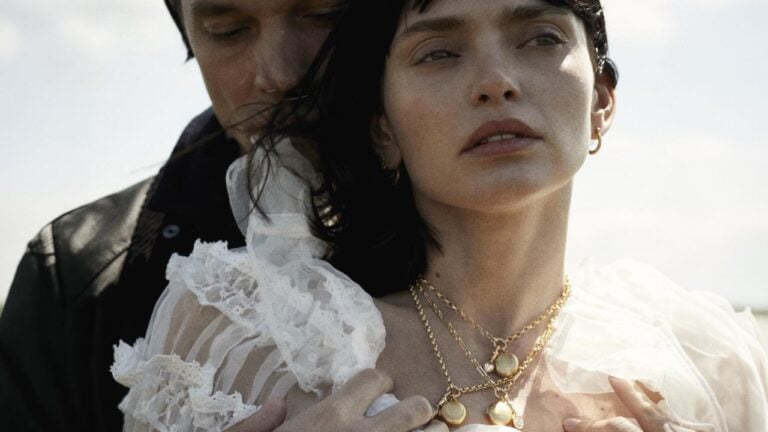
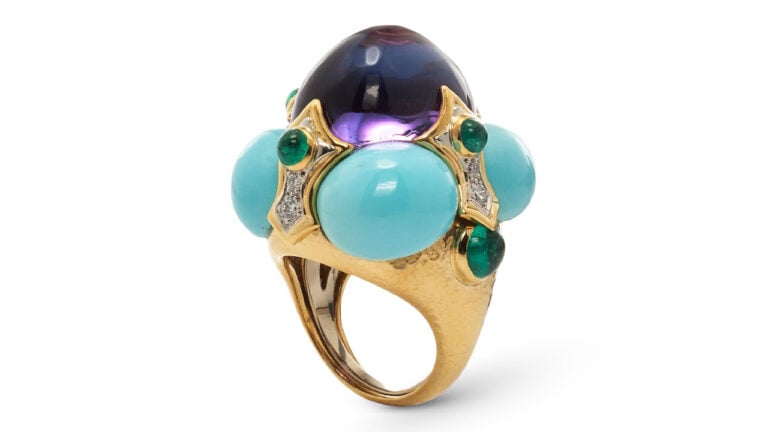
Jewelry gets inspiration from the Marie Antoinette period of eighteenth century France: ornate and delicate, Napoleonic, like what Erica Courtney does. Colored diamonds are a strong trend. Diamond pendants are important. Dark colored diamonds, in chocolate, gray, black. Pearls with a diamond pendant are the look. A lot of pendants, with bales that are interchangeable so they can be worn on pearls or on a leather or silk cord to change the look. People are wearing a bead strand with a pendant. The style is funky, nothing too serious, but all jumbled up. Pendants should be large; rings include a lot of knuckle-dusters that sit between fingers, hitting two fingers. For 2011, the must-have jewelry pieces harken to nature: animals, insects, artisan pieces, feathers or leaves.
Karo Vartanian
Costume Supervisor, “Desperate Housewives”
There are two trends: smaller — what people are buying as gifts and for themselves — and then big jewelry with colored diamonds. Colored diamonds are a trend, especially pink and yellow; it’s a more interesting look.
Necklaces are slowly coming back. They are bigger, with more diamonds and multistrands that tie or swirl, not a single strand. There are more necklaces that take up the whole neck, while chandelier earrings are getting smaller. Bracelets and cuffs are still strong, because it is always nice to see a bracelet when you are sitting at a table eating or talking.
On television, it’s all about earrings and necklaces. We don’t do as much with necklaces because they are distracting. But some actresses like to wear them and they do add pop. It’s becoming more of a trend because they are easy to notice. As more and more actresses become willing to wear big necklaces and other people get used to seeing them, everyone will find a version that works for them. Those people who really like necklaces will wear the bigger ones.
Gerald Celente
Trendcaster and publisher,Trends Journal
The overall economic trend will be extreme volatility. The central banks worldwide are pumping countless digital trillions into the system to keep it going. And interest rates are low. It’s unprecedented. The U.S. gross domestic product (GDP) budget deficit is 10 percent. The standard is 3 percent. Concurrently, there is a currency war going on. Nations are actively devaluing their currency so that exporters can sell more to other countries. Financial policies border on delusion, criminality. As a result, we will see some kind of crash, either in equity or currency, or some sort of financial calamity. They can’t keep flooding the markets with worthless dough. It’s war, and wars are usually fought over money; we are having a financial war. This will lead to a lower standard of living. It’s an erosion, not a collapse; we will sink into bleak times, a downward spiral. Unemployment will continue to rise with no job creation, no production in the U.S. to stimulate jobs. We need to increase our manufacturing base to counter it. We can’t do it with agriculture because it’s not a big enough employer.
The retailers who are doing the best are those at the lower end and the luxury firms. The smart retailer will create a new middle. The whole style needs to change. The American Renaissance has begun. The plague of America was 9/11. It brought in a whole decade of fear. We believe that beauty is the answer to fear. In the sense that beauty does not lie in the eyes of the beholder, it lies in behavior, it is not subjective. When you are surrounded by beauty, it will change your behavior. People behave differently around beauty. Retailers have extracted beauty through their merchandising. They are creating atmospheres that are dressed-up self-storage units. A bottom-line sickness has corroded intelligence and the soul of society. This is the time to create beauty. America used to be a quality country; now we have become a bottom-line society. Retailers have to elevate — add elegance, feel prosperous, look prosperous. The psychology of economics has brought it down to penny pinching, a dollar-store mentality.
Going forward, jewelry should continue to be positioned as an investment. Jewelry will always be worth something — even if it is less than what you paid, it will still have value. And depending on the quality and uniqueness, some jewelry may even become worth more.
The overarching trend is pessimism…again, the antidote to it is beauty. Create beauty. The way the U.S. will turn around is to go back to quality on all levels: food, entertainment, literature, politics. Those who understand this will profit. We call it the 20 percent solution: 20 percent of people are going in a different direction than the masses. They will grab the masses when the tide swings back.
.