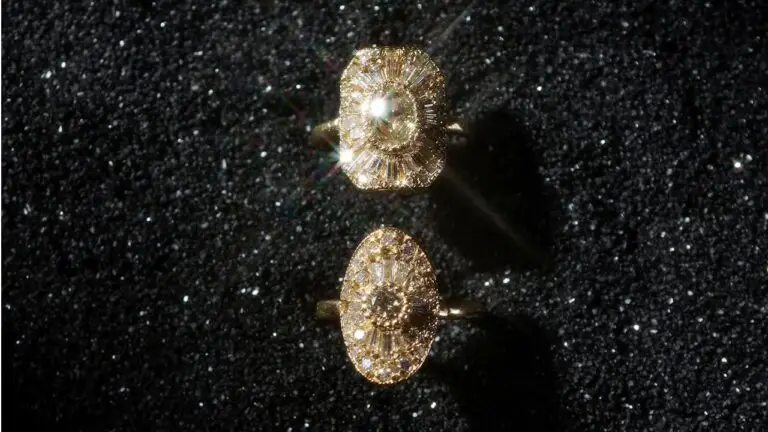


RAPAPORT… Modern brides are taking a page from the past and opting for period engagement rings featuring old stones.
Everything old is new again when it comes to choices for today’s engagement rings. Vintage stones and settings offer an attractive combination of quality workmanship and superior styling. Most of all, they offer a bride something that is unique and special, that, points out Benjamin Macklowe, vice president, Macklowe Galleries in New York City, “she won’t see down the line at the mall. And she’s going to be wearing something that will be an instant heirloom; something that in her mind she’ll be able to pass on to her children when she has them. There is a very powerful connection there.”
“Typically, in art, antiques, furniture or jewelry, it skips a generation,” says Malcolm Logan, one of the owners of Nelson Rarities in Portland, Maine. “So you tend not to like your mother or father’s antiques or jewelry or art, but tend to gravitate toward your grandmother’s things. Currently, the rage is for 1920s, ’30s jewelry. So that contributes to why people are buying vintage engagement rings.”
For today’s bride, the appeal of vintage jewelry, sums up Michael Goldstein, a dealer in antique diamonds and jewelry and frequent lecturer to the trade, “is that it is timeless, elegant and one of a kind.” Not only, he points out, is it handmade and typically has fine workmanship, “but it is unique as well.”
THE ALLURE OF AGE
When it comes to which styles are topping most wish lists, it’s “Art Deco, Art Deco, Art Deco,” says Macklowe. “Edwardian is okay, too, but Art Deco is really what people like the best. It seems to fit best with the modern sensibility and it’s usually all white, which people want. They don’t necessarily want colored stones in their pieces. And platinum is still the metal of choice, unquestionably.” Logan agrees that Edwardian to Art Deco are the most popular today, although it is “extraordinarily difficult to find and maintain an inventory of legitimate, original, antique and vintage rings.”
“Historically,” adds Diana Singer, D & E Singer, Incorporated, New York, “I’ve always sold the Edwardian engagement rings very well. Some of these will either be like a dome ring featuring a center stone, anywhere from a half carat all the way up, with small stones accenting the dome portion of the mounting, or a more traditional type of solitaire that goes across the finger. But in the past year or so, I have been selling Victorian engagement rings in yellow gold, some of which may have some black enamel. So it’s not only the white look now, I’m also seeing a resurgence of popularity in yellow gold and solitaires as well as regular jewelry.”
A CUT ABOVE
While size is always important — bigger is better — the cut of the diamond also is important, says Logan, pointing to the Asscher, cushion and old European cuts. One reason older cuts have such appeal, Logan explains, is that older cushion cuts or old European cuts “have a character all their own. An old cushion cut diamond was cut for candlelight, so the optical properties of that diamond are different than a modern brilliant cut diamond. Therefore, the cut can be very charming.”
“The diamond was cut on a more vertical plane and so the emphasis many times is on the idea that one’s eye goes into the diamond,” Logan points out, resulting in a more pleasant viewing experience over the long run “because some light escapes to the bottom of the diamond and that gives the diamond a sense of depth.”
According to estate jeweler Camilla Dietz Bergeron, Camilla Dietz Bergeron Ltd., New York City, as far as engagement rings, “we have very heightened interest in old cushion cut, Asschers, old European cuts, old mine. When we get a really pretty old cushion cut, old Asscher cut, old square cut, these we can sell pretty easily.”
Macklowe agrees that the cushion cut “has been very popular for the past two or three years and it continues to be. It’s a little more unusual than a European cut, which looks a lot like a round brilliant — which is because it is its predecessor. And it’s not as clinical looking as an emerald cut or an Asscher cut. So the cushion has been very popular with brides for the past couple of years. And we find that we’ve been able to sell them quite well.”
It’s increasingly difficult to find these stones. One recent find, Macklowe says he bought “right out of a Los Angeles bank vault, was an absolutely gorgeous Art Deco ring, which was distinguished by having very interesting filigree work, but also by having French cut diamonds. The French cut was a brand new cut in the 1920s and ’30s. It was very expensive because of the amount of lost material there was in it. So you’ll only see it in best-quality pieces.” A stone that Logan recently bought was cut at the turn of the century — 1899 to 1900 — and called The Twentieth Century Cut. “It’s a round cut that’s faceted on the top as well as the bottom,” he explains.
Many of the old stones that are available had been taken out of their mountings a long time ago, Bergeron says, and in that case, “We make up a mounting in the Deco style with the old stones. We do it in platinum with teeny tiny little diamonds. They really like it because everybody doesn’t have one like it. It’s not cookie-cutter, off the rack.”
THE REAL DEAL
When it comes to settings, estate jewelry not only offers exquisite detailing, but real value. “The cost of labor to make the antique settings is so much less than it costs today that people are getting a bargain,” says Logan. Since labor was inexpensive, jewelers could afford to make wonderful filigree diamond and platinum settings. “So compared to today’s reproduction,” Logan adds, “it’s truly a bargain.”
“I’ve seen a lot of modern duplication of older styles and the workmanship does not begin to rival what you see in the older pieces,” comments Singer. “And there is a softness to the older used pieces that is really quite elegant and I think that people like that.”
When it comes to the monetary value, says Singer, “the stone is a certain quality and it has a certain price-per-carat value, and the value of the mounting is what it is. In general, in estate pieces, the value of the mounting is going to be figured at considerably less than what it would cost to replace it at current labor prices. But what I do these days is I value the stone, I value the mounting and I usually pay a premium on top of that for the style and elegance and the timelessness of the piece.”
“I think people who buy estate rings think they’re putting their money into something very good,” adds Macklowe. “Generally with estate jewelry, there’s less of a markup than with new jewelry. And so they tend to be buying things a little closer to what is a market price, and there’s already a proven secondary market for it as well.”
The workmanship and the quality and size of the stones all figure in to the piece’s value, says Goldstein. In addition, “vintage has value that is growing as the demand outpaces the supply.”

Retail Rap: Getting Your Store Ready for the Holidays
Five industry professionals share how they choose their inventory and their décor, and what kinds of events they host.