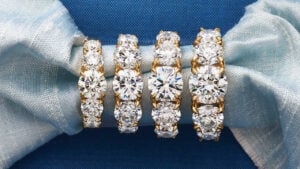

RAPAPORT… What is it about the combination of precious metal and diamonds that remains timeless? Silver, gold and platinum are referred to as “noble” metals because they are resistant to corrosion and oxidation. That immediately separates them from their baser brethren, at least in terms of durability. Diamonds retain their elevated status on the Mohs scale and that memorable tune, “Diamonds Are Forever,” still resonates. Yet the synergistic relationship between noble metals and diamonds is far more colorful and complex than their elevated status as valuable commodities. Throughout history and long into the twentieth century, the marriage of these two substances shifted, changed and reinvented itself over and over again. From the turn of the twentieth century and each decade thereafter, an innovation in technology altered the landscape. When platinum became a workable material, jewelry wore a new hue and on the horizon, the vista sparkled pristinely white.
SUBTLE HUES
The muted shades of the Victorian period imbued jewelry with a rosy glow that today would be described as a pink cast, as opposed to the contemporary and more assertive pink gold. “Gold is an alloyed metal,” says forensic gemologist and jewelry expert Gary L. Smith, located in Montoursville, Pennsylvania. “In the nineteenth century, gold was alloyed with copper. The look of the gold depended upon the prevailing taste of the time and pink was a very popular color back then.” Diamond pieces were usually mounted as silver-topped-gold-back, which meant that the diamond was held within a silver mount. “Silver is the whitest of the white metals,” Smith explains, “and diamonds will absorb the color of whatever metal they are mounted in. You could drop two or three color grades if you set a stone in yellow gold. It was common to find cape diamonds placed in yellow gold mountings just to enhance the color of the stones.”
Another unique characteristic that antique diamond jewelry possesses is its patina. Some call it tarnish. However, even after a piece has had a light cleaning, the aged gold’s surface works in tandem with old gemstones. “It’s part of the charm of the piece,” says Mark Schaffer, a principal of A La Vieille Russie in New York. “The old diamonds do not appear like headlights when they are mounted in these vintage settings. Mine-cut stones have more warmth. This type of jewelry was always meant for candlelight.”
ELECTRICITY
“Electric lights changed the look of diamonds and precious metals,” says diamond wholesaler Michael Goldstein of Michael Goldstein Ltd. “Incandescent light enhances the sparkle of the gemstone. Candlelight did not have the same effect.” The advent of electricity forced the diamond industry to find better ways to cut gemstones. When greeted with improved lighting, the antique stones appeared lackluster.
Overdosed on the sugary appeal of Victoriana, the Edwardian era was ripe for change. Armed with superior technology for cutting stones and workable platinum, jewelry turned a finer, more elegant shade of pale.
“Edwardian jewelry consisted of light, filigree pieces,” says Goldstein.“The ajouring improved and it really showed off the diamonds.” One of the optical attractions of an all-white composition is how it showcases the brilliance of a diamond.
“Diamonds blended into the composition,” Smith adds, “and placed focus on the flash. The stones were cut smaller and better.”
It was not until the 1940s that jewelry returned to gold. The war years strictly limited the availability of precious metal, especially platinum. Gold, too, took on a new hue — pink. Smith says that of the alloys still available at the time, copper was plentiful and it was mixed with gold to produce that evocative color associated with Retromoderne jewelry. “Pink gold is playful,” observes wholesaler Diana Singer of D & E Singer in New York.
“Diamonds and pink gold are a more subtle color combination,” says Schaffer.“The color of the metal does not overpower the diamonds.” Since gold was a valuable commodity at this time, jewelers hammered it out into thin sheets so that they would have a large expanse of metal without bearing any additional costs. When paired with large colored gemstones and a scattering of diamonds, the pieces took on an impressive feel.
“There was a lot of 14-karat jewelry created during the 1950s, but not much high color,” says Jessica Falvo, retailer and principal of Chartreuse in New York. “Jewelry was about texture, using satin or Florentine finishes on the metal. These nonpolished surfaces lent richness and set off the brilliance of the diamonds. It had an important, rich look — you knew you were handling the real thing.”
Falvo also notes that textiles had a significant influence on jewelry during this period. Up until the 1950s, special-occasion jewelry retained that cool look of white gold or platinum and diamonds. Toward the end of the decade, the luxurious feel of high-karat gold and diamonds became popular and challenged the traditional look of formal jewelry.
SHADINGS
Throughout the 1960s and 1970s, textured gold paired with diamonds was an organic response to the more formal and restrained jewelry of the previous decade. Eighteen-karat gold is a stronger yellow than its 14-karat cousin. When diamonds are mixed with this sunlit palette, the overall look explodes into a far bolder expression. “I’ve always found the combination of yellow gold and diamonds very appealing any time of day,” Singer enthuses, “and the warmth of the metal blends with most skin tones.”
“The 1960s was the perfect example of how 18-karat gold and diamonds work together,” says Falvo. “It was more of a citrus yellow and had a characteristic that worked so well with natural forms like tree branches, leaves and bark; these gold techniques had an appealing tactility and set off the diamonds beautifully.” Falvo has a fondness for 1960s and 1970s jewelry. “There was such a change in jewelry then. Artist-jewelers like Andrew Grima created pieces that reflected an organic quality. You were wearing art. Compare that to Bulgari where it was a conscious display of wealth — bold, shiny surfaces and pavé diamonds.”


What Does Love Look Like? Not Out-of-Touch Lab-Grown Messaging
The natural-diamond industry won’t attract couples by telling them synthetics devalue their relationship.

Bridal Shopping in the Age of AI
Couples are researching online, but they still want to make the ring purchase personal – and that creates opportunities.
Six Brands Serving Fresh Engagement-Ring Designs
Whether it’s hand-sculpted organic gold or reimagined divorce jewels, these designers are setting trends that resonate with bridal shoppers.