
Stratospheric
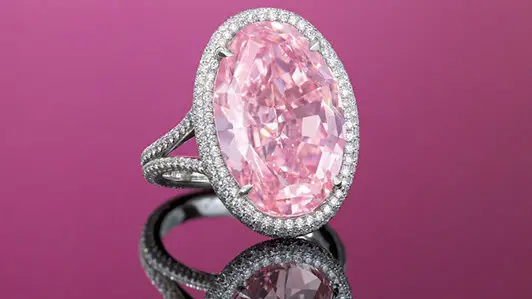
prices for fancy pink diamonds such as the Pink Promise — the fancy vivid pink,
VVS1 stone that recently sold at auction for over $32 million — have heightened
the craving for these enigmatic sparklers.
“Auctions
make a big impact on pink diamond prices, which have been steadily climbing for
quite some time,” says Leibish Polnauer, founder of Leibish & Co., one of
the first online dealers in fancy colored diamonds.
The
trouble is, there aren’t many of them available at any given time. An estimated
one out of every 10,000 diamonds discovered is a fancy colored stone, and pink
fancies represent an extremely small percentage of that subset. Of the 20
million carats recovered annually at the Argyle mine in western Australia, just
0.1% are classified as pink diamonds — a number that dwindles significantly
after the polishing process reduces their weight.
The
Argyle deposits are the only reliable sources of these stones, producing over
90% of the world’s pink and red diamond supply. Still, other regions have
recovered pink diamonds that are large and relatively free of inclusions. In
September 2017, Alrosa subsidiary Almazy Anabara recovered the largest pink
diamond in the Russian company’s history at 27.85 carats, soon after it
reported finding a 3.86-carat pink diamond.
“There’s
no correlation between certain geology and the presence of pinks,” says Dr.
Adolf Peretti, founder of GRS GemResearch Swisslab AG, who published his
findings on pink diamonds in a 2015 article for InColor magazine. “Neither is
there an association with lamproites (a mantle-derived volcanic or subvolcanic
rock) only, though there are magnesium-rich mantle-derived rocks found in the
Argyle mine in Australia, and not in Africa, Brazil, Russia or Canada (where
pinks are associated with older kimberlite rocks).”
What gives them their color?
Some
fancies owe their attractive hues to chemical impurities in the carbon crystal.
But pink fancies, scientists explain, acquire the tint when the tremendous heat
and constant pressure of their formation create distortion in their crystal
lattice. That deformation — known as graining — causes an absorption of green
within the stone, so the light that returns to the eye is perceived as a pink
tone.
“Much
research has been done to understand the cause of color,” says Peretti. “It is
still due to some unknown defect associated with nitrogen clusters [being] in
proximity to the octahedral growth planes [of a diamond while it’s forming].”
Since
graining is so identified with the pink coloration, it is most often visible
under magnification wherever the color appears, he explains. If graining is absent,
that’s “a strong indicator of a treated (irradiated or coated) or synthetic
irradiated pink diamond.”
Behind the shades
Fancy
pink hues are expressed as Bubblegum, Raspberry or Merlot, and strengths range
from light, to fancy, to intense, then vivid — the rarest and most valuable.
Polnauer
— who focuses on Argyle pinks — declares purplish-pink “the best modifier by
far,” and notes that this shade is the only one with “a secondary hue that
doesn’t drop in value compared to the straight color. Many Argyle pink stones
are purplish-pink. If you ask me, it only adds a powerful punch of color to the
straight pink. Brown pink [stones with equal degrees of each color] and brownish-pinks
[primarily pink, with a brownish back-color] also do quite well, especially since
they are sold at much lower price points.”
Peretti
agrees that a brown modifier reduces the pink’s value, “although interestingly
enough, it is often intense or deep brownish pinks that receive [the rarest]
‘fancy red’ grade, rather than the purple-pinks.”
No shortcuts
Stephen
Silver, CEO of Stephen Silver Fine Jewelry and former owner of the Pink
Promise, recut the stone from 16.10 carats to 14.93 carats prior to its sale at
Christie’s Hong Kong this past November. That resulted in a color grade of
fancy vivid pink, a rarer, more valuable designation than its former grade of
intense pink.
“This
diamond presented the greatest challenge of my life: to not make a mistake in
recutting,” recalls Silver. “The difficulty in cutting was to get the pink
color back up to the eye because of the unique nature (type IIa) of the
material. It is the most brilliant vivid pink diamond I’ve ever seen.”
What
do cutters consider before working on these rosy gems?
“This
is the million-dollar question,” Polnauer says. “It all depends on the
experience and expertise of the master cutter. He takes time to study the
stone, and only then decides the best shape and size to aim for. The process is
actually quite time-consuming, as he needs to allow enough time for the stone
to cool down before continuing. Each cut will affect the stone in a different
way, as the smallest angle of the facet will affect the light and consequently
its color.”
Pointing
to the recent Alrosa discovery, he explains that “you can’t just start to polish
a stone of that caliber without a proper plan and clear vision as to what the
outcome should be. For example, one might aim for an intense pink with a higher
clarity, or alternatively, a smaller weight with a higher color grade.
Sometimes a lower weight is preferred in a cushion or radiant, and sometimes an
oval would show the color much better.”
‘Timing is everything’
It
was not a particularly active day at Christie’s when the Pink Promise went to
auction, but the stone’s sale was certainly a highlight.
“At
$2.153 million per carat, the Pink Promise currently holds the world record for
fancy vivid pink over 10 carats, beating the price set by the 15.38-carat
[stone that] sold for $2.05 million per carat on May 18, 2016, at Sotheby’s
Geneva,” explains Silver, who believes “it’s always a good time to buy.”
But
when to sell?
“Timing
is everything,” he states. “Over a long period of time, true rarities always go
up.”
And
pinks have a charm all their own, says Polnauer. “Pink diamonds have a power
unlike any other stone. Raymond Graff [director of the workshop at Graff
Diamonds’ London headquarters] once told me that pinks are like the horses
pulling the carriages. You can’t make a piece of fancy color diamond jewelry
without
a pink diamond and hope for it to have the same effect. Pink diamonds have a
special effect on a woman’s heart.”
Image: Christie’s Images Ltd 2017


What Does Love Look Like? Not Out-of-Touch Lab-Grown Messaging
The natural-diamond industry won’t attract couples by telling them synthetics devalue their relationship.

Bridal Shopping in the Age of AI
Couples are researching online, but they still want to make the ring purchase personal – and that creates opportunities.
Six Brands Serving Fresh Engagement-Ring Designs
Whether it’s hand-sculpted organic gold or reimagined divorce jewels, these designers are setting trends that resonate with bridal shoppers.