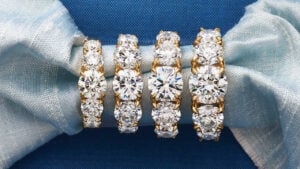

RAPAPORT… A favorite in estate jewelry, purple sapphire is gaining recognition in today’s market.
Certain gemstones explode on the scene with seemingly immediate global recognition. Tanzanite, a relative neophyte to the world of colored gems, burst into public awareness during the last quarter of the twentieth century. Still other gems of rarity and beauty meander into the international spotlight by stealth. Such is the case with purple sapphire.
Not a recent discovery, purple sapphire is, however, gaining momentum as a standout among fancy colored sapphires. The gems have been found as Old European cuts in Edwardian jewels, notes Suzanne Martinez, buyer for Lang Antiques, San Francisco. The red-violet sapphires appear more often in vintage pieces, Martinez finds.
When Richard Drucker, publisher of The Guide, a wholesale gemstone pricing publication, presented his annual “Best Buys in Tucson” update at the 2007 Tucson Gem & Mineral Shows, he noticed a curious shift among leading colored stones sold the previous year. Topping the list at number one was sapphire, with the number five slot going to fancy colored sapphire. Drucker singled out an increasing demand for purple sapphire, commenting that it is not yet readily available.
GEMOLOGY 101
The species corundum, or kurundam in the Tamil language, may actually be found as a clear crystal. When the aluminum oxide (AI2 O3) mineral appears colorless, it is marketed as white sapphire. Impurities found in corundum create colors. For example, when chrome is present, it colors the stone red, creating ruby. All other colors are called sapphire. When used alone, the term sapphire specifically means the blue variety, while the rainbow of other colors are referred to as “fancy colored sapphire,” including the magnificent range of lilac to blue-violet purple sapphires.
Next to diamond, corundum and purple sapphire enjoys the highest rank on a Mohs scale. The importance of this position is not status — but rather utility. Ranking 9 on a Mohs scale reveals sapphire’s extreme durability. Little pampering of that gem is required when wearing such a hard stone, and owners will enjoy years of pleasure from their sapphire jewelry, which will look almost as new as the day they bought it. The specific gravity (SG) of corundum is heavier than most colored gemstones as well as that of diamond, thanks to its molecular density. A 1-carat round, brilliant cut sapphire will be smaller in diameter than a 1-carat round, brilliant diamond — which is why jewelers replace stones by millimeter size rather than by carat weight when swapping out different stones in jewelry.
Purple sapphire is found in Sri Lanka, Ceylon, Vietnam, Thailand, Brazil and other sites. The enormous quantity of fancy colored sapphire, including purple, coming from Madagascar since the 1990s has contributed to the gem’s broader recognition. And the frenzied obsession for the colored diamonds that celebrities wear has had an unintended consequence of creating a greater call for fancy colored sapphire. Purple sapphire’s dispersion closely mimics that of colored diamonds, making it an affordable alternative. For instance, a “fine violetish blue 4.66-carat certified natural, oval cut sapphire” wholesales for $1,200 per carat on palagems.com. By contrast, an 8-carat natural purple diamond ring purchased for the wife of Lakers basketball star Kobe Bryant set him back $8 million.
Natural purple sapphire occasionally exhibits a color-change. That optical phenomenon occurs in a certain purple sapphire when the stone moves from natural daylight to incandescent lighting. It is a condition referred to as the “alexandrite effect” and is the result of selective light absorption. An example of this curiosity appears on Pala Gem’s website, where images of a 3.75-carat violet-blue, radiant cut Madagascar fancy sapphire turn purple.
A 30-year veteran colored gem dealer, Laurie Watt of Mayer & Watt has been trading in purple sapphire for a quarter of a century. According to Watt, who travels the world with her husband, partner Simon Watt, purple sapphires seem to be more abundant in Sri Lanka than at other mining sites for fancy sapphires. The high ratio of purple in the fancy sapphires recovered from that area leads her to speculate that the unique geological environs of that region may contribute to the high production.
“The rarity factor of purple sapphire’s occurrence in nature, the durability of the stone and the breathtaking purple hue bring to mind royalty,” says Watt. That connection between the luxurious color purple and its aristocratic association, Watt believes, contributes to its cachet.
A STANDOUT
Lately, forward-thinking designers are recognizing purple sapphire’s potential as a top choice in spectacular jewels, for both starring and supporting roles in luxury goods. Sami Zeira of Zeira Jewelry hand-fashions high-karat-gold custom jewels displaying exceptional old-world craftsmanship. Fancy colored sapphire features prominently in his current colored gemstone picks, as evidenced by his 22-karat yellow gold and diamond “Sunshine” pendant showcasing a vivid, brilliant cut purple sapphire.
In his current collection, Lorenz Baumer — the sought-after Parisian jeweler with a flair for unusual “gem” choices such as meteorites and pebbles — mixes purple sapphire alongside other intensely saturated bold gemstones, like rubellite and amethyst, with dazzling results.
When a jeweler adores a particular gemstone, it’s bound to become identified with his or her brand. So it is with Judi Anderson of Bijoux Extraordinaire. Anderson’s appreciation for the assortment of colors produced in purple sapphire fuels her inspiration for original designs where each unique shade of purple sapphire owns the spotlight. Anderson insists that much of her clientele is colored sapphire savvy. And they may owe that acquired taste to Anderson, who raves, “It’s the hue! I personally am a huge fan of violet and purple colors. I also love the durability of sapphire, so for us, it is a great combination.”
Certainly, the trait to consider with purple sapphire is the endless array of purple, lilac, violet, reddish purples and blue-violets to be found. Anderson reflects,“If you’re offered amethyst, for instance, you pretty much know what the color will be.” Because nature creates the vast color combinations found in purple sapphire, Anderson foresees an impressive future for this jewel that has yet to reach full public exposure.


What Does Love Look Like? Not Out-of-Touch Lab-Grown Messaging
The natural-diamond industry won’t attract couples by telling them synthetics devalue their relationship.

Bridal Shopping in the Age of AI
Couples are researching online, but they still want to make the ring purchase personal – and that creates opportunities.
Six Brands Serving Fresh Engagement-Ring Designs
Whether it’s hand-sculpted organic gold or reimagined divorce jewels, these designers are setting trends that resonate with bridal shoppers.