
The earliest instances of humans tracing out spiral designs date back to the prehistoric period, when our ancestors carved them into bare rock for reasons that remain shrouded in time. In the centuries since, the motif has appeared all over the world, from China to South America to Africa. In mathematics, a spiral is the visual representation of the Fibonacci sequence, in which each successive number equals the sum of the previous two. One can find this pattern in the tightly wrapped coil of a fern, the opalescent swirl of a snail’s shell, and the vortex at the center of a typhoon. Our own fingerprints contain the whorls of a spiral.
“The spiral is one of the first symbols humans ever created, and I think that’s because it captures something universal,” says jeweler Lily Gabriella Elia, who has taken inspiration from the motif since her Lily Gabriella brand’s first collection of rings, Spira. “It represents growth, evolution, cycles, continuity — ideas that are deeply human.”
Coming round again
Spiral forms are resonating with jewelry designers this season in particular, appearing in collections by Lily Gabriella, Tiffany & Co., Repossi, and other brands.
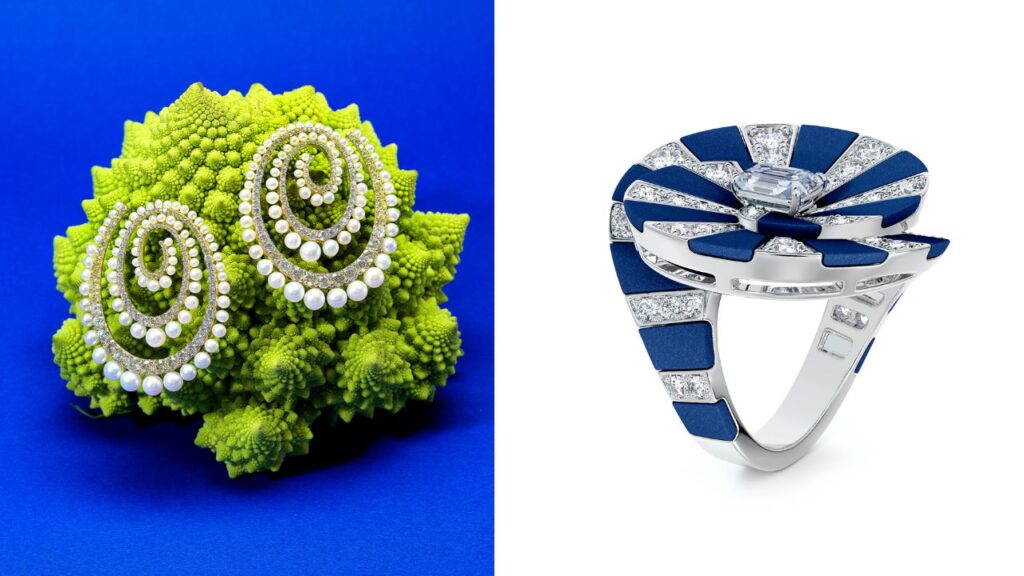
Jeweler Anabela Chan cites nature’s spirals as an influence in her new Chlorophyll collection. The pattern of dew drops on a blade of grass prompted Chlorophyll’s series of Vortex earrings, featuring freshwater pearls, opals, regenerative green agate, and regenerative turquoise.
“Since I was a child, I have always been fascinated by the Fibonacci sequence, and how it’s found in everything from seashells to pinecones, tree branches to flower petals, storms to galaxies,” explains Chan.
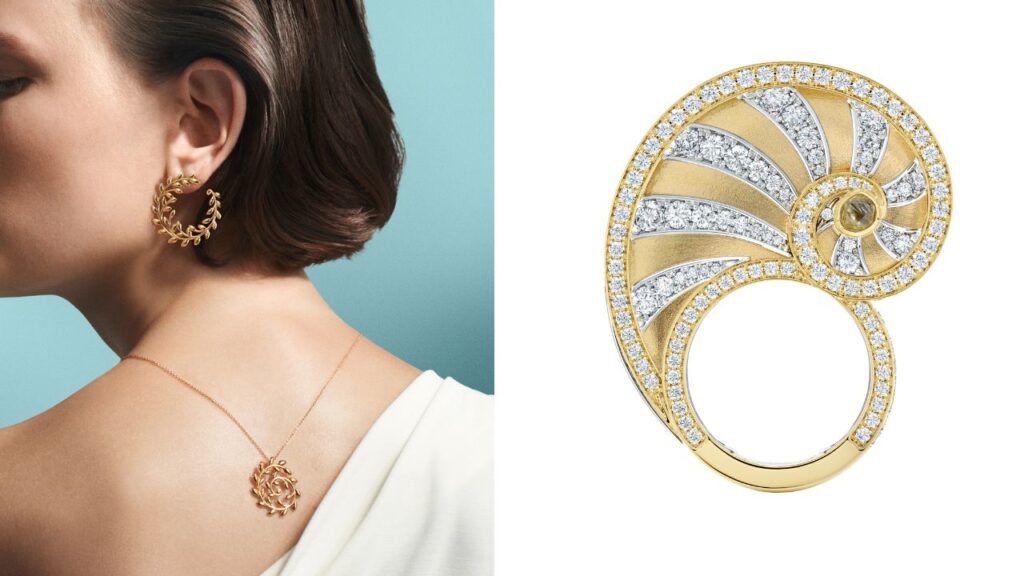
At Tiffany & Co., Paloma Picasso’s latest collection for the maison takes inspiration from nature, particularly the olive groves surrounding her home in Morocco. The spiral branch designs pay tribute to the olive tree as a symbol of peace, hope and harmony.
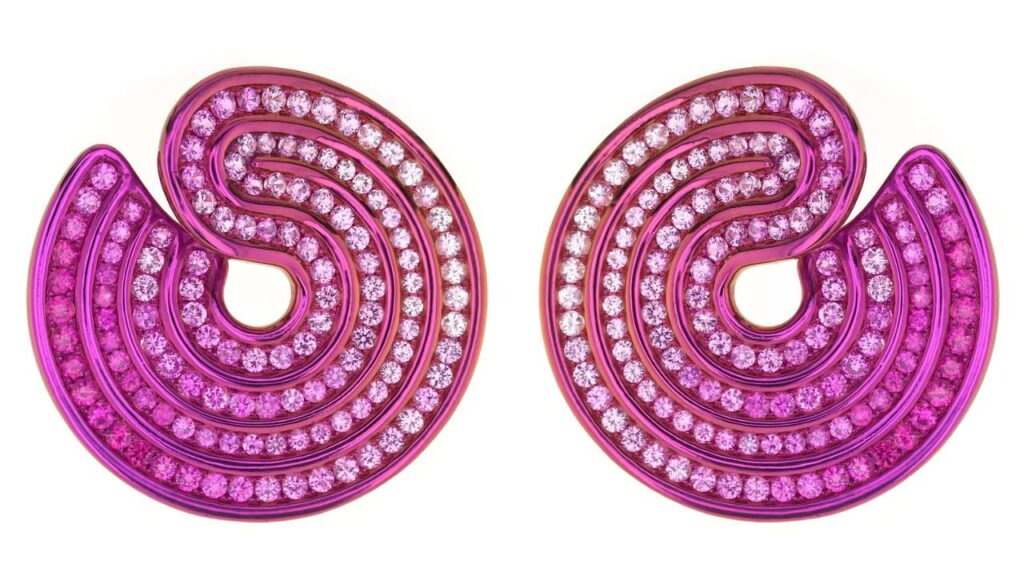
Sculptural fluidity Elia, meanwhile, is drawn to the symbolism and energy inherent in the spiral motif, which she has captured in her new titanium and sapphire Swirl earrings.
“I’ve always been drawn to forms that feel alive — shapes that have movement, rhythm and a sense of expansion. The spiral speaks to that perfectly,” she says. “It’s an ancient symbol but also an endlessly contemporary one: fluid, dynamic and inherently sculptural.”
Indeed, the works of modern sculptors such as Barbara Hepworth, Henry Moore and Anish Kapoor inform Elia’s designs. “My pieces reflect a fascination with the geometry of life: the way things grow, unfurl and connect,” she says.
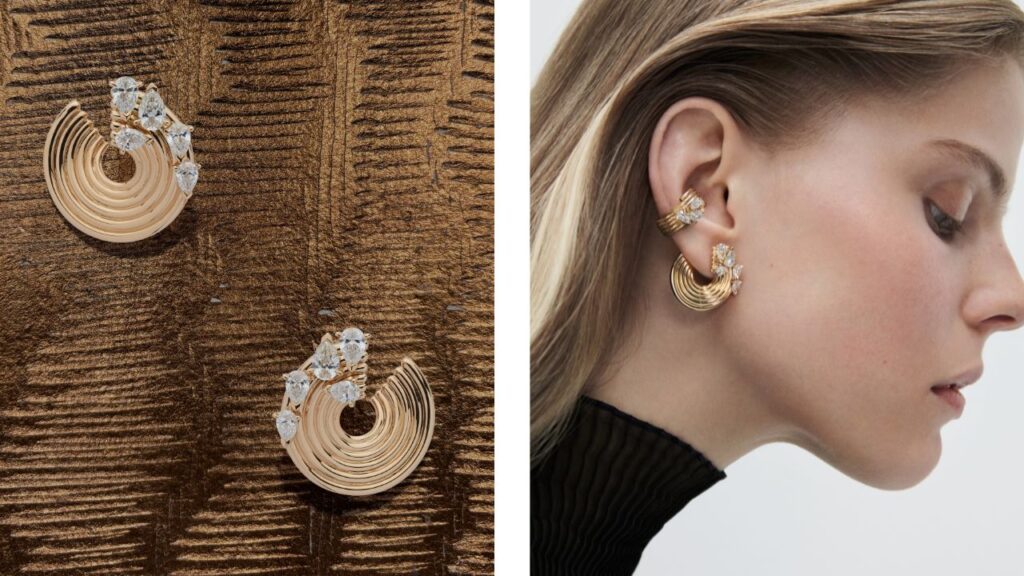
This organic fluidity of spiral designs — both ancient and modern — also influenced Repossi’s latest high-jewelry collection, Blast.
“The collection draws its inspiration from traditional jewelry of ancient cultures such as the Maasai, the Miao, and the Indonesian archipelago, whose spiraled lines and bold volumes evoke a sense of primal vitality,” says a spokesperson for the Italian jewelry house. “The collection is also deeply influenced by modern art, echoing the instinctive lines and sculptural forms found in the works of contemporary artists, which bring a different dimension to its designs.”
The Golden Ratio
The preponderance of spirals in nature and their link to the Golden Ratio — the mathematical concept also known as the “divine proportion,” which many believe holds the key to aesthetic harmony — could also be why humans have been drawn to the motif for millennia.
“The spiral pattern is not only one of the most captivating and beautiful natural phenomena, it is also one of the most ancient and enduring symbols of infinity and eternity — the journey of life, growth and transformation,” says Chan.
The curves of a spiral are hypnotic, drawing the viewer down into their never-ending, ever-expanding coils. “In jewelry, a spiral naturally wraps around, embraces, protects.
It feels intimate,” says Elia. “I think humans return to spirals because they echo the rhythms of life itself — from the cosmic to the cellular. It’s a form that feels familiar, even ancient, yet eternally modern.”
Main image: De Beers Optical Wonder ring set with a 1.01-carat fancy intense pink radiant-cut diamond. (De Beers)