
Rebecca Rau faces challenges that few other fine-jewelry designers encounter — like how to preserve the patina of an amulet with a centerpiece that’s more than 3,000 years old. Or how to avoid being fired by a jeweler who liked her idea of reinventing rare antiquities as wearable jewelry, but in practice found the process too labor-intensive and the materials too delicate. Or locating the perfect antique book chains at a time when the steep price of gold means people are either melting it down or holding it close as an investment.
Her Then & Now collection, which launched in November, takes historical artifacts dating from 1200 BCE to 1880 CE and combines them with modern gemstones, precious metals and pearls. The launch took place during New York City Jewelry Week, following an October preview at M.S. Rau, the New Orleans gallery her family owns.
A new sense of purpose
It was natural she’d be drawn to antiquities. Rau has a master’s degree from Sotheby’s Institute of Art in London and worked as vice president of acquisitions at M.S. Rau, which offers rare antiques and jewelry alongside a world-class art collection. But after a period of soul-searching in 2023, she relocated to New York and founded her Rebecca Rau Jewels brand in search of artistic expression.
One example from Then & Now is the Reimagined Jasper necklace. Taking inspiration from the Renaissance, it centers a first- to second-century brown jasper fragment in a frame of unheated orange zircons and umbalite garnets.
Many of the objects she collects were never meant to be wearable; at times, their purpose is unknown. The Green Flame necklace, for instance, features a Saxon-era gilt bronze fitting from circa 400 to 600 CE that once served as a horse bridle mount for elite warriors.
“It’s been a mixed bag, but I find it more of a creative challenge when the artifacts I’m using weren’t designed to be worn as jewelry,” she says. “It requires more innovation to add a bale or something that makes it wearable. I’m making a brooch right now from a piece that was probably sewn onto clothing and used to fasten a garment.”
Unearthing narratives
Rau acquires most of these objects from dealers who can document their provenance, and she finds their stories enchanting. “I love to hear palpable enthusiasm for how precious [the piece’s] contribution is to history, a design period, a family legacy, or the history of geopolitics,” she says. “It tells a story beyond its own beauty. There’s pleasure that comes from being able to touch and feel and hold pieces of history.”
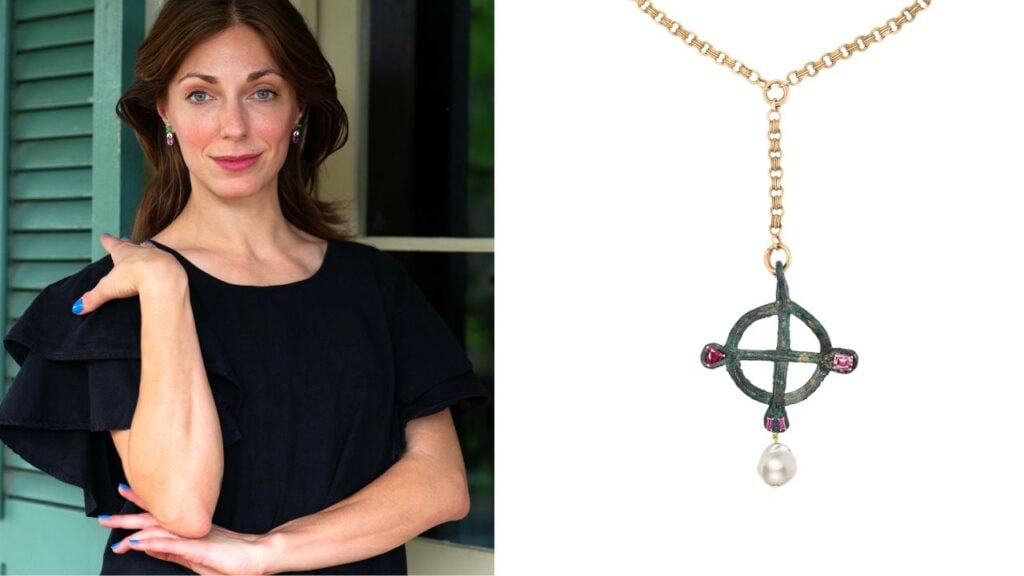
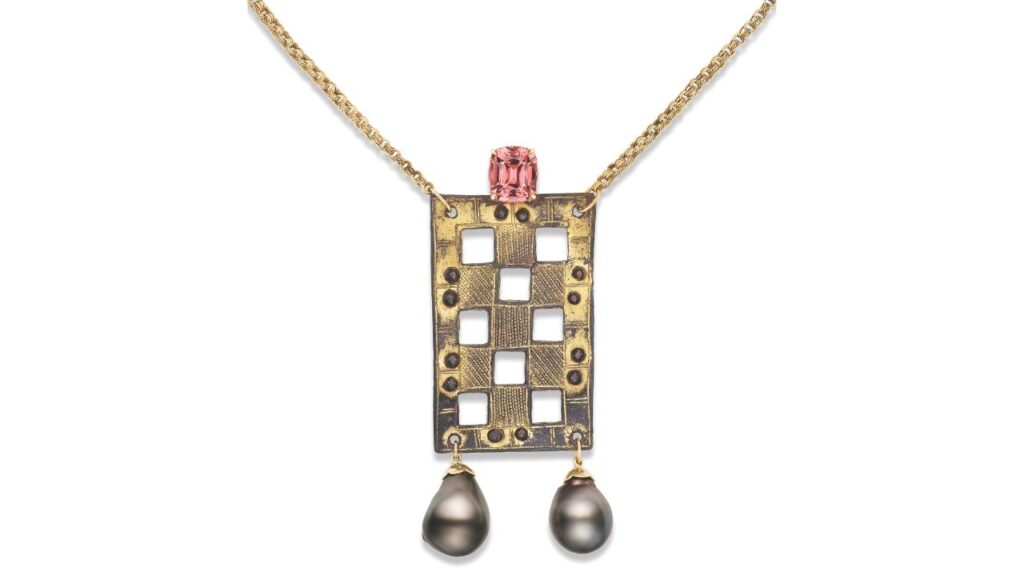
The bronze amulet from circa 1200 to 800 BCE that anchors her Criss-Cross necklace originated in the ancient civilization of Bactria, which spans parts of modern Afghanistan, Tajikistan and Uzbekistan. Rau paired the amulet with gemstones — including pink spinel, trillion-shaped rubellite tourmaline, step-cut pink sapphires, and a baroque South Sea pearl — and set it in 18-karat yellow gold with no alterations to the original bronze. It hangs from a 14-karat-gold Victorian book-style lariat chain from around 1880 and displays a vivid green patina that highlights its age.
Rau has also designed a more conventional colored-gemstone collection, Haute Joaillerie, which she views as an opportunity to continue training her eye. However, “as an art process or a creative exercise, I’m enjoying the nuance and unexpected challenges of incorporating antiquities,” she says. “I acknowledge that not every piece will make sense to a super-broad audience. But design-wise, risk-taking is important to me because I want to move the narrative forward and attract collectors who are open-minded and excited about something different.”
Reaching across time
Finding the colored gemstones is far easier than searching for the antique objects and old gold chains. For Then & Now, she’s worked with spinels, colored sapphires, fancy garnets, tourmalines, and old mine diamonds, among other gems.
“The collection celebrates the universal human impulse to adorn the body,” she explains. “It’s also meant to draw attention to the prevalence of globalization across human history. And it’s a marriage of masculine and feminine aesthetics — the gems and the added movement soften the more masculine look of some of the heavier objects.”
Beyond that, she adds, it’s “a nod to all of these impressively innovative metalsmithing techniques that extend further back into history than most people really appreciate.”
Her biggest fear is that jewelry-making is a disappearing craft, with fewer artisans willing or able to work on something so specialized. If she were assessing her business’s strengths, weaknesses, opportunities and threats, she says, “I think the biggest potential threat would be not finding the talent to manufacture these goods.”
The designer’s work is available for sale at M.S. Rau, as well as through trunk shows, jewelry shows and private events. While her website is “pretty thorough,” she says, she doesn’t expect the collection to be the kind that sells well online. “I think you have to be in front of the person to really understand [it].”
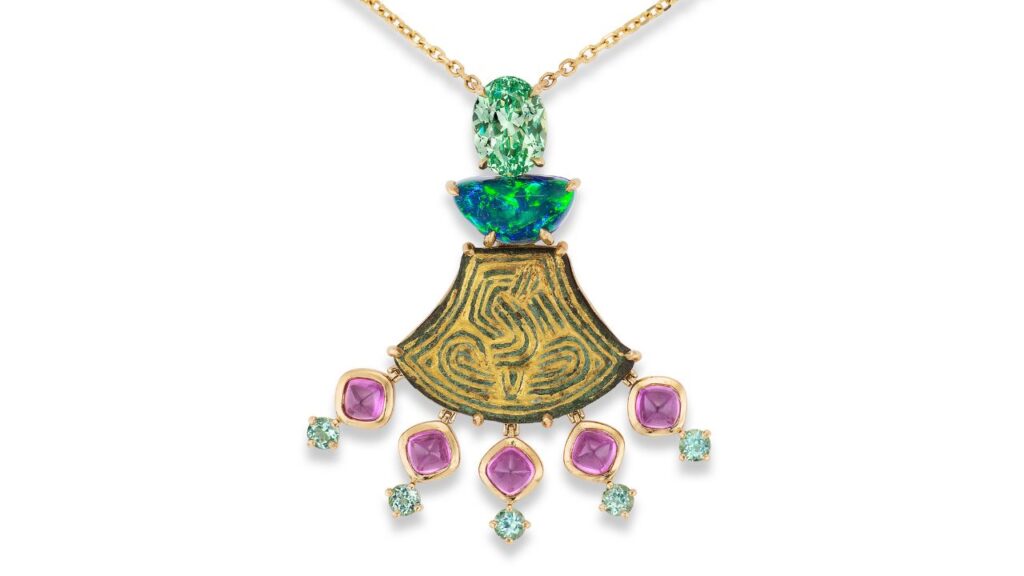
Main image: At the heart of this Renaissance-inspired Reimagined Jasper necklace is a 1st or 2nd Century brown jasper fragment. (Rebecca Rau)