
Since September, Matturi Fine Jewellery has occupied a charming showroom on London’s foremost luxury thoroughfare, cementing the brand’s position in the city’s independent luxury-jewelry marketplace.
The brand’s new London base is in a sun-drenched penthouse above the hustle and bustle of Bond Street, designed by South African interior designer Donald Nxumalo. With bespoke furniture from Nxumalo’s Cape Town workshop, and a custom lamp by Thabisa Mjo of Studio Mash.T in Johannesburg, the top-floor eyrie is calm, stylish and immediately feels comfortable.
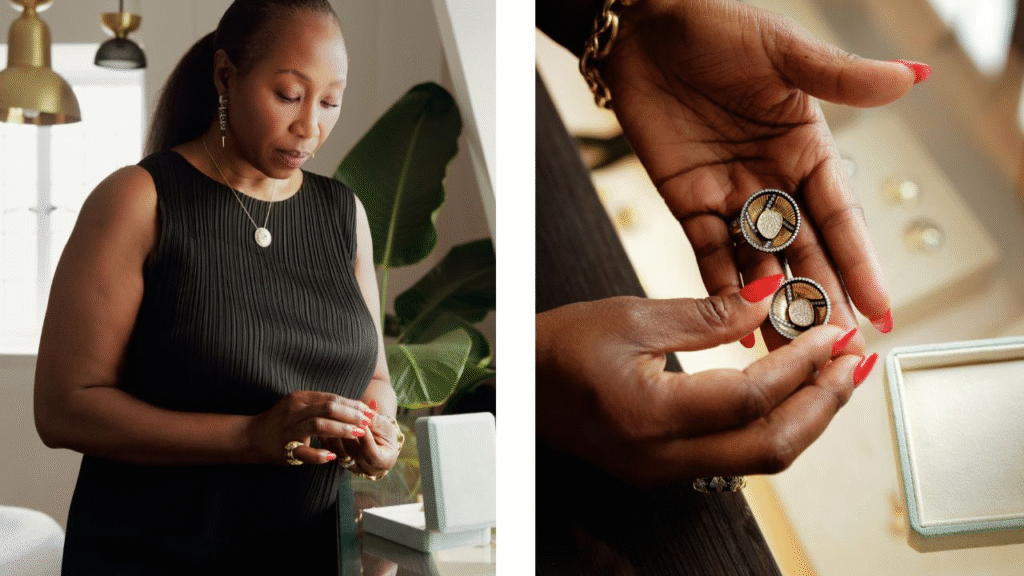
“I wanted the space to have a different vibe from the traditional jewelry showroom,” says the brand’s founder and creative director, Satta Matturi. “It’s a relaxed, informal lounge where you can view our creations, cocreate bespoke pieces from our selection of diamonds and colored stones, or have a passionate chat about jewelry.”
Artwork by contemporary African artists reigns, in a regularly changing curation that seeks to showcase African artists and businesses “who may not have the platform to be seen,” explains Matturi. “Some will be from my own personal collection — I’m not a collector, but I do have an interesting selection, which I buy because I love.” On the day of this reporter’s visit, works by Pitsho Mafolo and Aza Mansongi — both from the Democratic Republic of the Congo — are on show. In 2026, Matturi will be working with two galleries to showcase up-and-coming artists.

The ‘Afro-Deco’ aesthetic
Originally from Sierra Leone, Matturi set up her fine-jewelry brand in 2015 after a 16-year career in diamond wholesale at De Beers. Since then, she has carved a niche for her highly wearable jewelry, a distinctive blend of Afro-modernism and Art Deco. A strong narrative lies behind each series, with roots in African culture, heritage, objects and experiences.
“Over the years, the designs have taken on a contemporary Afro-Deco form through the geometric, abstract and figurative,” she relates. “The one thing that has always remained constant is that I wanted to create jewelry that would stand out and connect with the wearer.”
The Nomoli Totem masks, which take inspiration from west African masks and masquerades, are a signature on her earrings, necklaces and pins, pairing colored stones and onyx with brilliant-cut diamonds. Her customizable Pengusa earrings honor the formidable women of the Sierra Leonean community, playing with negative space to introduce hard stones and burnished precious wood. Meanwhile, the new Calabash earrings pay homage to the gourd of the same name, which is commonly crafted into everyday items for African homes.
“The experience of a brand is very important today, and so are the stories behind the creations, which are enhanced when conveyed in person,” says Matturi.
Sourcing responsibly
The designer brings her extensive diamond-industry experience to bear in responsible sourcing for Matturi. She buys diamonds from trusted sources that adhere to industry best practices, and since April 2024, the brand has exclusively used Single Mine Origin (SMO) gold, which is fully traceable and supports sustainable mining practices in Mali, Senegal, the Ivory Coast, and Australia.
“We are conscious of our footprint,” Matturi said at the time, “and are pleased to ensure that most of our creations use the best materials that are sourced in a responsible and sustainable way.”
The company has Responsible Jewellery Council (RJC) certification, and Matturi herself sits on the RJC board. “Being a diamond expert and having worked in the industry over the last two decades, I’m certain of where and whom we purchase from,” she asserts. “Likewise, our colored stones are acquired from responsible businesses; we just finalized arrangements with [sustainable supplier] Anza Gems in the US.”
Responsible sourcing is also a way to honor Africa’s rich natural resources; it ensures that the wealth resulting from those resources stays in the local community rather than getting lost in the supply chain.

A time for connecting
With unstable commodity prices and slowing consumer spending, it may not seem like the obvious time to invest in a new showroom in the heart of London’s luxury industry. But Matturi believes just the opposite.
“Now, more than ever, is the time to have a space to engage with customers who demand more interaction and experiential [connections],” she says. “Our jewelry is inspired by narratives, and so it’s ideal that we have a space where we can share our passion and what it stands for.”