
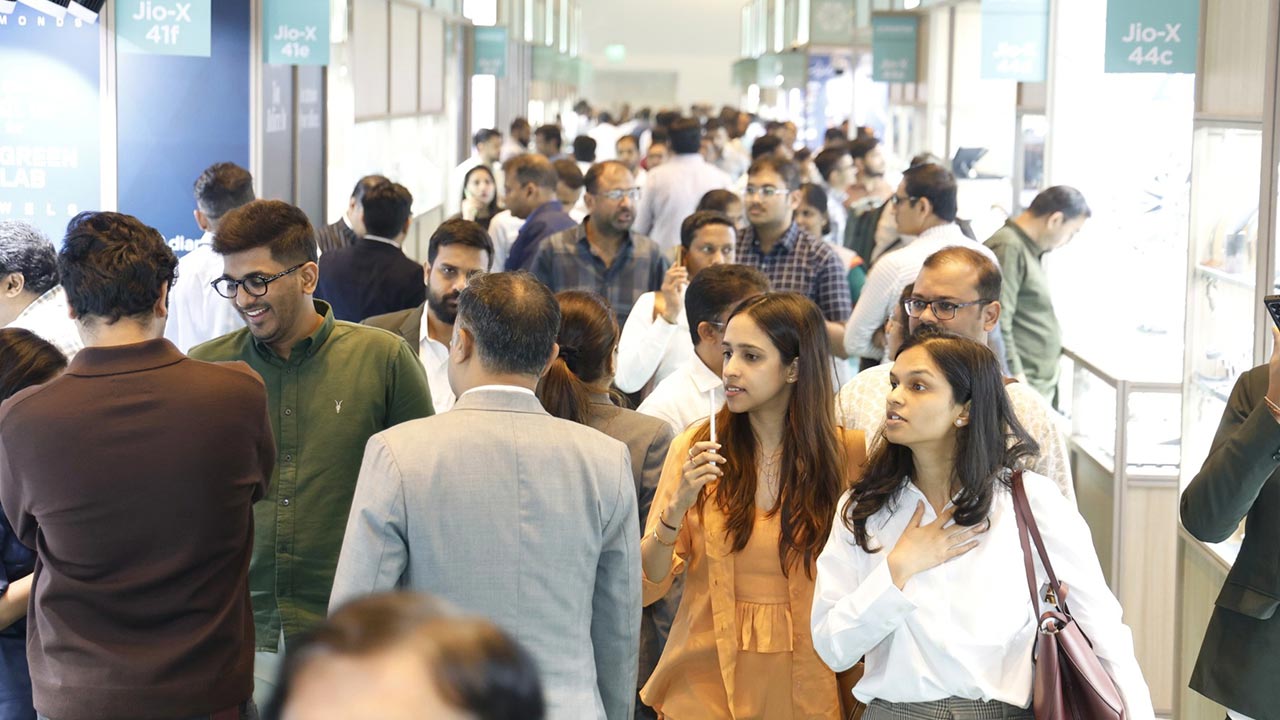
The diverse consequences of the high gold rate on India’s jewelry sector were evident at the IIJS Bharat – Signature show in Mumbai, which ended Monday.
Some of these effects are self-explanatory: Consumers have lower spending power, encouraging them to buy less or lighter-weight jewelry. This affects all component suppliers, including diamond wholesalers.
However, one impact participants stressed at the show was on margins.
Diamonds are more profitable for jewelry wholesalers and retailers than gold, exhibitors at the Bombay Exhibition Centre told Rapaport News on Sunday. When gold was at $2,000 per ounce in January 2024, and diamonds had experienced only part of their recent price decline, a larger proportion of the value of studded jewelry came from the mounted stones, and not as much from the metal.
Now, with gold hovering around $4,600 per ounce and diamonds less valuable than two years ago, the ratio has changed considerably. The RapNet Diamond Index (RAPI™) for 1-carat polished diamonds — which tracks round, D to H, IF to VS2 goods — has slid 31% since January 1, 2024.
“Margins are often perceived to sit on diamonds, while the rest of the value — gold, labor, design, overheads — is treated as pass-through,” said Sohil Shah, partner in Indian diamond manufacturer Star Rays and head of its jewelry venture, Star Jewellery, which supplies to Indian retailers. “It’s a real industry issue. There is pressure on manufacturers [and] brands when diamonds form a small percentage of the final ticket price.”
Diamonds currently constitute around 25% to 30% of the value of studded gold jewelry, compared with 40% to 50% before the price shifts, show participants estimated.
Margin issues
With the exception of top brands, jewelers can rarely mark gold up, the exhibitors explained. The metal is usually considered fungible: Each ounce is worth the same as and replaceable with any other. It’s also easily accessible for purchase. A consumer could just buy it elsewhere.
In the current market, retailers’ gold gains come from holding it in inventory over time, noted Ashish Borda, CEO of Surat-based polished manufacturer Anjali Diam and a diamond-panel member at the Gem & Jewellery Export Promotion Council (GJEPC), which organizes the show.
Diamonds, on the other hand, are profitable for jewelers on a short-term basis, in the sense that they can sell them in jewelry at a higher price than they buy them at wholesale. While prices have declined over the past two to three years, consumers don’t have the access to loose diamonds they have to gold.
Investment demand from those betting on further increases in metal prices somewhat offsets the weaker demand volume, but many of these are buying gold bars rather than adornments.
Global consumption of gold jewelry fell 19% year on year to 371.3 tonnes in the third quarter of 2025, according to the most recent World Gold Council (WGC) trend report, which the organization released in October. Investment demand for bars and coins jumped 17% to 315.5 tonnes.
Temporary blip
The combination of factors led to low overall sentiment at the show, with exhibitors mainly reporting slower traffic than a year ago and moderate caution from buyers.
This came despite several years of growth for India’s domestic diamond sector. The country overtook China as the world’s largest diamond retail market two years ago.
Participants saw this slowdown as a blip stemming from the gold situation rather than a fundamental shift. In the big picture, Indians are becoming fonder of diamonds than before, alongside the simple fact that its population and wealth are increasing.
This is especially the case in tier 2 and 3 cities, boosting branded and organized jewelry retailers and supporting demand for higher-quality diamonds, Borda pointed out.
“There is a noticeable shift in the Indian market, with consumer demand moving toward higher-quality diamonds compared to the previous focus on commercial grade at accessible price points,” he said.
The reporter attended the show as a guest of the Gem & Jewellery Export Promotion Council (GJEPC).
Image: Visitors at the IIJS Bharat – Signature show. (Gem & Jewellery Export Promotion Council)