
De Beers’ rough-diamond sales volume surged in the third quarter as a price reduction at its July sight appeared to stimulate demand.
Total sales volume rose 71% year on year to 9.8 million carats, parent company Anglo American reported Tuesday. On a consolidated basis – excluding sales by its joint-venture partners – volume nearly doubled, rising 91% to 8.7 million carats.
Consolidated revenue, however, edged up only 4% to $731 million in the three months that ended September 30. The company held two sights during the quarter, the same as a year earlier.
The consolidated average selling price fell 45% to $84 per carat. De Beers’ average rough-price index, which reflects like-for-like fluctuations, dropped 20% year on year and 6% from the second quarter, to 65 relative to 100 as at December 2006. The quarter included the July sight, at which De Beers lowered prices to bring them in line with the market, as Rapaport News reported ahead of the sale.
Anglo American did not explain the increase in volume, and De Beers had not responded to a request for comment by press time.
However, market insiders believed the price cut at the July trading session – the first under a new sightholder contract that runs through the end of 2028 – encouraged sales. “Pricing since the start of this [contract] is attractive enough to generate demand,” a sightholder executive told Rapaport News on condition of anonymity. “Remember the enthusiasm from India in August. People have brought forward goods they normally would have bought later in the year.”
A similar pattern emerged in the first quarter, when price reductions for smaller goods at the January sight appeared to boost sales. Consolidated volume then fell 11% year on year in the second quarter.
Anglo American attributed the decline in the average price for the year to date partly to “the return to a more balanced sales mix,” pointing out that the same period last year had a greater proportion of higher-value goods.
The parent company also struck a more positive tone on the market. “Rough-diamond trading conditions showed signs of stability during the third quarter, reflecting a more balanced supply-demand landscape and improved consumer demand across the US and India,” Anglo American said. In the second quarter, it described conditions as having “remained challenging.”
Lab-grown diamonds continued to weigh on demand for lower-value natural diamonds, adding pressure in more price-sensitive categories, the company added.
For the first nine months of the year, total sales volume rose 37% to 24.6 million carats, and consolidated volume grew 36% to 21.2 million carats. Even so, consolidated revenue fell 15% to $2.04 billion. The average selling price slid 37% to $97 per carat, reflecting an 18% drop in the price index as well as the sales mix.
Gahcho Kué boost
Production fell 11% year on year to 6.8 million carats in the third quarter. Output in Botswana dropped 20% to 4.8 million carats amid planned plant maintenance at the Orapa mine. In South Africa, production slid 37% to 418,000 carats as the Venetia mine wound down ahead of its two-year production pause. Venetia will yield no more diamonds this year, the company noted.
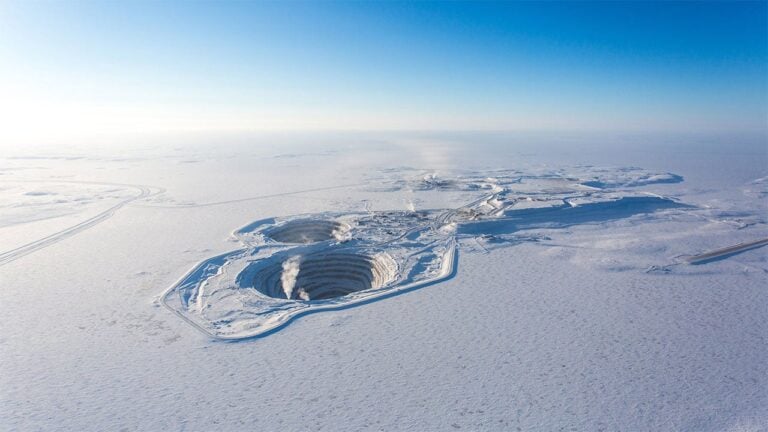
Namibian output rose 8% to 495,000 carats. In Canada, recovery more than doubled to 1.1 million carats due to the planned processing of higher-grade ore at Gahcho Kué.
De Beers raised its 2026 production guidance to between 25 million and 28 million carats, from 21 million to 26 million, after it took full ownership of Gahcho Kué on October 16. Mountain Province, its joint-venture partner at the mine, handed over its 49% stake in exchange for release from its obligations to the partnership, including outstanding debts. De Beers previously reported only its 51% share of the mine’s output.
“Whilst this does not impact global supply, this will result in an increase in De Beers’ reported attributable production,” Anglo American explained.
The company also lowered its unit-cost guidance to about $70 per carat from about $80, reflecting the higher contribution from Gahcho Kué, the Venetia pause, and ongoing cost control. Planned maintenance at the Jwaneng mine in Botswana will “substantially decrease” production in the fourth quarter, the company projected.
Anglo American, which owns 85% of De Beers, did not give details on the sale of the diamond miner. The Global Diamond Consortium, led by former De Beers CEO Gareth Penny and reportedly the preferred candidate, is in talks with Richemont and Signet Jewelers about joining its bid, Bloomberg reported last week.
“At De Beers, we continue to work towards a transaction in a challenging market, having taken decisive action to protect cash and preserve value,” said Anglo American CEO Duncan Wanblad.
Image: An employee at De Beers sightholder Almod Diamonds viewing a polished stone in Windhoek, Namibia. (Ben Perry/Armoury Films/De Beers)