


In 1968, Angela Taylor, writing for The New York Times, declared: “Piaget initiated the watch face made of precious stones.” By that time, Piaget had been wowing the watch industry and women since 1963 with its brightly colored, brilliantly designed watches.
Keeping time was secondary to the dazzling look of these timepieces. A handful of hard stones, such as coral, malachite, turquoise, lapis lazuli, tiger’s eye and onyx were deployed across the dials, cases and bands of Piaget’s modern women’s watches. Malachite and lapis might be cut into panels set in slabs of gold for bands; golden cages held cabochon turquoise around a coral face; and onyx was used to strike a note of sophistication.
Over the years, Piaget has used more than 30 different colors. The maison wasn’t merely doing a little window dressing; it was changing the women’s watch industry. Color and form were a ’60s revolution in timepieces.
A favorite for trendsetters
Society endorsed the look, too. Jackie Kennedy had a brushed-gold Piaget with a jade dial, while Elizabeth Taylor had one in opal – a deliberate nod to her violet eyes. Today, both are in the Piaget archives collection. The renowned film star and jewelry collector also owned a large sculptural watch of overlapping textured-gold hoops with a green hard-stone dial; it sold at Christie’s in 2011 for $80,500, against a presale estimate of $2,000 to $3,000.
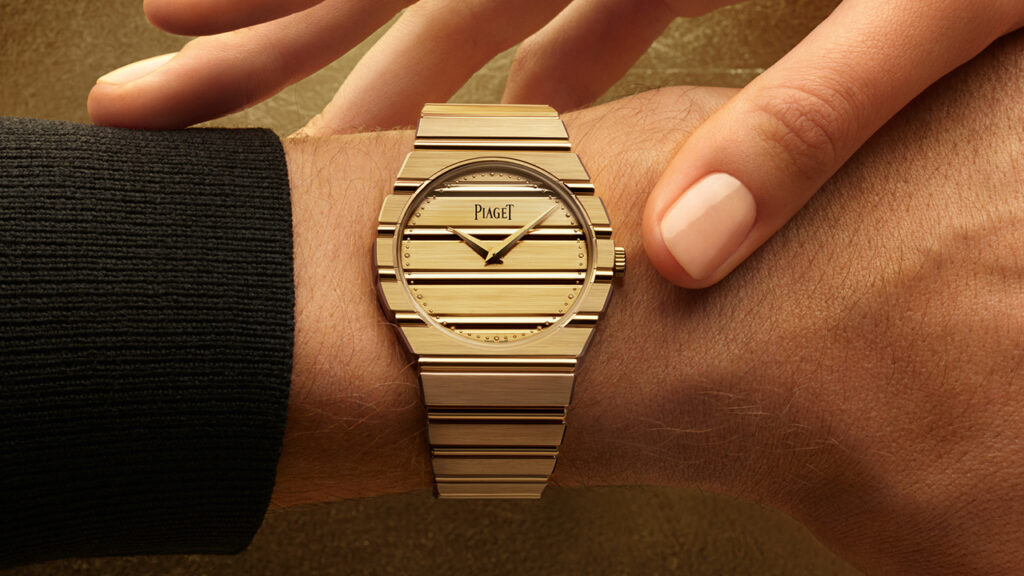
The “thin is in” lingo of the period – popularized by British model Twiggy – could just as well have applied to the Piaget timepieces that made all these design fantasias possible. Piaget debuted its ultra-thin silhouette in 1957 with the 9P caliber – a scant 2 millimeters thick – and again in 1960 with the even thinner 12P caliber, which boasted an automatic winding movement. With the ultra-thin, as the model was known, the fashionable jewelry watch for women was born. Like the best couture, it was the result of daring, savoir faire, and a dedication to quality. For the maison, this was not about producing multiples, but about making timepieces whose finely honed mechanics were matched by effulgent artistry. In 1969, the house debuted the 21st Century collection, which heralded a burst of newer and daring timepieces.
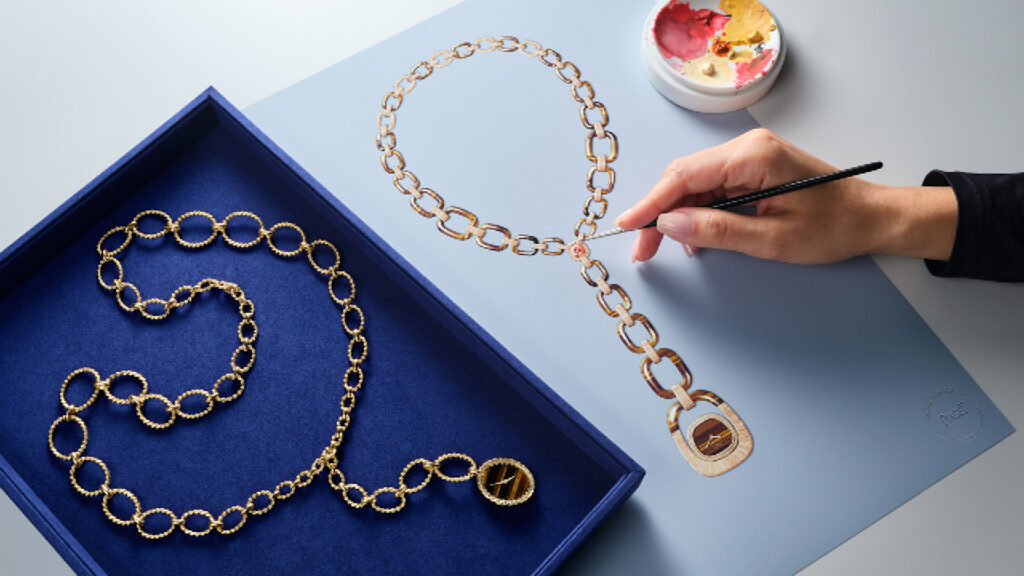
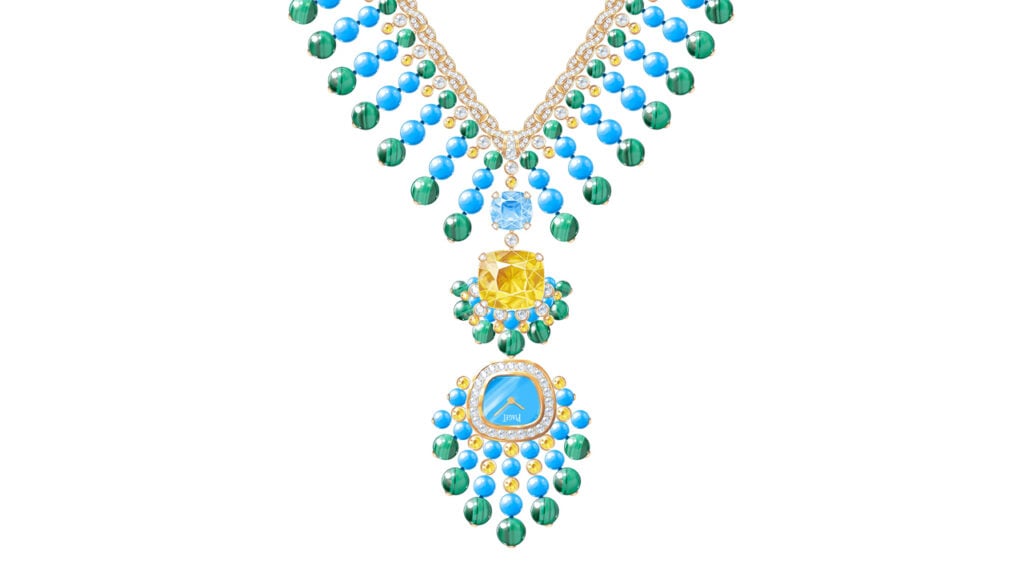
Nor was Piaget decorating only the wrist. The pendant-watch necklace was in sync with the newly fashionable sautoir of the ’60s and ’70s. Piaget’s pendant watches hung from a single or double gold chain, with hard-stone faces set in elaborate cases – and best of all, gold tassels often suspending beads in the same or contrasting hard stone. The message was simple: Style was fun.
Still going strong
Stéphanie Sivrière, who has been with Piaget for more than 20 years and is now creative director of jewelry and watches, continues to be inspired by the creations of the ’60s and ’70s. For her, “it was the golden age of design, freedom with color.”
That golden age has proven to be strong at auction. This May, Christie’s Geneva sold a 1975 tiger’s-eye suite – a bracelet watch, a necklace, earrings and a ring – for CHF 107,950 ($132,770). A year prior, a “slave” barrel cuff from circa 1970 with turquoise cabochons and a coral dial sold for CHF 50,400 ($61,990). The pendant-watch necklaces are also strong performers. For example, Phillips sold a tiger’s eye pendant-watch necklace for CHF 40,640 ($49,985) in May 2025. The desire for color and design carries over into Piaget jewelry as well: A striking necklace of alternating graduated malachite and onyx plaques in gold sold at Sotheby’s in June for $51,200, against an estimate of $20,000 to $30,000.
A tribute to the past
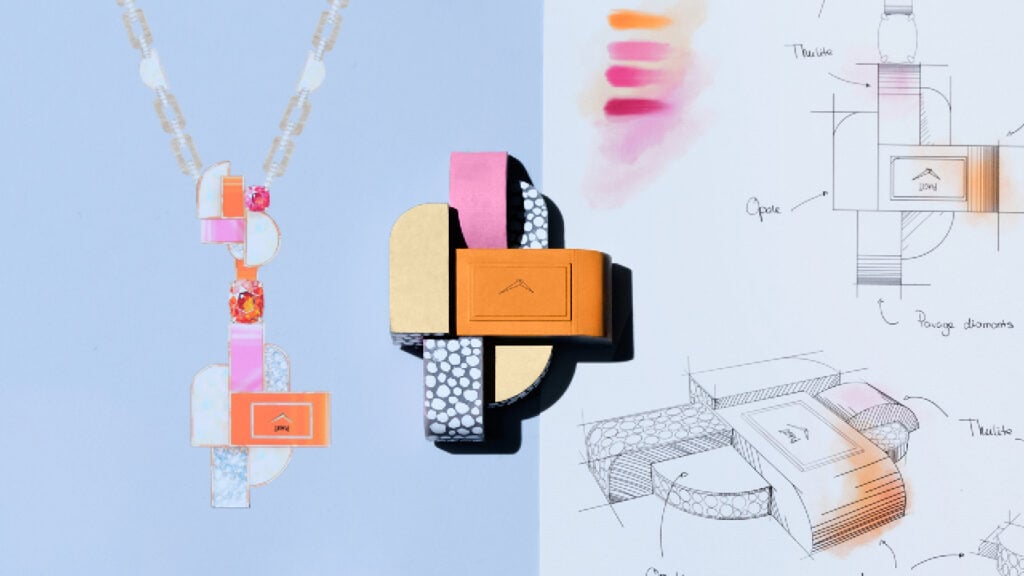
In designing the house’s high jewelry, Sivrière finds inspiration in period works that feature marquetry in hard stone – especially notable in her luxe Extraleganza collection, which champions sumptuous colorful stones, and the Sixtie line, a playful nod to the timepieces of the ’60s and ’70s.
Then there is Andy Warhol’s figurative imprint on the house – originally with his purchase of the Black Tie watch in 1974, and later with the Andy Warhol collection in 2024, a collaboration between Piaget and The Andy Warhol Foundation for the Visual Arts. Just last year, the jeweler debuted another Warhol tribute with its limited-edition Collage watch.
It may seem a far cry from the days when Georges-Édouard Piaget, a farmer in the small Swiss town of La Côte-aux-Fées, began making precision watch movements and eventually opened a shop in 1874. But you have only to look at the ultra-thins, the gold work and the love of hard stones to appreciate what Yves Piaget, a fourth-generation family member, once said: “A Piaget watch is first and foremost a piece of jewelry.”
The dealer’s take
Watch collector and expert Justin Gruenberg, founder of The Keystone and cofounder of Loupe This, discusses Piaget’s innovative designs and their artistic appeal for timepiece aficionados

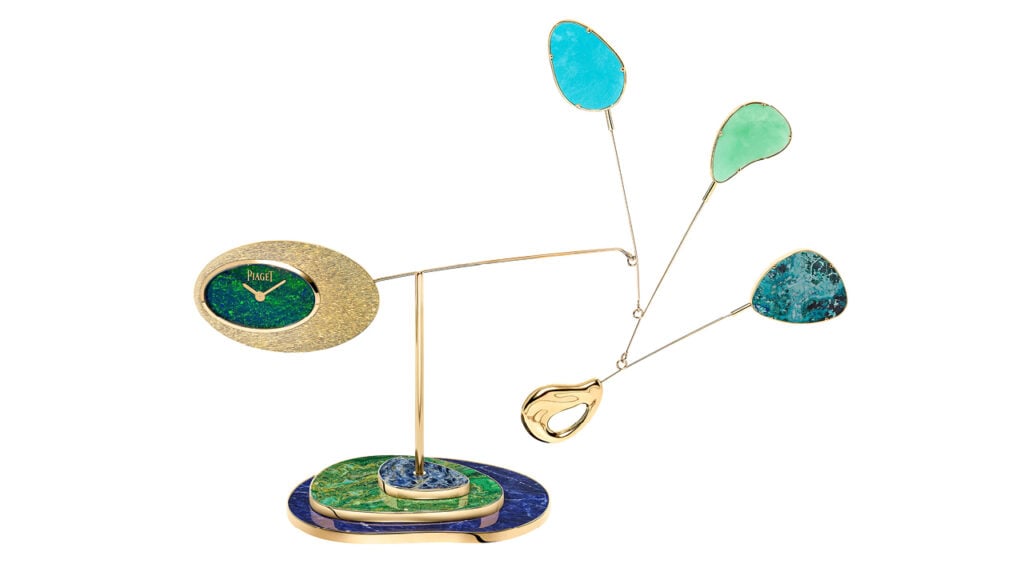
Piaget is an interesting brand, where everything seems to be unique, because there have always been many variations of a given model. You see watches from the 1960s and ’70s that feature turquoise or have jade with diamonds, all of them among the details that Piaget was producing at the time. Also from that time, there were truly avant-garde designs, such as sculptural watches – those with gold nugget-like designs, or [ones] that had bamboo shapes. These different shapes have become rarities on the secondary market.
As a dealer, I’ve always chased after Piaget’s strong designs, such as the big cuffs and sculptural works. Often only one or two pieces of a specific model and materials were made. Even the materials on a given style were changed, especially the hard stone, so that variation is part of what I seek. White gold from that time is quite rare when compared to the watches in yellow gold. I happen to love turquoise or coral on white gold. The brushed-gold finish – whether in yellow or white gold – is so characteristic of Piaget; it has a real ’60s vibe that is very period-looking.
Timepieces have generally been a men’s collecting game, but a few factors expanded the field to attract women. For example, in the ’60s, jewelry designers such as Gilbert Albert and Andrew Grima began designing watches for women, both of them for Omega. What they brought to the field was the sensibility that watches came to be seen as jewelry, not as something utilitarian.
In the 15 years prior to Covid-19, Piaget was under-collected. Since Covid, however, there’s been a shift in the traditional markets. Chic taste is no longer limited to a certain region. Big collectors might be European or American; you rarely see collectors particular to any one market these days. This means that selling is less specific to location.
Nowadays, women see watches as a new item to collect. They’re making better money than they were one or two generations prior, which has also empowered them to become collectors. Influencers, who bring a different eye to watches than men traditionally have, can reach women who will buy timepieces that suit today’s lifestyle. The all-diamond watch, for example, is less popular now, because the world has changed. Ten years ago, it was easier to sell that diamond watch.
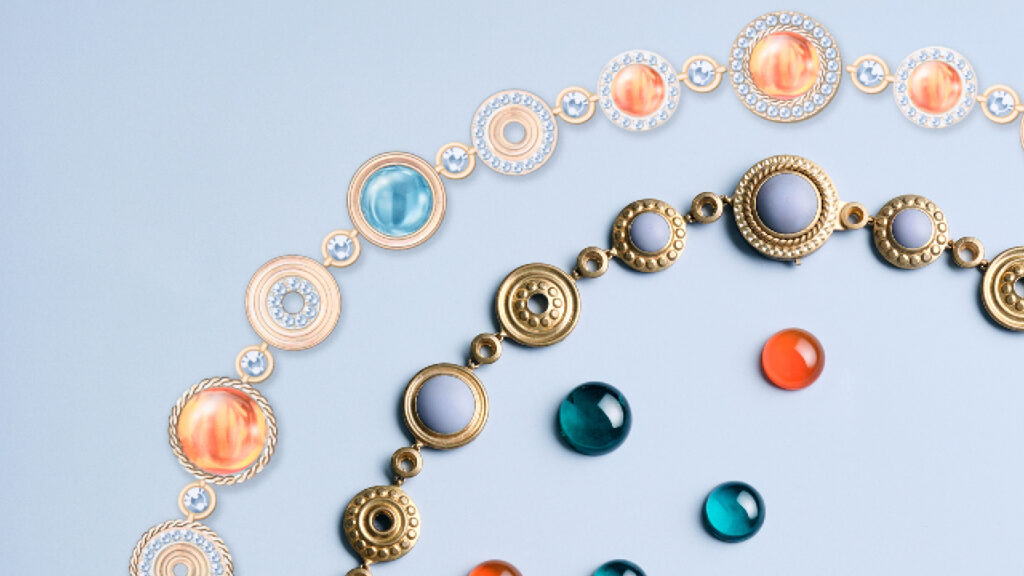
Piaget offers something different to collectors. Its more avant-garde designs have tended to show up in the larger forms. It’s when you get into these wide watches that you start to see rarity in the designs, such as the big sculptural cuffs done in heavy gold. They’re like art pieces. If you’re someone who tends to be more fashion-forward, then wearing a big cuff works, or even just wearing it as a statement piece for a special event. That said, they’re not easy to wear on a daily basis because of their size and heft. Ironically, that’s exactly what appeals to collectors of Piaget. On an artistic level, these are definitely something to collect. A Piaget watch signifies taste, and that’s what makes people love the brand. The Piaget collector is a design collector.
Main image: Necklace from the Extraleganza collection. (Piaget)

What Does Love Look Like? Not Out-of-Touch Lab-Grown Messaging
The natural-diamond industry won’t attract couples by telling them synthetics devalue their relationship.

Bridal Shopping in the Age of AI
Couples are researching online, but they still want to make the ring purchase personal – and that creates opportunities.
Six Brands Serving Fresh Engagement-Ring Designs
Whether it’s hand-sculpted organic gold or reimagined divorce jewels, these designers are setting trends that resonate with bridal shoppers.