

This year’s most compelling engagement-ring designs share a common thread: a move away from cookie-cutter bridal toward pieces built around individual stories, warmer and more characterful stones, and settings that prioritize personality over convention. Here are some of the brands leading those trends.
Artëmer
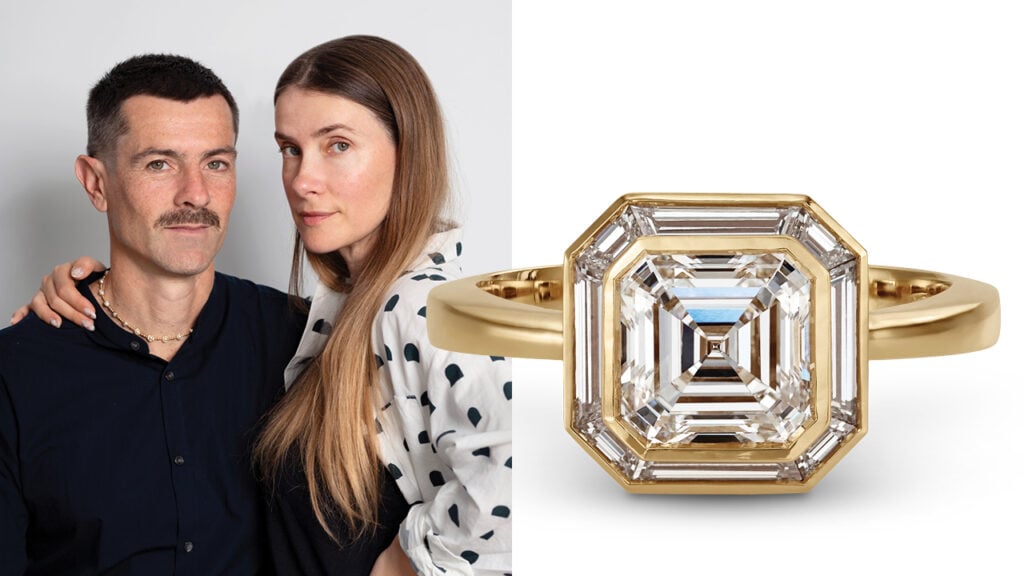
Life partners Tanya and Tomer Mikaeilyn founded Artëmer in 2011 in Herzliya, Israel, and the brand has built its name on alternative engagement rings shaped by the pair’s fine-arts training. That shows less in the decoration than in the process, which involves “sketching an idea, editing away the obvious, refining proportion until it feels right,” relates Tanya.
The brand sources exclusively through local suppliers in Ramat Gan’s diamond district. Its signature lies in mixed-cut compositions – baguettes, emerald cuts, carrés, Asschers – with a pull toward rounded step cuts in ovals and pears. “I love the angular lines inside an oval or a pear,” Tanya says.
One-of-a-kind parti-color sapphires remain a favorite, as do the brand’s steady-selling cluster rings, including a new style featuring two half-moons.
Warm champagne and salt-and-pepper diamonds are gaining ground, too. “The pristine white of lab diamonds has only enhanced the charm of natural stones and their flaws,” she says, adding that settings are loosening toward curved, organic lines – “bold and playful, in ways our clients keep surprising us with.”
The bigger shift, she observes, is toward independent designers over big brand names: “It’s becoming more mainstream, and we’re very happy to see it.”
KatKim
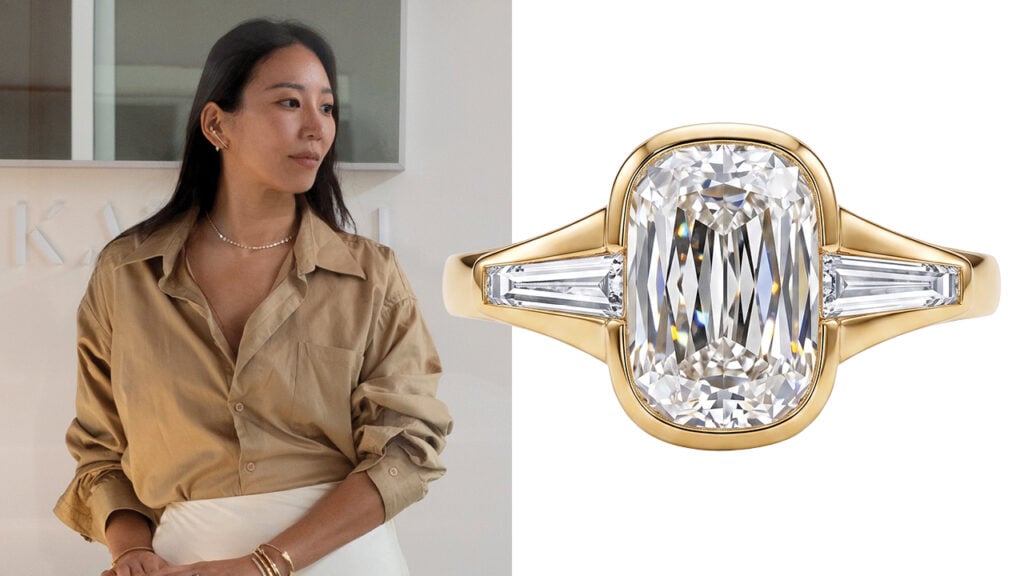
KatKim’s engagement-ring line “evolved very organically through our community and our clients,” says founder Katherine Kim, who resists the word bridal altogether. “It isn’t really ‘bridal’ – it’s about authenticity and what the wearer really wants. Incorporating all the little details of the wearer is what makes the piece significant.”
That belief shows in her prong-set Trace rings, with their elongated cushions, emeralds, Asschers, and pears, and in her bezel-forward Cosma collection, which she designed to keep the stone from getting buried in the gold. Rounds have quietly fallen away in favor of three-stone rings with tapered baguettes lining the shank, and Kim is developing a half-moon and Asscher combination she calls “stunning.”
Clients are gravitating toward warmer, near-colorless natural stones over larger lab-grown ones. “They want to take it back a little and have a more refined, special natural stone,” she says. Budgets have settled around $30,000 to $40,000 as the old three-month-salary rule fades, observes Kim, and her new men’s collection features subtler, self-purchased diamonds.
Fie Isolde
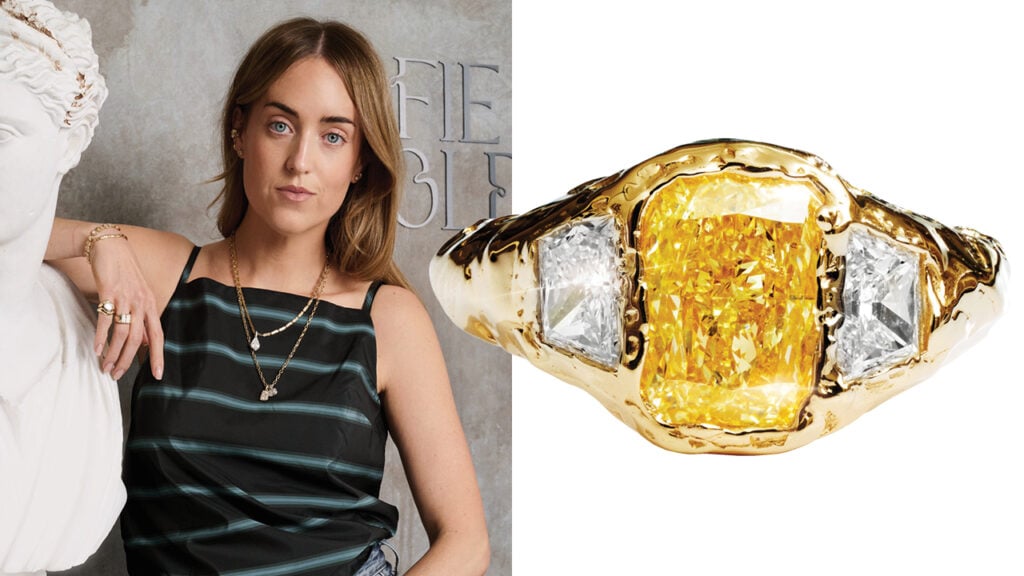
Fie Isolde’s eponymous brand began almost by accident. “I wanted to make engagement rings for myself, and at that point, my CEO wanted an upgrade of her ring as well,” says the Danish-born, Los Angeles-based designer. Hailing from Copenhagen, she holds a bachelor’s degree in trend and design – though, as she puts it, “the way I learned about jewelry is basically by doing.” Every piece still starts the same way: She sculpts it in hot wax with a hot pen, chasing “this very organic, runny liquid gold” look, then scans and prints it before working on it a second time by hand.
The brand now spans over 30 styles, with round brilliants, radiants, ovals, Asschers, pears and cushions set in chunky gold “to highlight the stone in a very natural way,” she says.
Since a lot of her styles aren’t too feminine, Isolde wants the pieces to be “something you can wear every day, not a cocktail ring.” Rings with smaller diamonds in open or closed bezel settings average $15,000 in 14-karat gold, while custom pieces in 18-karat gold or platinum with a natural center diamond of 5 carats or more typically start around $100,000. Clients can choose natural or lab-grown stones for any of the rings, she adds.
A collection slated for release in September explores a stronger, Art Deco aesthetic, veering away from the softer silhouettes that have been the brand’s signature look.
Uniform Object
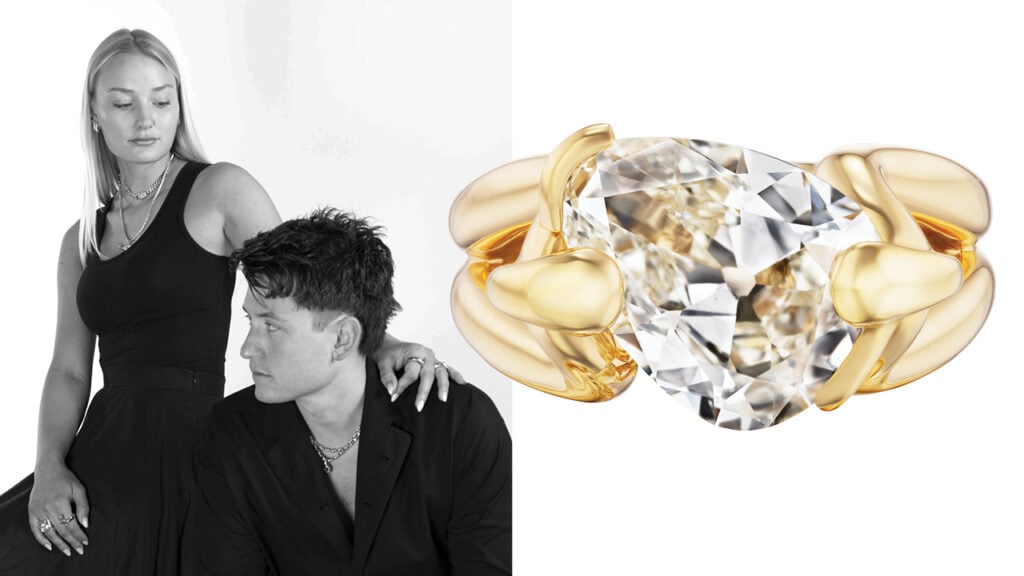
Uniform Object takes its name from a physics term for a theoretical perfect sphere. “I wanted to create a brand that was, in my mind, my perfect sphere, no compromises,” says David Farrugia, who founded the label in 2021 with his high school sweetheart (and now wife) Katie, a former litigator who supported the brand quietly before leaving law full-time in 2024. His family is split between artists and tool-and-die makers – a duality that comes through in the brand’s aesthetic: “It’s all about contrast, bold and brutal and aggressive, but restrained with elegance, permanence and beauty,” he says.
Functionality anchors every decision, he explains. “Everything looks simple, but it has to be stronger than a typical ring. Usually the answer is more gold; it protects and strengthens.”
That ethos is evident in the brand’s bezel-heavy settings, as well as in signatures like the mantle setting – “two clamps, our version of prongs” – and the impact setting, which relies on tension – “like a stone from the sky fell into a piece of gold,” in Farrugia’s words. Stone choices lean toward pears, marquises and old European cuts, and they come in 18-karat gold or platinum. Prices start near $25,000 but can go beyond $100,000.
Clients now want antique stones and warmer shades, seeking bigger stones by opting for lower colors. “I’ve seen L’s that look quite colorless,” Farrugia says. “It depends on the cut, the setting, the gold color.”
Single Stone
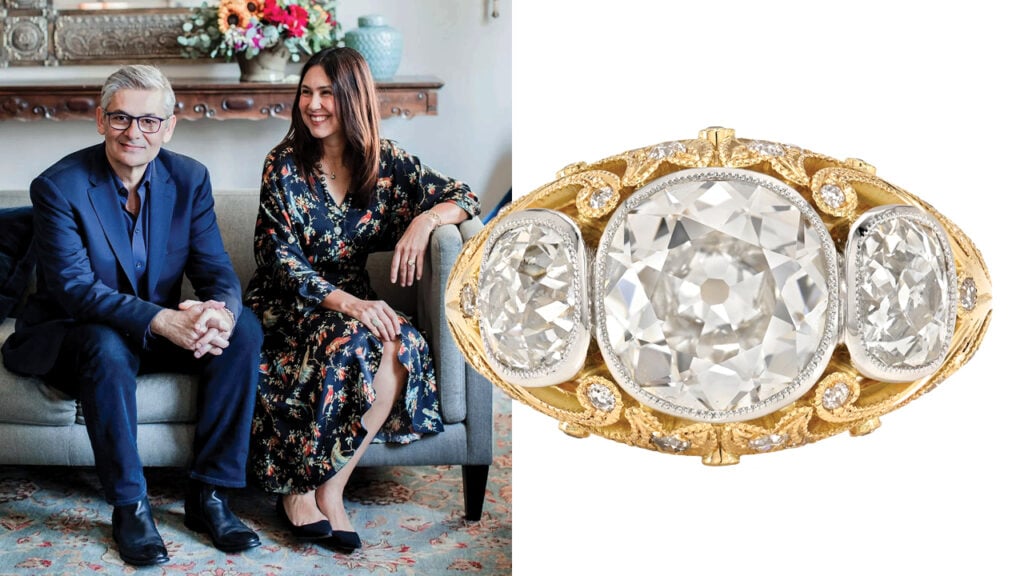
When Ari Madilian launched this vintage diamond brand in Los Angeles, he chose the name as a nod to his father’s Istanbul business, Tek Tas – “single stone” in Turkish. Madilian’s wife Corina joined the brand in 1998, and they spent years restoring and reselling vintage engagement rings before deciding to start designing their own in 18-karat gold and platinum.
“Every single piece of jewelry we make starts with the center stone,” says Corina Madilian. They use hand-engraving, milgrain and filigree, crafting the pieces entirely in Los Angeles; their own artisans make every component, down to the chains and jump rings.
Clients are shifting toward warmer, old-cut diamonds that were once considered a hard sell, she reports. “It was always an uphill battle teaching people about the [brown diamonds], the champagnes. All of a sudden, now they’re the trend.”
Elongated cushion cuts – aided by the hype over pop star Taylor Swift’s engagement ring – and emerald cuts remain dominant, as do sturdier shanks that better suit how today’s women use their hands. “Ring sizes have gone from a three-and-a-half to a seven-and-a-half,” Corina says.
Average price points have climbed from the $15,000 to $25,000 range to between $30,000 and $50,000 as younger couples deprioritize home ownership.
“Give yourself permission to do something unique,” she tells clients, “rather than getting what everyone else has.”
Sam Ham
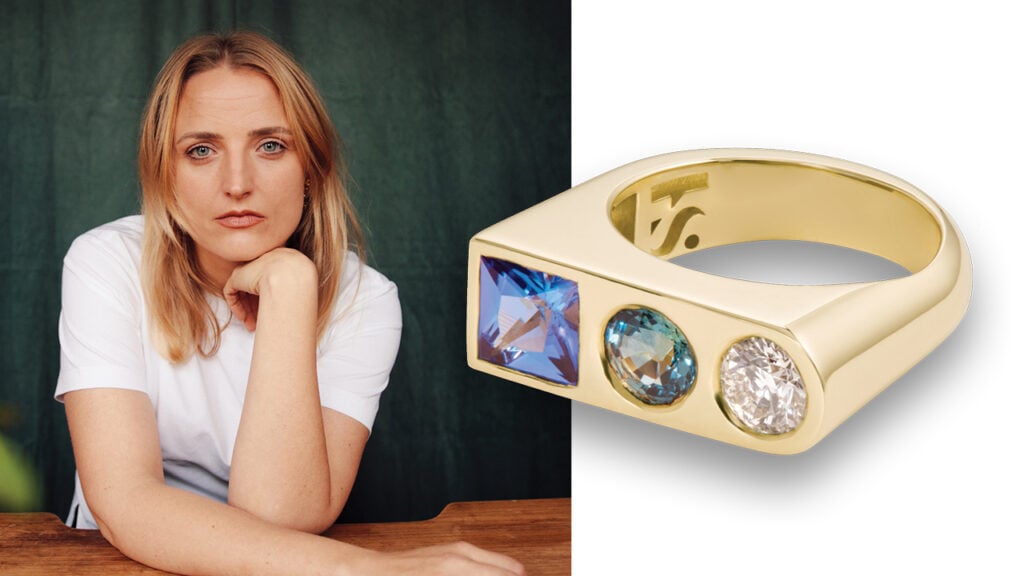
Irish designer Sam Hamilton founded this London-based brand in 2017 after training on the bench and later at luxury group Richemont’s design incubator in Milan. She built the company on remodeling clients’ jewels, not designing new ones; she offers a bespoke service for life after divorce, turning inherited, unworn or emotionally charged jewelry into pieces with personal meaning. “Some of life’s most defining moments happen after the happily ever after,” she says, “and I design for such moments – the unforeseen, messy curveballs, the reinventions.”
The pivot happened almost by accident, post-pandemic, when Hamilton realized older clients interested her more than brides who were “staying the same age” while she herself got older. “There was this woman out there who had a ring she wouldn’t get market value for, didn’t need to sell, and it sat in a drawer,” she recalls. For the woman’s 60th birthday, her daughter commissioned a piece that would take the diamond from her divorced mother’s ring and reset it off-center in a three-stone design alongside a tanzanite and teal sapphire – one stone for each of the woman’s three daughters.
Hamilton points to a general UK trend of rising divorces among women near 60 – so-called “silver splitters” – who are financially independent enough to walk away. The capsule collection she created this year for her divorce and heirloom clients includes several rings, a pair of studs and a pendant, all in 14-karat yellow gold. She can also craft custom pieces in 18-karat gold or platinum.
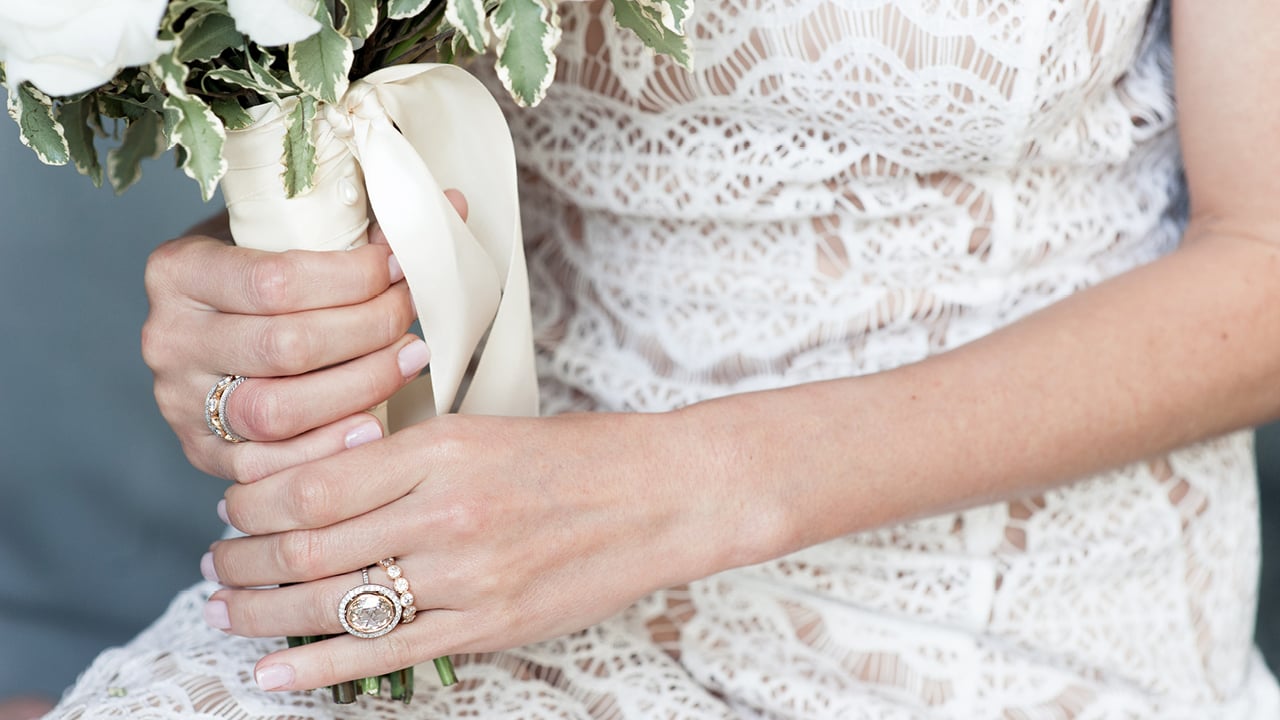
Main image: Single Stone rings on model. (Single Stone)
What Does Love Look Like? Not Out-of-Touch Lab-Grown Messaging
The natural-diamond industry won’t attract couples by telling them synthetics devalue their relationship.
Bridal Shopping in the Age of AI
Couples are researching online, but they still want to make the ring purchase personal – and that creates opportunities.
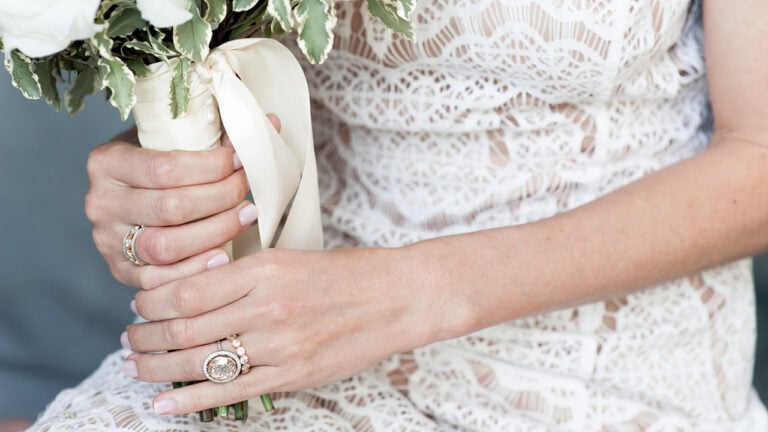
Six Brands Serving Fresh Engagement-Ring Designs
Whether it’s hand-sculpted organic gold or reimagined divorce jewels, these designers are setting trends that resonate with bridal shoppers.