 WhatsApp
 Email
Email
 Facebook
 Twitter
 LinkedIn
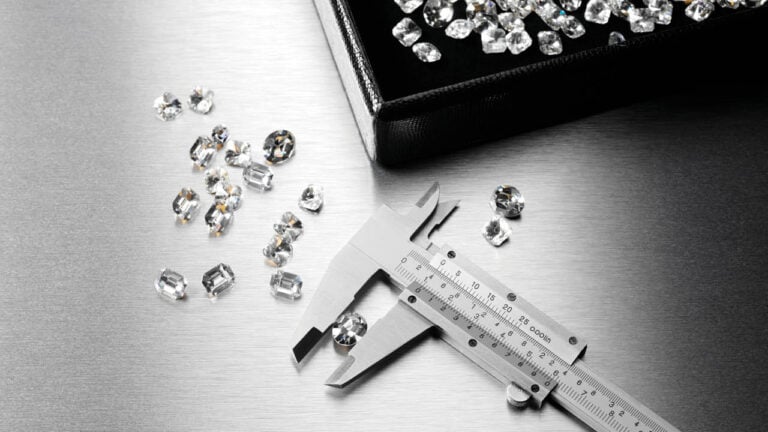
RAPAPORT… When asked about the status of synthetic diamonds in Japan, Michio Iwasaki, president of Iwaden Sangyo Co., Ltd., a diamond importer/wholesaler, and also the director in charge of public relations at Japan Jewelry Association (JJA), went straight to the experts: Japan’s major gemological laboratories.
Yoshiko Doi, president of the AGT Gem Laboratory, an affiliate of Gemological Institute of America (GIA), responded that her lab had encountered about 50 synthetic stones during the past year. Yoichi Horikawa of Central Gem Laboratory (CGL) said that his lab had identified about 20 stones as synthetic during the same period, most of which were inscribed with the marketers’ insignia on the stones’ girdle, with the exception of five or six pieces that had no markings. “I consider the numbers minimal, and nothing to be worried about,” concluded Iwasaki.
Taking Heed
From the very beginning, when the technology of mass-producing synthetic diamonds first became available, and particularly when Lazare Kaplan, one of the major world diamond marketers, started selling High Pressure-High Temperature (HPHT) color-altered stones, the Japanese trade took heed. To protect against such stones crossing the country’s border, a sort of “Operation Waterfront” measure was instituted. JJA warned the Association of Gemological Laboratories (AGL) to be vigilant, since almost all stones that come into the country are sent to gem laboratories for grading and certification before they are put up for sale. That means any suspicious stones would be picked up by labs and prevented from getting into the market.
CGL’s Horikawa guarantees that “if stones are made by HPHT processes, any major labs can identify them.” Except for small-time con artists who occasionally sneak dubious stones into the country through unconventional means, Japanese markets have been virtually free of synthetic diamonds — or so it was thought.
Then, in the fall of 2006, gemological laboratory Zenhokyo picked out about 200 pieces of synthetics from a 600-piece melee lot, whose sizes are smaller than 1/100 carat. “We believe this is a one-time incident and the synthetics were mixed in with the natural lot accidentally,” said Hiroshi Kitawaki of Zenhokyo, since the presence of synthetics subsided immediately after the lab shared the findings with the dealer who had submitted the lot to the lab.
“At the time, JJA was running a campaign promoting ‘Golden Colored Stones’ that included yellow diamonds. It is understandable that dealers were trying to make the most of the campaign and pushed a little hard,” said Kitawaki, who declined to reveal the name of the dealer.
Zenhokyo took the matter to JJA. “I heard that JJA then contacted the suspected exporting country,” said Kitawaki, although he does not know for sure if anything ever developed from it. “Unfortunately, two of our secretaries general quit their jobs in less than a month. We have no one in the secretariat who can answer the questions,” said Iwasaki, but he dismissed any notion that the mix-up of the synthetics in the lot was intentional.
Then, at the end of June, IrisGem of Valencia, Spain, started marketing its synthetic diamonds in Japan. The company’s commercials are seen on TV, directly pitching to consumers and saying that its synthetic diamonds “are made of a loved one’s hair,” a reference to the technology where carbon is extracted from human hair and then “grown” into a diamond. Consumers are now openly exposed to the fact that synthetic diamonds are around and accessible.
Been Around
Iwasaki pointed to the fact that it is no secret that synthetics have been around for some time. In fact, De Beers and Sumitomo Electric have been producing them on a commercial basis. In Sumitomo’s case, the synthetics are for industrial use only and the production is well controlled. They are not even marketed in Japan.
IrisGem is not only targeting consumers but also trying to penetrate into dealers’ markets. “We’ve been approached by Iris,” said Masahiko Akaike of Orient 4Cs, a stone and jewelry manufacturer/wholesaler. “At the moment, I don’t think they are a threat to the dealers’ market. The prices are three times higher than natural diamonds.”
It is uncertain at this moment if the number of synthetic diamonds will increase anytime soon or what kind of impact they will have on the natural diamond market. One can look at the colored stone market — where synthetics and treatments have been the norm of the trade — for an indication. That market has been in a slump for some time. Have the synthetics and treatments damaged the integrity of natural gem stone markets? “I don’t think so,” said Iwasaki. “If synthetics and treated stones are taking market share away from natural stones, then the synthetic market would be thriving — but that is not so.”
JJA is not specifically dispatching an alert to trade members about the emergence of synthetics, but on its website does explain exactly what synthetic diamonds are.
The Marketplace
• Due to the weak yen, market prices are up by 3 to 5 percent.
• 4/4 grainers in H-and-better colors and VS-and-better qualities are also going up in price.
• Large-size rounds, fancy shapes, capes and browns are moving well, as the market sees their price advantage over rounds. It is suspected that foreigners are buying these stones.
• Melees and smalls are weak.