

RAPAPORT… De Beers is studying how to eliminate the carbon footprint
of diamond mining by storing the emissions inside kimberlite, it said
Wednesday.
The miner recently received a government grant of CAD
675,000 ($514,000) to test the process at its Gahcho Kué mine in Canada, having
carried out successful laboratory experiments. The project involves injecting carbon
dioxide into processed kimberlite rock to accelerate “mineral carbonation,”
in which the greenhouse gas reacts with metal oxides to form a stable and
benign substance.
The storage capability of kimberlites is so large that it
would require only 10% of the rock’s storage potential to capture the
carbon-dioxide emissions of a whole mine, De Beers explained. “There is great
potential to achieve carbon-neutral mining operations at sites where this type
of rock is present,” said De Beers CEO Bruce Cleaver.
The cash award from Natural Resources Canada’s Clean Growth
Program will enable De Beers to study whether the process can work in
large-scale field demonstrations at Gahcho Kué, which De Beers co-owns with
Mountain Province. De Beers also plans to perform tests at its Botswana operations
to assess differences between various climates and geological settings. The
University of British Columbia (UBC), Trent University, the University of
Alberta, and the Quebec-based National Institute of Scientific Research are
working with the company on the project.
“We’ve demonstrated rapid carbon fixation within days to
weeks in the lab, but the challenge is to reproduce this success at large
volumes,” said Greg Dipple, project lead and professor at Bradshaw Research
Initiative for Minerals and Mining (BRIMM) at UBC.
“[The grant] will help us accelerate this innovative work
that could fundamentally change the carbon footprint of not only the diamond
industry, but the mining sector more broadly,” Cleaver added.
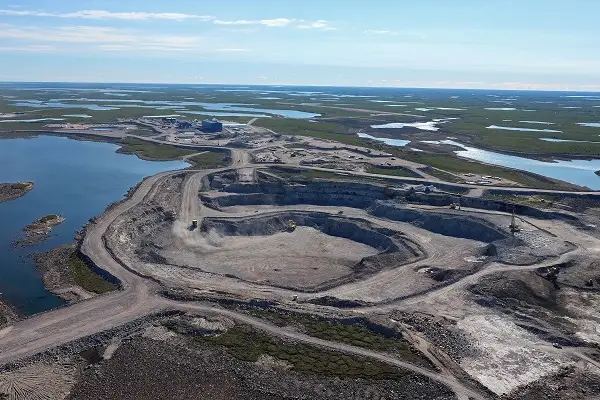
Image: The Gahcho Kué mine. (Mountain Province)

Qatar Diamond Exchange to Collaborate with Italian Bourse
Parties signed MoU to extend connection among their members, broaden cooperation and advance commercial relationships.
China Signs Deal to Reinvigorate Interest in Natural Diamonds
Shanghai Diamond Exchange hosts signing of Beijing Declaration, with government representatives from Botswana, Namibia and South Africa.

AI, Gen Z Are Hot Topics at AGS Conclave
This year’s edition is last to take place in September, as event returns to spring in 2027.