

RAPAPORT… De Beers has reduced its full-year production guidance by 7 million carats, putting the miner on course for its lowest output since 2009.
The miner expects to produce between 25 million and 27 million carats in 2020, compared to the 32 million to 34 million in its original projection, it said Thursday. The revised forecast for 2020 was due to the impact of the COVID-19 pandemic on mining activity and consumer traffic in key markets, the miner noted.
Rough-diamond production for the first quarter of 2020 slipped 1% to 7.8 million carats, roughly in line with the previous year. However, the coronavirus shutdown measures were not implemented at the miner’s sites until the end of the period, and had a limited impact on output, De Beers said.
Sales volume rose 19% to 8.9 million carats for the three months ending March 31. The increase was due to a favorable comparison with the same period the previous year, when demand was weak due to an oversupply of polished stones in the manufacturing sector. Additionally, the decline in demand caused by the pandemic — during which De Beers allowed customers to defer some of their allocations to the second quarter — was offset by higher appetite for lower-value goods, the company noted.
Production in Botswana declined 5% to 5.6 million carats, with diamond recovery at De Beers’ Orapa mine falling 7% as result of challenges in commissioning new plant infrastructure. Output at Jwaneng slipped 4% due to a planned shift to lower-grade ore.
Production in Namibia grew 6% to 511,000 carats, and in South Africa jumped 97% to 751,000 carats, as the final ore from the company’s open-pit operations at Venetia was mined prior to the transition to underground.
Output in Canada slid 19% to 844,000 carats, primarily due to the closure of the Victor mine, which reached its end of life in the second quarter of 2019. Output from Gahcho Kué, which the company owns in partnership with Mountain Province, rose 4% to 844,000 carats.
The first quarter featured two sales cycles, with proceeds falling 9% to $906 million. Demand reached a near-yearlong high in January, but fell again in February as the coronavirus began to spread. The company was forced to cancel its third site, which was due to begin at the end of March.
In 2009, the company slashed production by 49% to 24.6 million carats for the year when the global economic slowdown hit diamond demand.
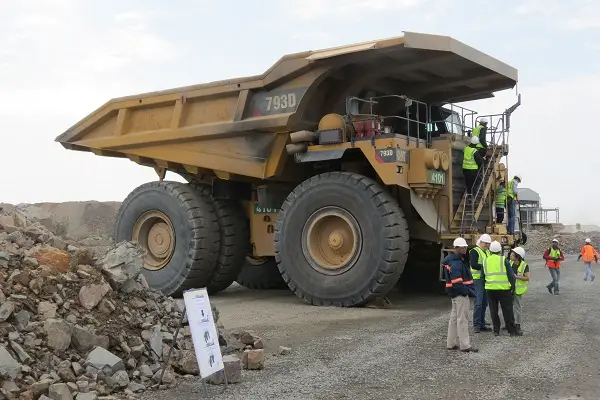
Image: A truck hauling ore at the Jwaneng mine. (De Beers)

AI, Gen Z Are Hot Topics at AGS Conclave
This year’s edition is last to take place in September, as event returns to spring in 2027.

Patek Philippe Watch Could Fetch $4.9M at Phillips
Timepiece from 1945 is among highlights at Geneva sale.

Deloitte: Holiday Spending to Reach $1.71T
US sales likely to increase as much as 4.8% year on year for November-to-January period.