
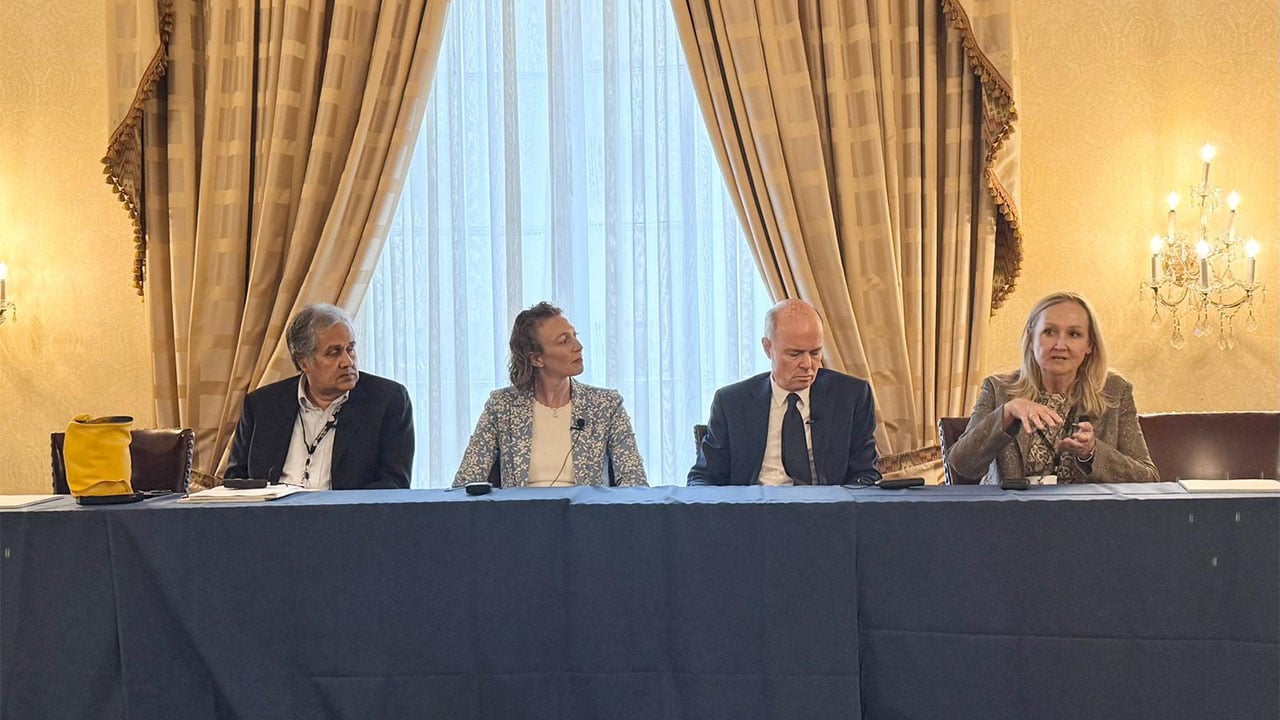
Botswana President Duma Boko had to try twice to inject some energy into a sleepy audience at the annual World Federation of Diamond Bourses (WFDB) gathering in New York. It was the morning after the JCK Las Vegas show, and many (including this reporter) had just got off a red-eye flight from the Nevada city.
“A very good morning to you all,” the event’s star guest said after introducing the standard list of dignitaries in the room. Underwhelmed by the mumbled “good morning” he heard back, the event’s opening speaker pressed repeat. “Good morning to you all,” he said once again, pausing after the first two words as though he were a schoolteacher expressing mild disapproval with the classroom’s level of enthusiasm. This time he received a strong “good morning” in response. He got a few laughs, too.
Sometimes it felt as if this interaction reflected the state of the diamond trade. Some speakers and panelists at the federation’s annual president’s meeting, which ran on June 10 and 11 in Manhattan, were trying to wake the industry up. There were numerous calls to invest in effective marketing, better traceability and to see things more from the consumers’ perspective
There was occasional resistance from those in the room and in private, behind-the-scenes discussions, especially around the issue of traceability.
Here are five key issues that came up in the speeches and panel discussions during the meeting.
1. Traceability is controversial.
In his speech, President Boko called on WFDB members to align traceability systems and standards, echoing a message he gave at JCK Las Vegas about promoting Botswana-sourced diamonds as a brand. Others at the meeting also pushed for traceability.
While there was general acceptance that this would be a good thing, concerns arose that diamonds without clear origin — or those of undesirable origin — would lose value and that mandatory traceability would put parts of the industry at a disadvantage.
JCK news director Rob Bates, who moderated the panels at the meeting, noted that the industry was so far from universal traceability that it would be a long time before these concerns would become practical.
There was also anxiety that a country could shift from desirable origin to undesirable origin very quickly — as was the case with Russia.
2. Reigniting natural-diamond demand shouldn’t be hard (in theory).
Another sentiment that came up both in Las Vegas and at the WFDB meet was that consumers instinctively believe diamonds are cool and beautiful. It should be easy to monetize this.
But, as Olivia Landau, CEO of online natural-diamond retailer The Clear Cut, pointed out on a panel about natural and lab-grown diamonds, the story consumers have heard about lab-grown diamonds has made them channel their desire in that direction.
The trade, Landau said, views natural diamonds as the better product with intrinsic rarity and value and sees synthetics as a mass-produced alternative fit for fashion jewelry.
But American consumers “don’t aspire to a natural diamond,” she argued. “A lot of people aspire to a lab-grown diamond, because they think, hey, it’s more sustainable…, it’s more ethical.” They also believe lab-grown is better quality than natural, the executive said.
“There’s no lack of wanting or aspiring to a diamond,” Landau said. “That’s why lab-grown diamonds are a thing — because people love diamonds and think they’re beautiful and aspirational. But why a natural diamond and not a lab-grown? And that is something we can’t shy away from talking about anymore.”
Sally Morrison, market lead for natural diamonds at De Beers, presented a different analysis at a panel about marketing.
“What we see is that 80% of consumers go into a store assuming they’re going to buy natural,” said Morrison, whom Bates invited onto the panel on the spot after she had arrived at the meeting as an audience member. “They get converted at the point of sale…where it’s easier for the retailer to close on a lower price point. So I really believe that all of us collectively have to stand shoulder to shoulder with our retail colleagues and help them make the move back.”
The overall message was that consumers continue to desire diamonds — but the natural industry needs to try harder to tap into this.
“The engagement we get on social media is multiple times…what the fashion industry gets,” emphasized David Kellie, CEO of the Natural Diamond Council (NDC). “Consumers love diamonds.”
3. “Synthetics” were the target, mostly.
The WFDB is a challenging situation because many of its bourses’ members profit from lab-grown diamonds. Still, the meeting focused on promoting natural diamonds.
“Love cannot be grown in a lab,” said Boko in his speech.
It came shortly after the Gemological Institute of America (GIA) announced it would stop using 4Cs grading for lab-grown — a move that was well-received at JCK and at the WFDB gathering.
The language of lab-grown was also a big theme.
An important footnote to De Beers’ public closure of its Lightbox lab-grown diamond brand is that it’s using the term “synthetics” much more than before. CEO Al Cook peppered the word into his speech at the company’s JCK breakfast, as a colleague pointed out to this reporter. Paul Rowley, De Beers’ executive vice president for diamond trading, also used the term freely in a panel about natural and lab-grown at the New York meeting.
At one point, Landau urged fellow panelist Tom Moses, the GIA’s executive vice president and chief laboratory and research officer, to reconsider the institute’s own policy. “If you said that they are synthetic diamonds, this would solve a ton of our problems,” Landau said. (The GIA used this term on its grading reports for the category until 2019, when it switched to “laboratory-grown diamonds.”)
One of the few voices in favor of a more balanced approach was Ahmed Bin Sulayem, executive chairman and CEO of the Dubai Multi Commodities Centre (DMCC) and chairman of the Kimberley Process (KP). He encouraged attendees to visit the Lab-Grown Diamond Symposium in Dubai on September 30. “Listen to what the naughty boys are saying, and make your pitches,” he urged the audience.
4. Something big is happening in Angola today.
Industry leaders noted they would be meeting in Luanda, Angola, on Wednesday for the Angola Ministerial Roundtable on the promotion of natural diamonds, which the country’s Ministry of Mineral Resources, Petroleum and Gas (MIREMPET) is hosting. Sources in the sector expect a major announcement about marketing funding.
Ministers from Botswana, Namibia, South Africa, Sierra Leone and the Democratic Republic of Congo will attend, as will Al Cook, according to a statement from De Beers.
5. A tariff exemption for diamonds will take time.
Attendees were almost unanimously united against the US’s 10% import duty.
“You can put as many tariffs as you like on natural diamonds, but you cannot create diamond production jobs in the US,” said De Beers’ Cook in his address, noting that the lack of diamond mines in the country made the duties pointless. “It’s simply, in the words of some American leaders, a consumption tax on the American people.”
Still, uniting the industry on the issue entailed challenges. “When we started engaging the trade across different regions, everyone wanted something slightly different,” said Feriel Zerouki, president of the World Diamond Council (WDC) and senior vice president of provenance, ethics and industry relations at De Beers. “Some wanted exemptions on the rough, some wanted exemptions on the polished, and some wanted, like us, exemptions on both.”
The first step, Zerouki said as a speaker on a panel about the topic, was to ensure the trade had a single line of argument. “If we’re going to be engaging with the same administration, one certain way of not achieving success is to be asking for different things from the same industry,” she said.
The Donald Trump administration is still at the stage where it is engaging with other countries rather than with specific industries, Zerouki pointed out.
“Every single industry out there is saying that they are special and…calling for an exemption,” she added. “We can focus on why our product should be considered for exemption and we’ve got…facts to support that statement. But at the same time, we strongly believe that by exempting natural diamonds, rough and polished, we are supporting…the call from the administration to support growth and job creation here in the US.”
Image (left to right): Bharat Diamond Bourse (BDB) president Anoop Mehta; Lisa Bridge, CEO of Ben Bridge Jeweler; Natural Diamond Council (NDC) CEO David Kellie; and Sally Morrison, market lead for natural diamonds at De Beers. The four were speaking on a panel on marketing at the WFDB meeting. (WFDB)