
Since the publication of this article, the US has announced a 90-day pause on most reciprocal tariffs.
The US’s bombshell announcement of import duties on the entire world has created panic in the diamond market.
The last time the industry experienced anything like this was in March 2020, when Covid-19 lockdowns froze the global rough and polished trade.
Dealers hope President Donald Trump is using his tariff policy as a negotiating tool and will reverse it soon.
For now, however, the market is in a crisis of uncertainty. The entire supply chain is worrying about the impact on demand and trying to understand how trading can continue.
As of April 5, America has been collecting 10% duties on almost all products from virtually all countries. From April 9, bigger levies will go into effect on imports from select targets, including India, which Trump has hit with a 27% tariff. India manufactures more than 90% of the world’s polished diamonds.
Many questions remain unanswered: Will US orders fall as consumer prices rise? Which segment of the supply chain will absorb the extra costs? How will grading and memo work? Will the tariffs disappear in a month? How will US customs verify the origin?
Sales outside the US have mostly stopped in the meantime, several dealers told Rapaport News on Sunday.
“No one seems to know what to do, and for now business has come to a complete standstill,” said an Antwerp-based trader on condition of anonymity.
Inventory transfer
The exception to this was a big shift in inventory from overseas to the US at the end of last week as companies rushed to get their shipments in before the tariffs took effect. Goods in transit before the relevant deadlines are not subject to the new duties.
Large Indian manufacturers moved diamonds en masse to their American branches from April 3 onward following Trump’s April 2 announcement. Some dealers reported shipments to customers, too. Businesses with local American offices have an advantage, as they can move goods without needing a final sale.
The number of round, 1-carat, G to I, VS1 to SI2 diamonds on RapNet listed as being located in India has dropped 6.3% since April 1, while US stocks of the same categories have risen 10%, according to data from the platform. Figure 1 shows how sharply the two trends diverged on April 3.

“Lot[s] of shipment[s] went [out] before April 5,” said Vipul Shah, CEO of Mumbai-based diamond and jewelry manufacturer Asian Star and former chairman of India’s Gem and Jewellery Export Promotion Council (GJEPC).
Shah also expects a shutdown in trading until there is more clarity or a change in policy. “Exports to [the] US will fall drastically unless [there is] any revision [to the] tariff[s],” he predicted.
Price predictions
Many in the industry — including Rapaport Group Chairman Martin Rapaport — expect stateside inventory to gain value relative to others, since the goods are already in the US and do not attract tariffs.
Average asking prices on RapNet for round, 1-carat, G to I, VS1 to SI2 goods have seen a modest increase over the first seven days of this month. American inventory in that range has risen in value by 2.7%, with prices of India-based stones edging up 0.5% (see Figure 2).

“While the tariffs have caused some shifts in global trade dynamics, the effect on natural diamond prices has been relatively muted so far,” commented Dinesh Lakhani, group director of Mumbai-based Kiran Gems, which claims to be the world’s largest manufacturer of polished diamonds. “However, there have been reports of price fluctuations in certain categories, particularly in the rough-diamond market, where supply chains are more directly impacted by global trade tensions.”
Once all the tariffs are in force, the focus will turn to consumer prices; should these rise as anticipated, sales volumes will likely suffer. The alternative is for the industry to foot the bill, squeezing margins further.
The best scenario would either be a Trump U-turn or some sort of exemption for diamonds and jewelry. The latter is not likely to happen immediately: The White House is thinking in country terms, not product terms, and this is the basis of negotiations at present. More than 50 nations have contacted the president seeking to begin talks, National Economic Council direct Kevin Hassett told ABC News on Sunday, citing the US Trade Representative.
Lobbying efforts
However, there could be a later phase in which industries will be able to make their case, though the diamond sector is, of course, small fry from the US government’s perspective.
The World Diamond Council (WDC) is preparing to lobby on the sector’s behalf once this becomes possible, according to Feriel Zerouki, the group’s president and senior vice president for provenance, ethics and industry relations at De Beers.
Various trading centers, including India, have been pressuring their own governments in search of a special deal, but Zerouki wants the global industry to cooperate.
“Several industry centers and WDC members have since reached out, expressing similar concerns and a desire to collaborate on a united plan,” the executive added. “It’s still early, but there’s growing consensus that the fragmented efforts of recent years have been detrimental to us all. We’ll be discussing this with the board and the wider WDC membership. If there’s alignment, we’ll begin coordinated efforts to lobby for a broader exemption on diamonds.”
Nissim Zuaretz, president of the Israel Diamond Exchange (IDE) and a WDC board member, said the tariffs in their current form “present a perilously uncertain future [for] the global diamond industry. Together we can work as a unified global industry to devise long-lasting, workable solutions to this and all other serious headwinds we face to ensure the diamond trade endures for generations to come.”
There are other urgent issues.
The US market is heavily reliant on memo, as this reduces risk for the American retailer. It’s unclear if importing on this basis will be worth it any longer.
The JCK Las Vegas show is two months away, presenting logistical challenges. The Temporary Importation Under Bond (TIB) mechanism enables the shipment of goods to US trade fairs free of import duty, so long as they return unsold within a certain amount of time. This is also a potential solution to the problem of sending goods to grading laboratories. But the process involves extra work and costs, and there remains confusion about how the exemption applies.
Meanwhile, De Beers customers bought larger quantities at the miner’s March-April sight compared with trading sessions earlier this year, raising concerns that manufacturers may end up with too much inventory that they can’t move.
That’s not to mention the 37% US tariffs on Botswana, which will apply to exports of rough from the country to the US and any polished manufactured in the African country. The nation’s cutting sector, already under pressure, stands to suffer even more. (Botswana rough that’s cut and polished in India is considered of Indian origin because of the principle of “substantial transformation.”)
Margin effect
There is slight comfort from the fact that nearly every product is subject to the same tariffs.
However, diamonds tend to be one of the first victims of economic crises because of the category’s discretionary nature.
In addition, profitability in the industry is sensitive to small changes in costs, meaning the new tariffs could have a devastating effect. The midstream cannot afford to absorb this, according to Akshay Shah, sales director for the solitaires division at major Indian polished manufacturer Dharmanandan Diamonds.
“As the diamond industry works with very limited margins, these additional costs will eventually have to be borne by the consumers,” Shah said.
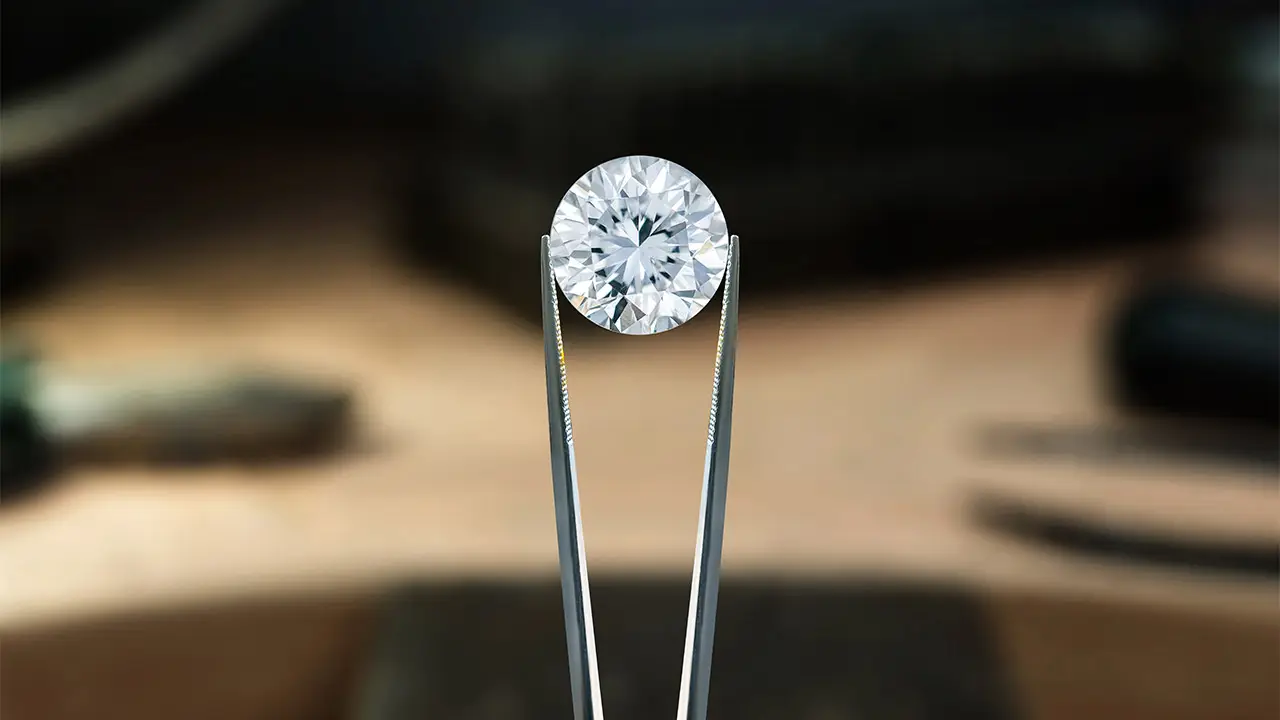
Image: A polished diamond in tweezers. (Shutterstock)