
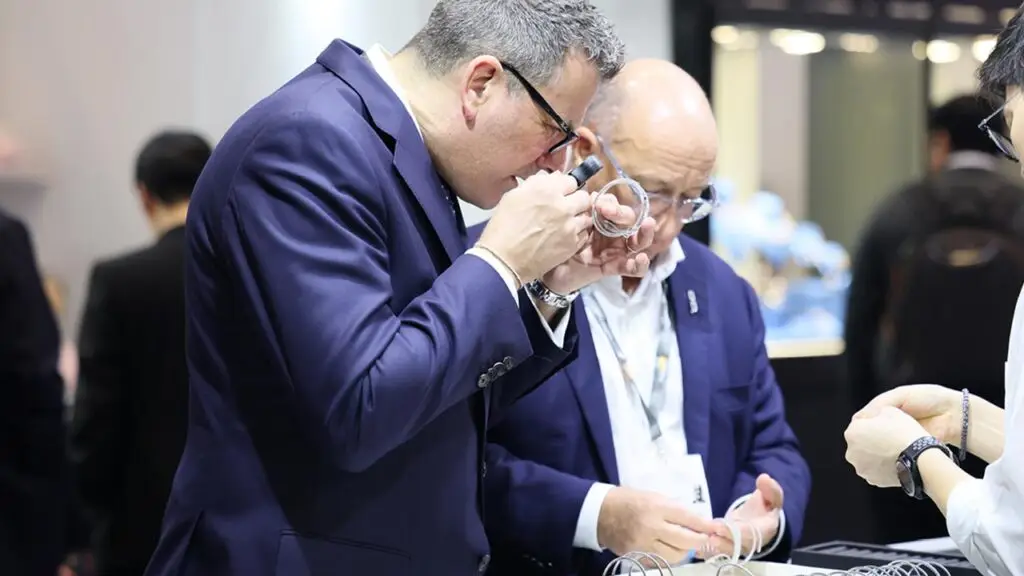
The halls of the Hong Kong shows used to generate a different sound, according to Philippe Barsamian, an Antwerp-based diamantaire with 50 years of experience in the business.
“Twenty years ago, you heard the [money-]counting machines working,” the owner of small-diamond supplier Barsamian Diamonds said at the Hong Kong International Diamond, Gem & Pearl Show earlier this month. “Today, you don’t have that anymore. I don’t think there are a lot of cash transactions. Like everywhere in the world, [authorities] became more and more strict.”
Now, transactions are by wire transfer or check. Exhibitors have regulators’ certifications on their walls. This year’s diamond halls featured booths staffed by representatives of Hong Kong’s Customs and Excise Department reminding visitors about the municipality’s cash rules.
It’s those regulations that have had a fundamental impact on the diamond trade. As of two years ago, dealers in Hong Kong can no longer buy and sell freely in paper money. This has cut off important sources of revenue and shaken the city’s status as a cash market, which was traditionally one of its main appeals. The outcome is an even tougher situation for the industry, which is also suffering from weak Chinese diamond demand.
As a result, Hong Kong is reflecting on its role in the global diamond business.
New regime
On April 1, 2023, the government implemented a new regime restricting cash transactions in precious metals and stones.
The purpose was to “enhance the regulatory regime for combating money laundering and terrorist financing in fulfillment of Hong Kong’s obligations under the Financial Action Task Force [FATF],” the Customs and Excise Department said in an email to Rapaport on March 18. The FATF is an intergovernmental group that the Group of Seven (G7) nations founded to counter corruption.
Under the rules, a dealer intending to engage in noncash transactions of HKD 120,000 (around $15,000) or more must register with the Commissioner of Customs and Excise as a “category A” company. But if the company plans to carry out cash transactions in that range, it must register under “category B,” subjecting itself to enhanced regulatory supervision of its anti-money laundering (AML) and counter-terrorist financing (CTF) conduct.
A company classified as category B takes on a number of responsibilities in return for the right to buy or sell in cash. It must carry out due diligence on its customers, including providing their identification documents.
The restrictions affect show exhibitors, too. The customs booth inside the diamond halls handed out leaflets reminding companies that they must file a cash transaction report for any cash purchase or sale above HKD 120,000 that they carry out while in Hong Kong, or the equivalent in other currencies.
Harder for business
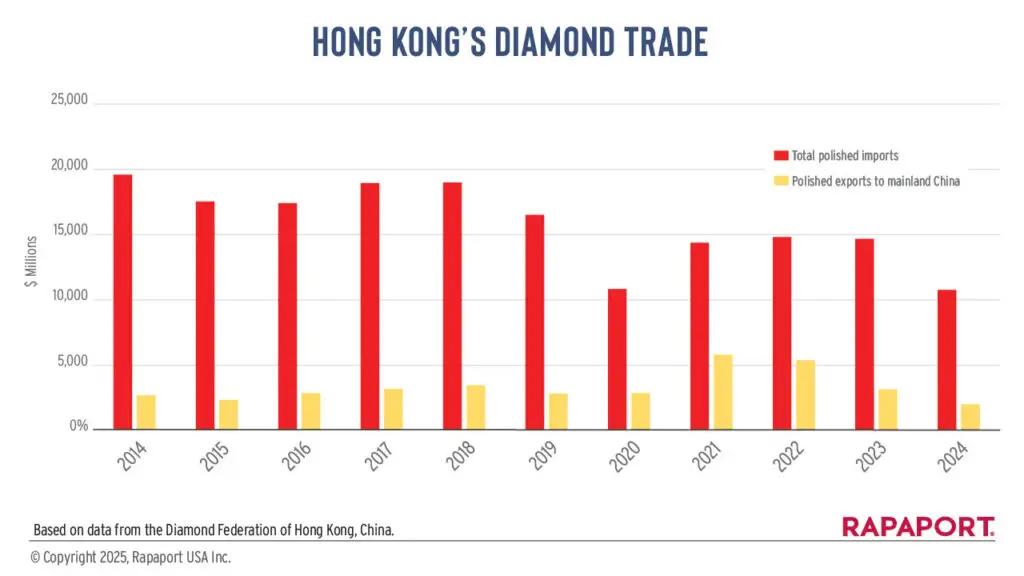
Hong Kong’s polished-diamond imports have fallen from $14.37 billion in 2021 to $10.77 billion in 2024, according to data from the Diamond Federation of Hong Kong, China.
Imports from India, the most important source of goods, have dropped each year over the past four years, from $6.59 billion in 2021 to $3.28 billion in 2024.
This mostly reflects China’s decline in diamond demand, which has cut off much of the business that used to feed Hong Kong. Hong Kong’s polished exports to the mainland slid from $5.77 billion in 2021 to $1.98 billion in 2024.
But the new cash requirements constitute one of the less-discussed factors weighing on Hong Kong’s diamond trade.
“Hong Kong had a lot of cash flowing for everybody, which suddenly stopped,” said an Indian manufacturer on condition of anonymity.
Previously, diamond manufacturers and dealers, especially in India, viewed Hong Kong as the place to sell goods for immediate cash. Local traders, in turn, would supply to informal wholesalers or retailers from China or other southeast Asian countries that often did not declare their transactions. These buyers would come to the shows, too.
While Hong Kong still focuses on outright sales — unlike the memo-centric US market — the flight from cash has taken buyers off the market.
Trading hub
Hong Kong has a rich history as a trading hub. It used to be a manufacturing center in the 1950s and 1960s — including for diamonds — before key industries such as textiles moved to mainland China in the 1980s. The territory pivoted to become a financial center, benefiting from “simple but straight regulations,” explained Lawrence Ma, president of the Diamond Federation of Hong Kong, China, and chairman of the organizing committee for the Hong Kong International Diamond, Gem & Pearl Show and the parallel Hong Kong International Jewellery Show.
Hong Kong has long been the gateway to China. Its shows have also attracted diamond and jewelry exhibitors because of the ease of shipping goods in and of transacting, as well as the low taxes and lack of import tariffs. The flight time and clock difference from India are also reasonable, and safety is relatively high.
But the new cash rules are creating a challenge for selling, especially for smaller, less organized companies that are not accustomed to documenting.
“Earlier, with no limit [on transactions], the client used to come [and] pay cash and do business at the show,” said Milind Jhaveri, director of Glint Far East, a diamond and gemstone trader based in Hong Kong. “And now with restrictions, it’s very difficult.”
Hong Kong’s role has faced a number of other challenges. The US’s tariffs on China under President Donald Trump’s first administration hit the mainland’s jewelry manufacturers, reducing demand for loose diamonds. Some of these have moved their factories to Thailand and other southeast Asian locations, which Hong Kong is still able to serve.
The national security law, which China introduced in 2020 in response to the 2019 anti-government protests, has raised uncertainty about the Chinese Communist Party’s control and the future of business in the city.
Rents have also escalated, making it hard for overseas dealers to maintain offices and families in Hong Kong. A number of Indian manufacturers have scaled back or shut down their Hong Kong premises during China’s downturn. The main beneficiary has been Dubai, which has grown its diamond industry despite the market slowdown.
Reasoning for the rules
Some cash buyers are unwilling to present their identification documents because they are not declaring their income in their home country.
However, there is also a feeling that the cash rules are bringing Hong Kong in line with the rest of the world, and that traders feel the pain now because of the quick transformation from freedom to a regulated economy.
“Will it hurt our business? [It’s] unfortunate, but yes,” said Rishi Mundra, managing director of Hong Kong-based diamond manufacturer and trader Stellar Group HK. “But I do think there’s a reason why the government wanted to implement these AML rules.”
Hong Kong still has a role in exporting goods to southeast Asian markets, which were a source of strong buyer turnout at the show. Demand in mainland China also appears to be improving, albeit slowly, according to exhibitors.
Ma at the Diamond Federation of Hong Kong, China, sees potential for the municipality to facilitate and gain from President Xi Jinping’s Belt and Road Initiative, which promotes Chinese investment around the world. Plans for the economic development of the Greater Bay Area — a region that encompasses southern China and Hong Kong — could also open opportunities.
As for diamonds, Ma believes the new rules are necessary to ensure Hong Kong’s trade doesn’t finance terrorism — a great risk with high-value stones.
“Hong Kong used to be easier, and now people just say, ‘Oh, now, [in] Hong Kong, you can’t do anything,’” Ma elaborated. “Actually, the whole world [has had similar restrictions] for a long time. Our industry realized that we [needed] the best practices.”
Hong Kong is “still a good place for you to liquidate diamonds,” Ma continued. “For someone to liquidate diamonds, first, he has to own the diamonds legally. Second, he has to import the diamonds legally. [In] Hong Kong, there are many companies, very solid companies. They [will] buy volumes of diamonds as long as the price [is] right and everything is legal.”
Main image: David Polak/Midjourney.
This article was first published in the March 2025 edition of the Rapaport Research Report.
The writer attended the Hong Kong International Diamond, Gem & Pearl Show and the Hong Kong International Jewellery Show as a guest of the Hong Kong Trade Development Council (HKTDC).