 WhatsApp
 Email
Email
 Facebook
 Twitter
 LinkedIn
In mid-December, one of Val Katayev’s retail clients received a vendor shipment with 250 separate product codes — information that would have taken nine hours to type manually into the store’s computer system. Instead, the CEO of Luxe Software and Jocalio Group told the merchant to snap a photo of the invoice and share it with him. Then Katayev’s AI software analyzed the page, digesting every name, stock-keeping unit (SKU), description, and price, and plugged it into the store’s point-of-sale system — all within six minutes.
This meant the retailer “could focus on the things that were more important” than typing in information for memo goods, Katayev explains. “Imagine you have to spend a whole day just working on one memo [shipment], only for [the products] to go back two weeks later [if they don’t sell].”
This is just one of many innovations in the world of inventory-management tools for jewelry retailers, which range from software to smart jewelry trays.
Getting with the program
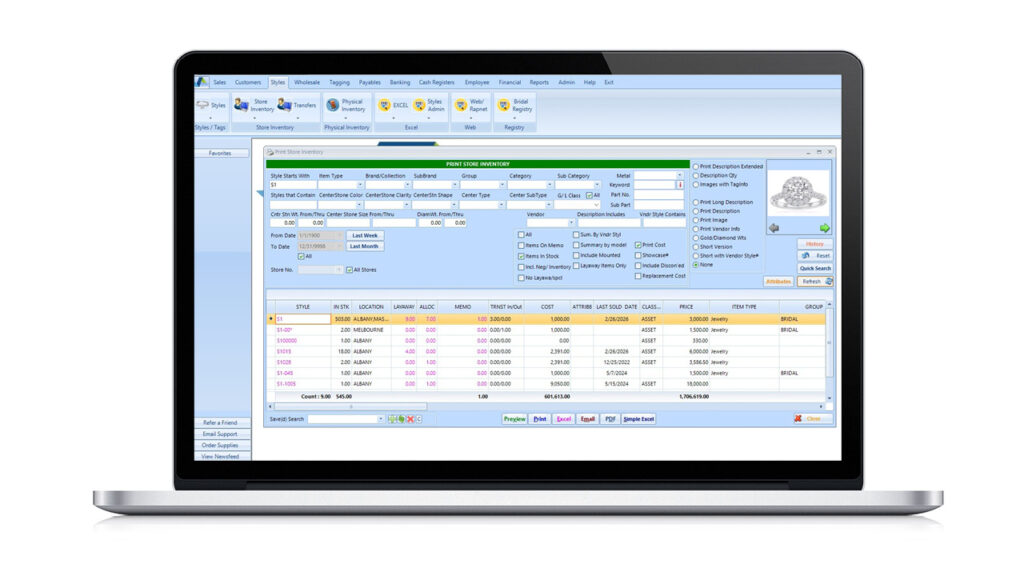
Katayev’s software is a complete operating system for jewelry stores, as opposed to separate point-of-sale, texting, and customer relationship management (CRM) products.
Luxe’s AI functionality lets users see a store’s top 30 vendors and all their product categories by hovering over different parts of the interface’s bar graphs, permitting a fast and fluid look at inventory. “You can quickly look into aged inventory [that has been sitting unsold], categories of inventory, and how much you have with each vendor,” says Katayev.
Assessing old stock is also an important feature in the new digital dashboard of 38-year-old software firm RightClick, which manages over $3 billion in industry inventory. The software integrates with RapNet and precious-metal indices — using the data to calculate the goods’ estimated market value — and updates the user on “inventory that hasn’t sold in a long time, so it can be melted,” explains Nick Milazzo, the company’s vice president of operations.
Technology aside, one of the firm’s biggest assets is its team, which Milazzo says is in “constant communication” with clients. Team members show them ways of leveraging the data to improve their business, and make “suggestions about what we offer as far as inventory management.”
Wish-list items that these companies hope to make a reality include systems that seamlessly “speak” to each other, and integration with security-camera footage. The latter would allow store owners to observe exactly who looked at particular products, and even outline demographic information.
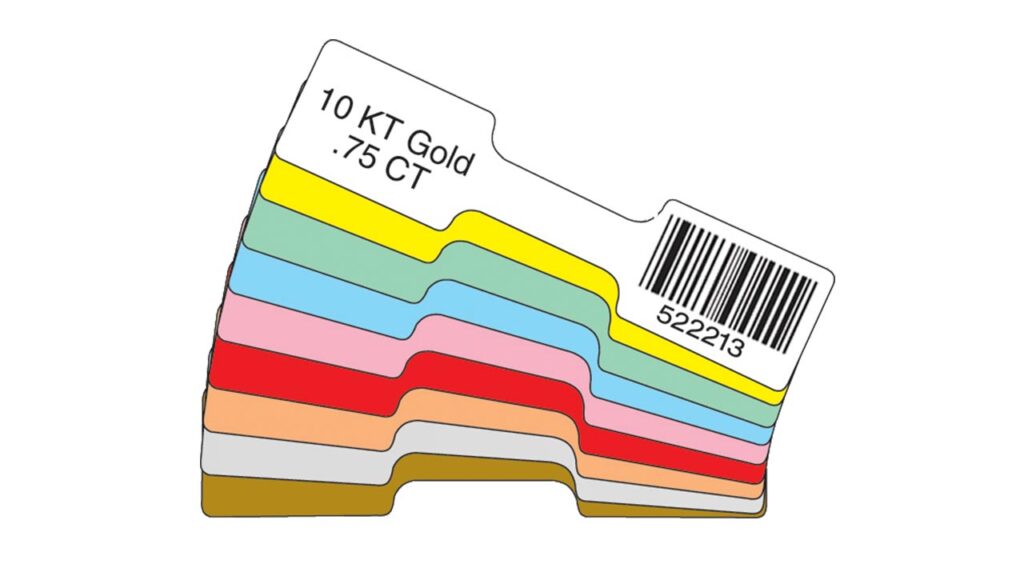
The trusty barcode
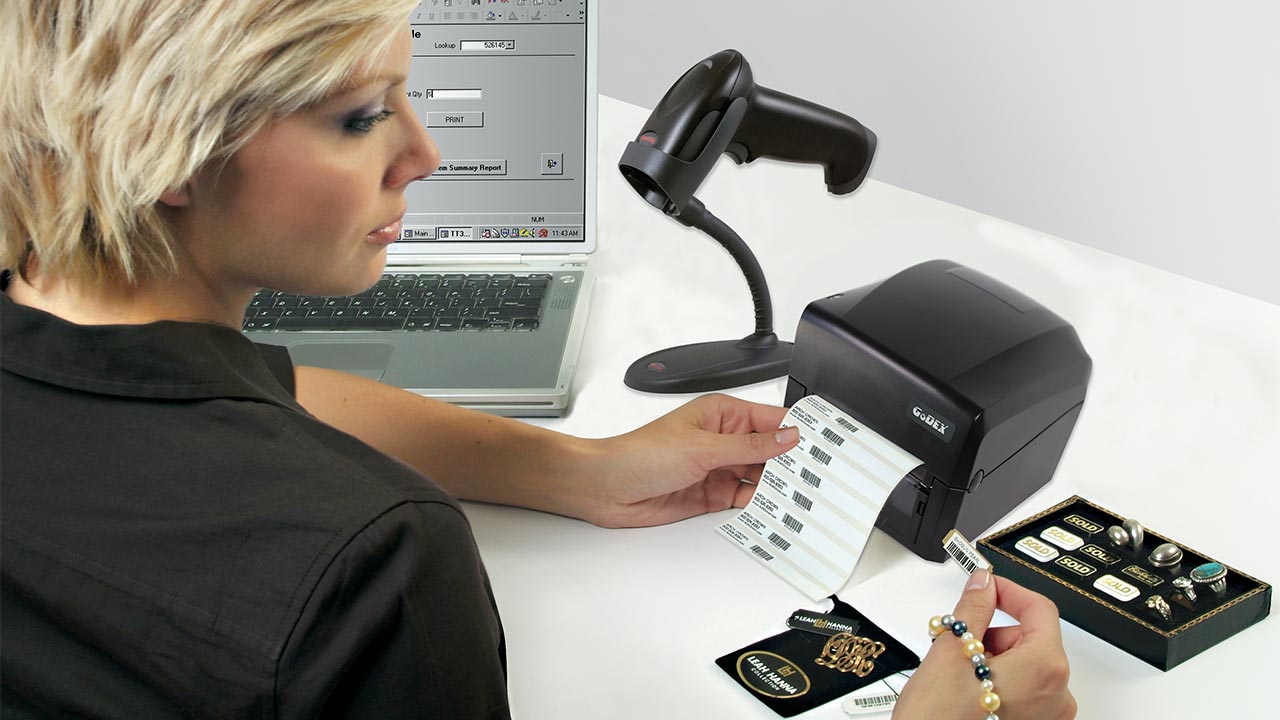
Barcoded tags on jewelry are a basic first line of defense in the inventory-management toolbox. They have largely replaced handwritten price tags, according to Craig Meadow, president of Arch Crown, which has been making product tags for 119 years and includes barcodes among its offerings.
“[Barcodes are] an incredibly essential tool for a jeweler,” he says; they solve issues such as whether people can decipher the handwriting on a regular tag — which is key in an industry where prices can vary so widely.
He compares the situation to Campbell’s soup cans: “You go to the store, and for every can of tomato soup, they all have the exact same barcode. In a jewelry situation, with diamonds, every piece — no matter whether it looks the same or not — is going to have a different price and therefore a different barcode. [It’s] hugely important to be able to identify each piece and understand if a number is a six or an eight. It’s a big deal when you’re talking about precious stones and precious metal.”
Upgrading to RFID
The next-generation barcode is the radio frequency identification (RFID) tag, which is superior to regular barcodes and QR codes because it allows multiple scans from up to 300 feet away. While the technology has been around for some time, integrating RFID tags into jewelry trays, showcases, repair benches, and safes can give them a significant upgrade.
“There’s a whole ecosystem of RFID in jewelry logistics,” explains Paul A. Whitney, chief operating officer and vice president of AsReader, which makes code-reader components and batteries.
One company employing RFID is WJewel Ishal, an all-in-one, jewelry-only point-of-sale system that can integrate with labs and shipping companies. Besides an AI feature that can aid in appraisals, product descriptions, and even report-writing if desired, what makes WJewel competitive is its large staff of programmers who can tailor the system to clients’ needs, and RFID solutions that let retailers scan large numbers of products in trays. The latter enables store managers to monitor exact product locations within stores — and if an RFID-tagged item leaves the premises, the staff can see in the system that it’s missing.
“A lot of people would love to have RFID used as an alarm system, but it doesn’t do that,” acknowledges company president Javid Ishal. “Somebody even asked me about a briefcase that if somebody snatches it, it will start beeping.”
Smart and portable
The technology to make that happen isn’t there yet, but the RFID advancements that do exist are impressive. Enter the smart jewelry trays that AsReader helped develop with inventory-management firm PT Next — which provides RFID systems for the jewelry industry, including its Argos platform — and Pac Team Group, a display, packaging and fixture manufacturer. The portable Argos trays feature built-in RFID tech that can charge overnight for an entire day’s worth of easy trackability via PT Next software. Any tagged items on the tray are instantly visible to management in the system, which both improves product security and provides next-level insights into sales.
“As soon as somebody pulls a ring out of or places a product on a tray, you know exactly what SKUs they are,” explains Clemente Borgogni, PT Next’s technical program manager. “The benefit of the tray is that a lot of boutiques these days are moving to more lounge-style seating [when presenting jewelry to customers], so furniture gets moved around, [and] they do events, [so] it’s beneficial for them to have something that’s less fixed in place.”
Jewelers can also link the RFID trays to enterprise resource planning (ERP) software to help improve business by assessing sales rates, even across different stores. “So maybe a product does really well in one boutique but has a much bigger conversion rate in another,” elaborates Borgogni. “[The retailer] may want to investigate why.”
In fact, at one client’s high-jewelry event, the trays exposed a pain point in one of four salesrooms. Three rooms had consistently high conversion rates and high-end lighting, but the fourth had off-the-shelf, commercial-grade lights from a hardware store. Once the client installed better-quality lighting in the fourth room, the conversion rate spiked.
Considering that the most common challenges in inventory management stem from human error — such as incorrect or missing product descriptions, or lack of images in a database — AI and other tech bring a lot to the table. That said, there are things AI can’t figure out on its own, like exact carat weights and metal purity — so people are still a crucial part of the retail picture.
Main image: Arch Crown barcode labels. (Arch Crown)