 WhatsApp
 Email
Email
 Facebook
 Twitter
 LinkedIn
In the world of Van Cleef & Arpels, lions don’t bite and flowers never wilt. Since its 1906 founding in Paris, the maison has been making jewelry distinguished for its appealing elegance. Take the house’s clips danseuses, or Dancer clips — graceful twirling and leaping ballerinas with rose-cut diamond faces and fanciful tutus, debuting around 1942. Then there is the 1950 Baroda necklace with its pretty yet commanding fringe of teardrop-shaped emeralds and diamond pavé, and the exceptional Walska brooch from 1971: a phoenix with blazing feathers of yellow diamonds, white diamonds, and emeralds, featuring a 96.62-carat yellow-diamond briolette dangling from its golden beak. Each of these jewels is a thing of beauty.
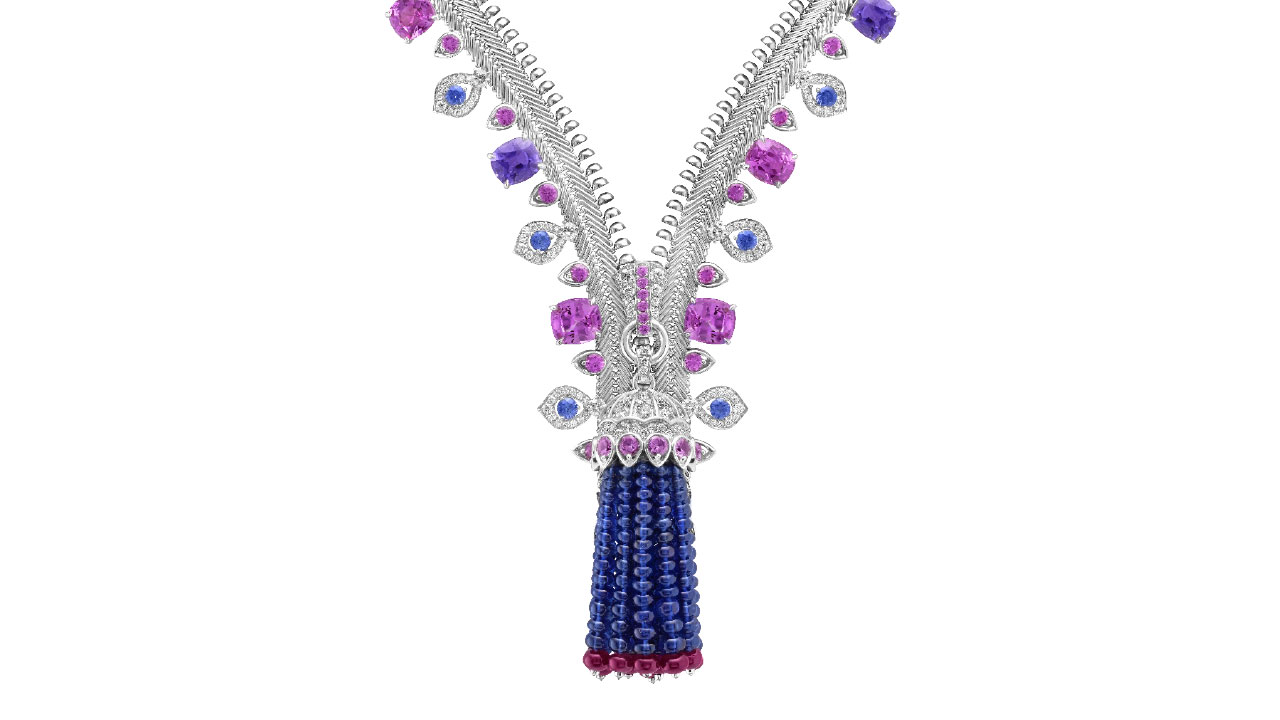
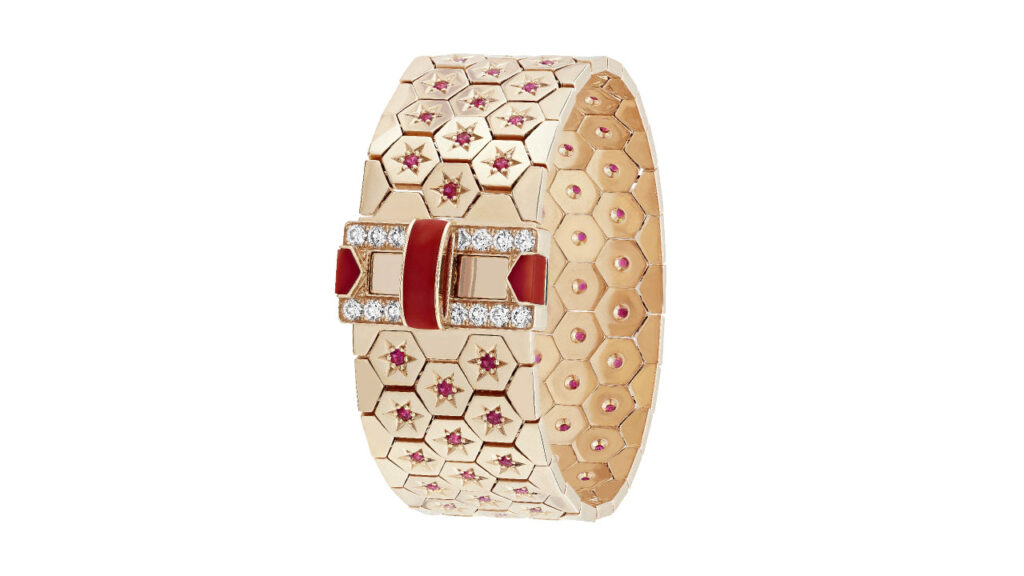
Then, too, there is the savoir faire that wends its way through many Van Cleef & Arpels creations. Consider the innovative Mystery-set jewelry it patented in 1933 — including lush floral brooches and ear clips — and the inscrutably engineered Zip necklace that debuted in 1951, a jeweler’s construction of hardware-as-décor. Still relevant are the gold honeycomb Ludo bracelet from 1934 and the Cadenas padlock watch of 1935, while the striking nécessaires and minaudières of the 1920s and ’30s gave women the independence to carry their cigarettes and other personal things when out in public — an idea that seems quaint now, but was unthinkable a century ago. Another classic is the 1941 Spirit of Beauty clip that once belonged to heiress Barbara Hutton, depicting a winged fairy. Is it any wonder that Van Cleef & Arpels became the “official purveyor to the principality” of Monaco for Grace Kelly’s 1956 marriage to Prince Rainier?
Famous names
Van Cleef & Arpels goes back decades with society and Hollywood. An outstanding example is actress Marlene Dietrich and the oval-shaped ruby and diamond Jarretière bracelet that Louis Arpels made for her in 1937; she wore it to great acclaim in Alfred Hitchcock’s 1950 film Stage Fright. When she died in 1992, the bracelet sold at auction that same year for $990,000. The buyer was Anne Eisenhower, granddaughter of the 34th US president. Just over 30 years later, it was the star of Eisenhower’s 2023 estate auction at Christie’s, selling for more than $4.5 million.
Last March, a gold and diamond Zip necklace-and-bracelet combination from the 1950s went for $482,600 at Sotheby’s. The Walska briolette reached a staggering $10.6 million at the same auction house in 2013.
Mystery-set jewelry remains especially strong on the auction market. A ruby and emerald Mystery-set flower brooch went for $1.2 million at Christie’s in December 2022. The duchess of Windsor’s bespoke 1936 ruby and diamond holly leaf brooch sold for $806,000 at Sotheby’s in 1987, almost 40 years ago. And this past June, Christie’s sold nine lots of Mystery-set jewelry from the estate of philanthropist Lucille Coleman; the combined total was over $4.5 million.
A special charm
A dedicated collector base seeks out the ballerina pins, especially those from the 1940s and ’50s, with sales averaging in the mid- to upper $200,000 range. Notable is the sumptuous 1942 pin that the house based on 18th-century French dancer Marie Camargo, who was known simply as La Camargo. With her pear-shaped diamond face, ruby headpiece, and multi-tiered diamond dress with swags of rubies and emeralds, La Camargo is forever young. When the brooch sold in 2009 at Christie’s, its $422,500 price set a new record. Four years on, another Camargo ballerina showed up, this time with a skirt of Mystery-set rubies. The combination was irresistible: At Sotheby’s in 2013, it closed at $557,000.
Any summary of Van Cleef & Arpels has to include the evergreen Alhambra. Whether vintage or new, in hardstone or in diamond pavé, these four-lobed charms always sell. They may or may not have magical powers, but as Jacques Arpels once said, “To be lucky, you must believe in luck.”
The dealer’s take
Russell Zelenetz, co-owner of New York jeweler Stephen Russell, shares his enthusiasm for the maison’s Art Deco masterpieces.

Van Cleef & Arpels is a leader in workmanship and design. It was also a great innovator of pieces that are considered iconic today, such as the Zip necklace, the Cadenas watch, the Ludo bracelet, and Mystery-set jewelry.
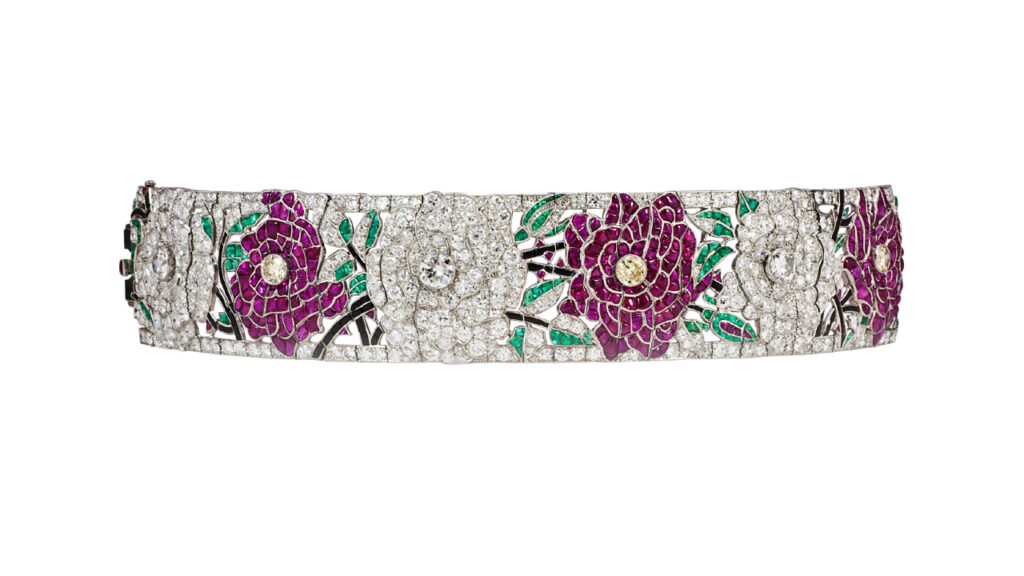
For my preferred periods of Van Cleef, I would have to say Art Deco, followed closely by the 1950s and ’60s, especially all those Georges Lenfant jewels with gold and diamonds. We were fortunate to have owned the Deco ruby and diamond Fleurs enlacées, roses rouges et blanches bracelet that won the Grand Prix award at the 1925 Art Deco exhibition. Today, it’s part of the Van Cleef & Arpels heritage collection. In my opinion, it’s one of the most iconic bracelets of the Art Deco period. If you like art, how do you not love that?
Our collection is finely curated. If it’s Art Deco, then we want to make sure we have the best of Art Deco jewelry. If it’s ’50s, then a great piece from the ’50s. Our clients have come to expect the finest, such as Lenfant jewelry from the ’60s, and definitely the more unusual Art Deco pieces. For example, we had an important platinum and diamond sautoir from 1928, which could be converted into a number of pieces. Another piece we had, which has since been in a few Van Cleef & Arpels exhibitions, was the 1924 sapphire and diamond Cornucopia bracelet.
Van Cleef & Arpels is highly sought-after in the secondary market. We are aggressively seeking these older and iconic jewels. Jewelry that is not mass-produced is what makes the house distinctive.
Main image: An example of the iconic Zip necklace. (Van Cleef & Arpels)