 WhatsApp
 Email
Email
 Facebook
 Twitter
 LinkedIn

Age becomes Tiffany & Co. In a roll call of American jewelers, Tiffany is first in its class for many reasons. One is its longevity; its 1837 founding makes it the oldest American jeweler still in business. Another is its commitment to a diversity of designers — the “& Co.” of the company name. Those designers include Paulding Farnham and Louis Comfort Tiffany, who established the brand’s bona fides in the late 19th century in the US and abroad; Jean Schlumberger, surely the most important hire under Walter Hoving’s chairmanship in 1956; innovative creators Donald Claflin, Aldo Cipullo and Angela Cummings in the 1960s; Elsa Peretti, who pioneered American minimalism in jewelry during the mid-1970s; and 1979 addition Paloma Picasso, who became known for combining saturated color with structural precision.
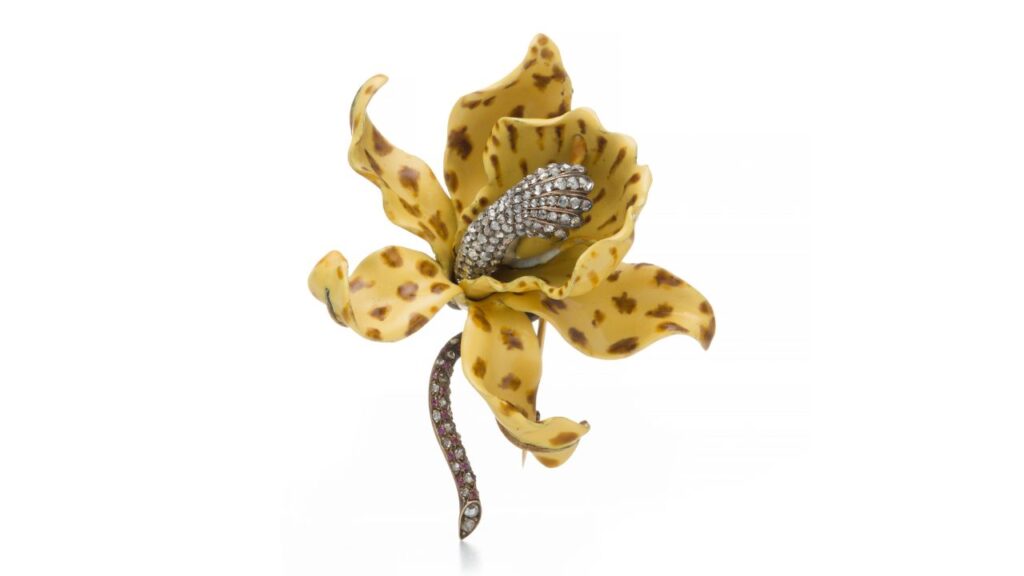
Thanks to these designers and the creative freedom the house granted them, their lasting and identifiable contributions to great American jewelry are bountiful. We look to Farnham for his lifelike orchid brooches, and to Louis Comfort Tiffany for astounding Art Nouveau necklaces, especially his delicate lavalieres. Schlumberger produced classics like his paillonné-enamel and gold bangles and the Sixteen Stone wedding band, but also dazzling creations such as the multi-stone Jasmin necklace and his La Méduse brooch — a glowing moonstone-and-sapphire jellyfish. Claflin had his many whimsical collections of figural brooches, as well as his tanzanite Crisscross ring, and Peretti’s Bone cuff and Diamonds by the Yard are enduring icons of the house. The list goes on.
(The Tiffany Archives)
Pearl and flower power
Further proof of Tiffany’s enduring strength is amply apparent on the secondary market, whether at auction or among dealers.
Pearls are often the bedrock of a heritage house and the staple of many a collector. That only adds luster to last year’s sale of a necklace with 73 natural pearls and a marquise-diamond clasp; it went for $672,000 at Sotheby’s in December, making it one of the priciest Tiffany necklaces to sell at auction.
Flowers continually lead big sales for Tiffany. Any orchid design by Farnham is newsworthy — including his circa-1890 brooch depicting the Odontoglossum maculatum species, which sold for $327,600 at Christie’s in 2022. In 2015, a Schlumberger Jasmin necklace went for $725,000 at Christie’s. Also notable was the Tiffany Art Deco Moonlight Rose bracelet from circa 1930 at the June 2023 Christie’s sale of Anne Eisenhower’s jewels. The all-American Tiffany-Eisenhower connection led to a closing bid of $604,800.
The elusive Medusa
In jewelry circles, there has long been a swirl of mystery surrounding Louis Comfort Tiffany’s Medusa pendant necklace. This otherworldly creature is one of his earliest jewelry designs, with a circa date of 1904, and was part of the Louisiana Purchase Exposition in St. Louis that same year. Sometime thereafter, art patron Henry Walters purchased the piece, and it remained in the Walters family until 1943, when it came up for auction. Afterward, the Medusa seemingly went missing; it was quietly classified as “whereabouts unknown.”
Nearly 80 years later, it resurfaced as part of the Schocken family collection at Sotheby’s. Its story proved irresistible to bidders at the 2021 auction, and in the end, Tiffany raised the winning paddle for a staggering $3.7 million. Today, the necklace is on display at Tiffany’s Fifth Avenue flagship in Manhattan — proof that you can go home again.
The dealer’s take
Ben Macklowe, president of Macklowe Gallery, reflects on Tiffany’s “radical” path to success.

I love that Tiffany & Co. is a uniquely American brand, one that really reflects our open society. This is jewelry that expresses individuality, because from the outset, Tiffany pushed its designers forward, allowing them each their own aesthetic stamp and making them part of the story, rather than stamping everything only “Tiffany & Co.” Early on, thanks to Edward C. Moore and Paulding Farnham, Tiffany achieved international acclaim. It’s hard to imagine, from 2025, how radical it was for them to succeed on the international stage, but in the late 1800s, all “good taste” was European taste.
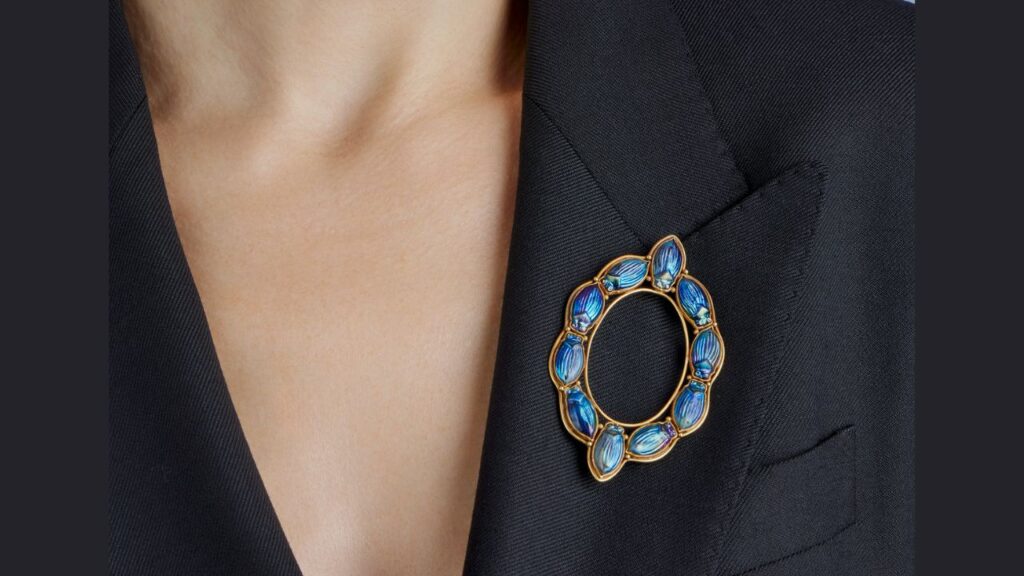
Tiffany has endured for nearly 200 years by being relentlessly focused on quality and innovation, and allowing its designers to explore various aesthetic and material movements. At Macklowe Gallery, we consider the jewelry that Louis Comfort Tiffany made between 1902 and 1919 a lodestar, but we’re just as happy buying pieces by Angela Cummings, whose beautiful but casual wearability appeals to today’s customer.
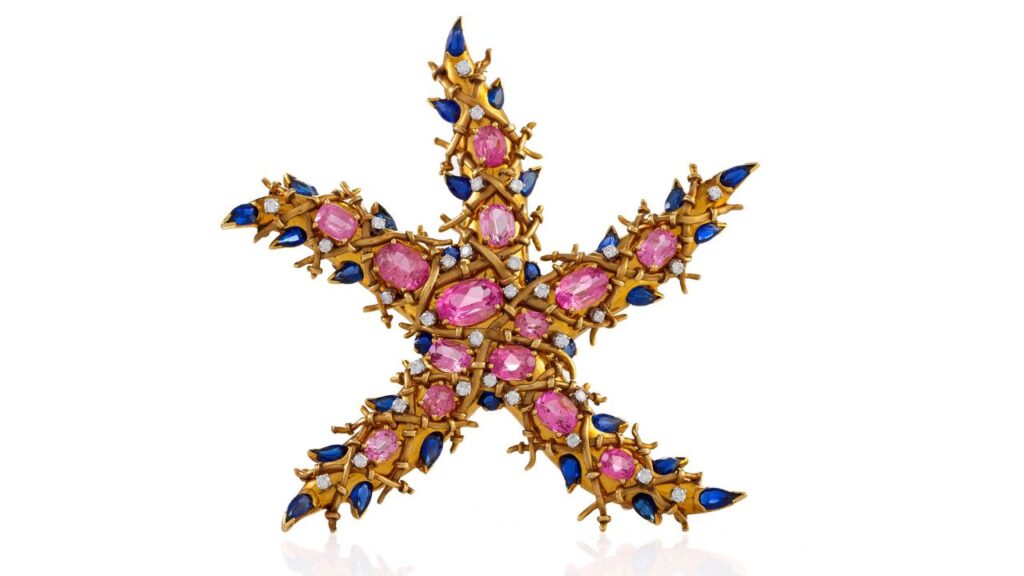
The most interesting outlier, if you will, is Jean Schlumberger. His jewelry is not immediately accessible aesthetically; it requires a leap of faith. Like the French Surrealists he knew in Paris, Schlumberger created jewelry that could be fantastical but also somewhat menacing. The jewelry he was proudest of represents dreams and nightmares. Consider his starfish brooch from 1945, with those spiky pink tourmalines. It’s daring, a little bit dangerous, the femme fatale expressed in jewelry. We’ve sold a lot of Schlumberger over the years, including some to Tiffany & Co. for its archive, like that starfish brooch.
The most fun thing about collecting Tiffany is that you can focus on different periods and designers, from Elsa Peretti’s Diamonds by the Yard to Donald Claflin’s nursery creatures. For me, the fact that Tiffany contains multitudes is what makes it the brand I love so much.
Main image: Hedges and Flowers necklace by Jean Schlumberger for Tiffany & Co., circa 1960, with yellow sapphires, turquoise, and diamonds. (The Tiffany Archives)