
All three presidential candidates were given the opportunity to comment and state their positions in this article.
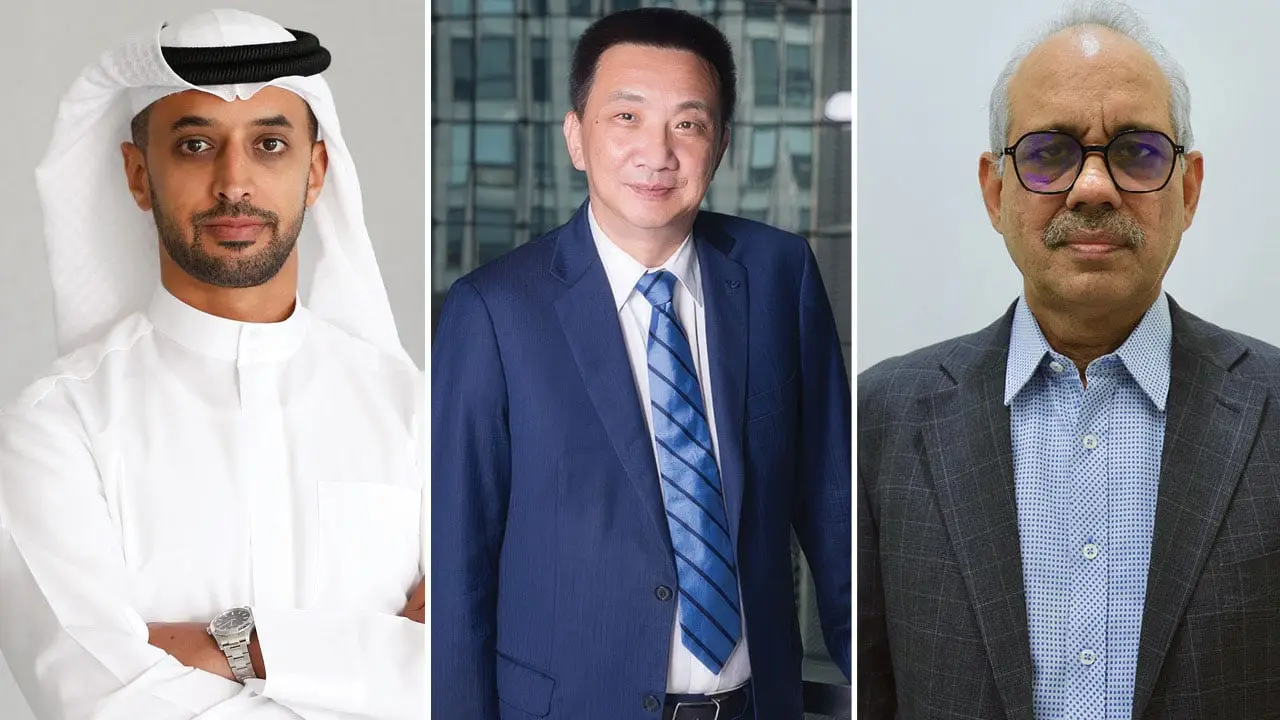
Three candidates from India, China and the United Arab Emirates (UAE) are running for president of the World Federation of Diamond Bourses (WFDB) in an election that reveals contrasting approaches to the organization and the industry.
Bharat Diamond Bourse (BDB) vice president Mehul Shah, Shanghai Diamond Exchange (SDE) president Lin Qiang, and Dubai Diamond Exchange (DDE) chairman Ahmed Bin Sulayem have put their names forward ahead of next Monday’s election, which will take place during the World Diamond Congress in Singapore.
Israel’s Yoram Dvash is standing down after completing the maximum two three-year terms.
The election for his successor, understood to be the first contested battle for the position in many years, reflects power shifts in the trade as well as open questions about the WFDB’s character and future.
It comes at a time of soul-searching for the organization following fundamental changes to the sector – most significantly the challenge from lab-grown – and the weakening role of the 26 bourses it represents, which are no longer the practical necessity they were two decades ago.
Influence has swung to other organizations, such as the World Diamond Council (WDC). Last year, the Israel Diamond Exchange (IDE), one of the WFDB’s oldest members, withdrew from the federation. It is now in the process of returning, Dvash said.
‘Reacting to events’
The situation has revealed a deep split around how the industry’s leadership should view these issues and whether experience or youth should be in charge.
Bin Sulayem, who has diverse interests in the Dubai commodities market from gold to coffee, has gathered a following of younger industry members who believe the WFDB needs fresh faces in charge.
David Troostwyk, until recently the president of the London Diamond Bourse (LDB), is running as vice president on an informal slate with Bin Sulayem, while Molefi Letsiki, president of the Diamond Gem & Jewellery Association of Southern Africa (DGJASA), is vying to be treasurer. All three are under 50 and are members of the Young Diamantaires, a group founded at the World Diamond Congress 10 years ago.
The WFDB’s current approach is one of “reacting to events as they come and preserving what exists,” Trootswyk wrote last week in an article he posted on LinkedIn. “There is nothing dishonorable about this, but it leads gradually, and then suddenly, to an organization of diminishing relevance.”
Members must now choose between “the long road the WFDB has walked for the last 80 years, or something new, refreshing and modern, ready to serve its members, defend the trade, and elevate the natural-diamond category that is crying out for exactly this kind of leadership.”
“With modernization and reform, we can bring back the importance of the WFDB and the relevance of it,” Troostwyk said in an interview with Rapaport News on Monday.
‘Learn the ropes first’
Shah, who has been BDB vice president for 16 years and WFDB treasurer-general for a decade, also wants to strengthen the federation, add new members, and return the “glory” that he remembers from his earlier years in the organization.
However, he believes in an apprenticeship model whereby less experienced people learn the ropes in more junior roles first.
“Experience matters a lot,” he said. “Youngsters I welcome, but youngsters have to get some more experience under the seniors. When your son joins the business, he has to work under you [and get] enough experience, and then he should think of taking the chair.”
World Fed, not World Cup
Qiang, also a candidate with 40 years in the industry, focused on his desire to make the WFDB stronger and more united and seek new ways of boosting demand for diamonds. The SDE’s June 5 letter to the WFDB nominating Qiang emphasized his role in expanding the bourse over the 26 years of its existence and his work to promote diamonds in China.
“We are not forming a football team,” Qiang commented. “Whoever will be [president], I don’t think the age will be the main issue. For [the] team [under him], of course, we need new blood, new faces.”
Whether the president himself “is young enough or old enough, I don’t think that’s the problem,” he continued.
It’s a good sign that multiple people are running for president this time, he added. “All the leaders from different bourses think it’s a critical moment, and the WFDB will play an important role [handling] all the challenges in the industry,” he said. “So that’s why this time [the contest] is very active. I don’t think it’s a competition. I’m glad to see that more and more people wish to take up the responsibility [by running for positions].”
Dubai factor
Another complexity of the election is that it pits the industry’s fastest-growing major trading center, Dubai, against two countries that have much to protect: India and China.
Furthermore, Belgium’s diamond industry, which has a strong relationship with China, has had a degree of rivalry with Dubai, which has taken market share in the trading sector.
A source familiar with the WFDB, who wished to remain anonymous, saw this election as a factional battle for control and believed Qiang had the support of Antwerp’s bourses.
“Antwerp will respect the choice of any new president [and] will work together with the new elected team in the best interests of all the members of the diamond bourses in the world,” said Raphael Adler, president of the Federation of Belgian Diamond Bourses, who cautioned that he was not the president of any of Antwerp’s four exchanges and couldn’t vote. “It is only in this spirit of unity that our trade can move forward and face future challenges.”
Troostwyk also stressed it was “not one hub versus the rest.”
Lab growth
Trootswyk, Shah and Qiang all said they saw the WFDB as a natural-diamond organization, even if its membership contained companies that sold lab-grown.
But Bin Sulayem – whose experience in the natural trade includes pioneering Dubai’s trading hub and chairing the Kimberley Process (KP) for a record three terms – has been active in expanding Dubai’s diamond sector into synthetics, for example by hosting the Lab-Grown Symposium in the emirate in 2023 and 2025. The fact that, as CEO of the Dubai Multi Commodities Centre (DMCC), he is involved in much more than just natural diamonds has become yet another issue in the election.
Asked whether the industry’s establishment had failed to stave off the threat from synthetics, Shah at the BDB responded: “India has never hosted a lab-grown diamond conference. [The] BDB…banned lab-grown diamonds for many years.” (It lifted the ban in 2020 following improvements to detection.)
Shah, who is chairperson of Mumbai-based diamond exporter Star Brillian, also emphasized his own status as a full-time diamantaire who knows the “in[s] and outs” and “terminology” of the diamond business, having spent 46 years in the trade.
Bin Sulayem declined to comment until after the election other than to say the WFDB “is in good hands no matter which direction they agree on taking forward.”
Simple majority
Each bourse has one vote for president, irrespective of size. According to a March 2024 rule document, the president’s and the vice president’s service is limited to two consecutive three-year terms, and a simple majority of votes is required in contested elections. WFDB secretary-general Rony Unterman had not responded to Rapaport News’ questions at press time.
The congress, which takes place every three years, also sees the WFDB and the International Diamond Manufacturers Association (IDMA) join together for the conference – a partnership that did not happen in 2023.
Other items on this year’s agenda include voting for Qatar to join the WFDB. This follows Botswana and Angola becoming “nation affiliated” members of the federation.
Image (left to right): Ahmed Bin Sulayem, Lin Qiang and Mehul Shah. (DMCC, Shanghai Diamond Exchange, Bharat Diamond Bourse)