
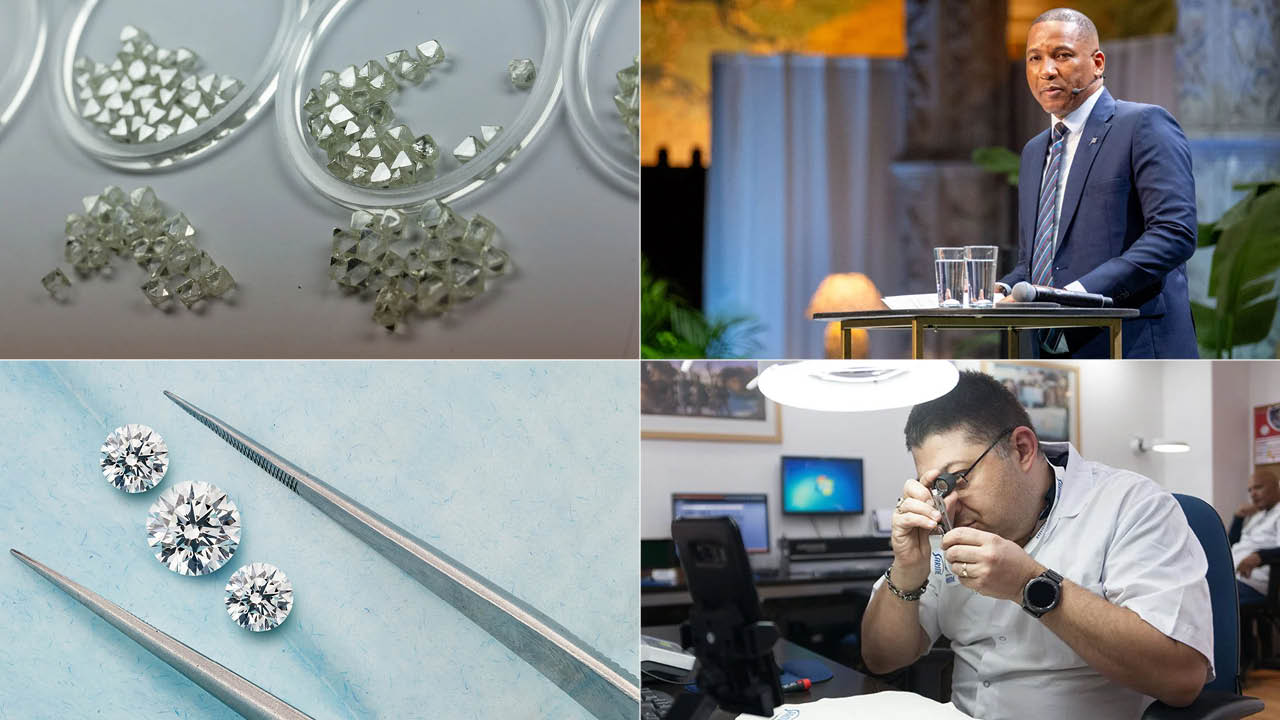
What are some of the most interesting quotes experts expressed during 2025? Rapaport News pulled up some of the most in-depth, interesting and inspirational quotes from the diamond industry this year.
Here are this year’s top quotes:
Natural diamonds:
Sergey Takhiev, Alrosa’s head of corporate finance, on the company’s forecast for diamond supply and demand:
“The decline in production observed in recent years due to the natural depletion of the global resource base and the growing capacity of the luxury goods and jewelry market, in particular, are factors that will ensure growth in prices for diamond products in the long term.”
Sandrine Conseiller, CEO of De Beers Brands, on the miner’s joint program with the Gem & Jewellery Export Promotion Council (GJEPC) to support India’s natural-diamond trade:
“India’s diamond growth story is quite remarkable, and it has now become the second-largest market in the world for retail sales of diamond jewelry. However, with its vibrant economy, growing young population and large number of leading diamond businesses, India still holds a wealth of untapped potential.”
Antwerp World Diamond Centre (AWDC) CEO Karen Rentmeesters on the diamond-industry slump, after asking the Belgian government to help improve the operating environment in the country:
“The diamond industry is experiencing a severe global crisis. Internationally, the sector is caught in a perfect storm, causing declining figures across all trading hubs. Weak consumer markets and competition from synthetic diamonds are leading to historically low demand for natural diamonds, resulting in rock-bottom prices. These factors inevitably affect Antwerp.”
Sandrine Conseiller, De Beers Brands CEO, on the introduction of the company’s new verification device, DiamondProof, at select retail stores:
“Natural diamonds and lab-grown diamonds are two fundamentally different products. Consumers should be able to have confidence in such a meaningful purchase.”
Joan Hilson, chief financial and operating officer at Signet, on the jeweler’s strategy to bring its sourcing under one roof:
“We are fully centralizing our sourcing practices to leverage the scale of our buying power and deep market expertise. The newly chartered Signet diamond-sourcing team will negotiate pricing across our portfolio and improve our agility as a large buyer in the marketplace for both loose diamonds and finished diamond jewelry.”
De Beers on its plan to launch its highest category-marketing spend in 10 years to promote natural diamonds and drive demand:
“There is no better time than the present to take the actions that will accelerate improvements to our industry. The difficulties we have faced have been testing, but they have also challenged us to be better, to work harder, and to tell our story more widely.”
Botswana President Duma Boko on manufacturing all diamonds from the country’s mines locally:
“We are moving to a point where no mineral will leave this country without being processed. No diamond will leave this country raw — all will be cut and polished here.” (Quoted in The Projects Magazine.)
An unnamed source on a proposed revision of the Kimberley Process (KP) definition of “conflict diamond” from the African Diamond Producers Association (ADPA):
“If they’re armed and they act in a way to use diamonds to continue their nefarious activities, they will be in the definition, even if they are not fighting the government”
GJEPC vice chairman Shaunak Parikh on the Luanda Accord, an agreement producing countries and organizations signed to create a collective marketing fund for natural diamonds:
“The Luanda Accord marks a fundamental shift in the way our industry comes together to protect and promote the future of natural diamonds. A unified global marketing push is no longer optional — it’s essential.”
A diamond dealer on a Natural Diamond Council (NDC) marketing campaign in New York:
“I don’t understand why the word diamond is used for synthetically produced tetrahedral carbons. You can’t sell wine that you’ve added bubbles to as champagne. It’s the same with diamonds.”
A De Beers sightholder on the miner’s August sight:
“The mood on the sight floor is dead. There’s no real hunger or appetite for rough.”
Lab-grown:
David Meleski, chairman of the Responsible Jewellery Council (RJC), on its new guidelines for members when working with lab-grown diamonds:
“Our mission at RJC is to promote responsible business practices from laboratory or mine to retail.”
De Beers CEO Al Cook on the company’s intention to shut its lab-grown diamond jewelry business, Lightbox:
“The planned closure of Lightbox reflects our commitment to natural diamonds. We are also excited at the growing commercial potential for synthetic diamonds in the technology and industrial space.”
AWDC CEO Karen Rentmeesters on launching a new marketing campaign for natural diamonds that centers around a gumball machine full of synthetics, to highlight the falling value of lab-grown:
“The association that I have, and that I think many people have with things that are in gumball machines is, it’s not about chewing gum. It’s about cheap goods. I remember, as a kid, being excited to get something out of the machine, and then it was a huge disappointment. Within minutes it broke, or I would chuck it away because it was so unimpressive.”
HRD Antwerp statement on no longer issuing certificates for loose lab-grown diamonds:
“By becoming the first diamond lab in the world to take an explicit and exclusive stance in favor of natural diamonds, HRD Antwerp is sending a strong signal. A clear distinction between natural and synthetic diamonds is essential to strengthen consumer trust and help safeguard the future of natural diamonds.”
Mehul Vaghani, founder and CEO of Kira Jewels’ US business, on the company’s decision to nearly double its production of lab-grown diamonds:
“We’re not just shaping the future of lab-grown diamonds, we’re working to make that future accessible to everyone. As the industry grows, what sets us apart is our commitment to keeping a reliable, certified inventory available at scale.”
Ajoy Chawla, CEO of Titan’s jewelry division, on India’s lab-grown diamond sector and its expansion:
“From the diamond grower’s perspective, [the] US market has been rather sluggish. So they have to look elsewhere, and India is possibly the most convenient market, because other markets are not really going anywhere. China is also not going anywhere with LGD [lab-grown diamonds]. So we can expect increased investments in LGD.”
Tariffs:
The National Retail Federation’s (NRF) chief economist Jack Kleinhenz on consumers stocking up on goods in March prior on the implementation of tariffs.
“There is no question that the consumer is not feeling great given the confusion of policy announcements from Washington. On-again, off-again rising tariffs and resulting turmoil in the stock market and world economy are clearly impacting consumer concerns about higher prices and future consumer spending growth.”
Watches of Switzerland on US spending patterns following the initial tariff announcement:
“In the US, following a temporary period of consumer uncertainty in response to the initial tariff announcement, we have seen a return to normalized trading patterns.”
Sarine Technologies’ on posting a net loss in the first quarter as companies paused a large portion of diamond-scanning activities amid concerns over tariffs:
“The import tariffs implemented by the US administration…have caused high levels of uncertainty across the supply chain. As the tariffs dynamics are in a state of flux, there was an initial burst of importation activity to beat the tariffs, followed by a wait-and-see attitude.”
GJEPC chair Kirit Bhansali on the increase in tariffs of Indian imports into the US to 50%:
“It’s a very black day for the gem and jewelry sector.”
Sanctions:
Russian bank BCS reflecting on weakness in the diamond market and ongoing sanctions against Russia:
“[Alrosa] is caught in a ‘perfect storm’: an overvalued ruble, an industry crisis, and sanctions pressure.”
Image: (Alrosa/AWDC/Shutterstock/Sarine Technologies)