
Dan Mano met Martin Rapaport for the first time in the lobby of the Setai in Jaffa, a quietly elegant hotel on the southern tip of Tel Aviv. It was early 2025, and Mano – a product and technology executive with two decades in ad-tech and gaming – knew almost nothing about diamonds. He had bought jewelry a handful of times, including an engagement ring with an emerald-cut diamond, but that was about the extent of it. The opportunity to apply for CEO at Rapaport had come up. He had asked a friend in the trade, his go-to source for all things diamond, who this person was. The response: This is someone you need to meet.
“This company is very complex,” he says now. “We have different businesses that are very different in their nature. A publication is completely different from an auction house. An auction house is also very different from the trading platform. The Price List is another creature.”
It struck him how far ahead of the industry Rapaport had always positioned itself. Long before “tech company” became a boardroom buzz phrase, founder Martin Rapaport was chasing new tools as they emerged – among the first in the trade to adopt the fax machine and the telex, not as office equipment but as instruments for doing business, Mano says. “Martin was always very tech-savvy, very futuristic in the way he viewed things… The company was always one step [ahead of] the industry.”
Israel-born Mano is candid about how little he knew walking in. But he believes artificial intelligence (AI) has made it possible to absorb details of an industry much faster than in the past. “It’s way easier to become super informed than it used to be,” he says. The same shift shows up everywhere, he observes. Customers will walk into a car mechanic already confident they know what needs fixing because they asked ChatGPT.
That first meeting led to a period of shadowing Rapaport himself – sitting quietly in meetings, including calls with government officials from diamond-producing African countries, to get a feel for the organization before anything was formalized. “I understood that this is interesting,” Mano says. “You’re getting into a very global position in a company that is definitely a market leader, a company that really influences the market and has a lot of responsibility.”
That history shapes how Mano describes his own mandate at Rapaport. The company, he argues, has been a tech company from the start – but now it has to “behave like” one. “It’s not only how many developers you have,” he says. “It’s a culture of constantly improving, growing, and applying top-notch technology. I don’t do it for the sake of applying technology. I just think that it can benefit us [and] our customers.”
Applying the ‘playbook’
Mano has spent the best part of 20 years training this proverbial muscle elsewhere. He is now putting it into action at Rapaport, across a customer base that ranges from a jeweler in Kentucky who logs in occasionally to a manufacturing team in India that runs pricing and buying desks around the clock.
Mano formally started in April 2025, followed by a handover of around three months overlapping that year’s JCK Las Vegas show. He then spent several more months learning the organization before a strategy took shape.
The process was familiar to him from three stints as a CEO elsewhere and one as founder. By around nine months in, that strategy was ready to present publicly. At this year’s JCK breakfast, he and his team launched the rebrand, an agentic AI tool, and a slew of other new tech-based products. The implication was that Rapaport was now a tech company in both content and appearance.
Much of the approach draws on what he calls a “playbook” he developed at earlier companies. (Mano is fond of citing case studies and comparisons.) At 888 Holdings, early in his career, he watched the business fold separate brands – including Casino-on-Net and Pacific Poker – into one unified 888 identity to eliminate confusion and avoid overspending on marketing. Perion, where he was general manager, was an even messier case: The serial acquirer had accumulated names like Undertone, CodeFuel, Vidazoo, Smilebox and MakeMeReach to the point where the company would turn up at conferences with five booths, none of them under the Perion banner.
“Imagine that [at] Rapaport, the publication had a different name, and the Price List had a different one,” he says. “[It was] crazy.”
That experience informed the decision to retire RapNet as a brand. It was partly semantics – “network,” the word behind the “Net,” is a relic of the early internet, not a description of what the platform does today. Maintaining two strong brands – Rapaport and RapNet – also made little sense.
Putting the ‘trading’ in Trade
But the deeper reason is Mano’s goal for the business. RapNet has functioned largely as a guarded marketplace, with heavy compliance to get in, then mostly listing and browsing goods once inside – what Mano calls “a closed Craigslist” for diamonds. The rename to Rapaport Trade signals an intent to become something more: an actual trading platform, moving, as he puts it, “from a walled-garden bulletin board to a walled-garden trading platform.”
That means taking the mechanics of a trade seriously. Sitting with a dealer to watch him work, Mano learned that nobody just buys. A dealer spots a diamond, finds a WhatsApp number, confirms it’s still available, then negotiates – on price, but also on shipping, timing, and more. Usually it’s a batch of diamonds rather than one stone. A “Buy Now” button Rapaport once tried didn’t work for those reasons. What’s coming instead is deeper support for the stages that actually make up a trade – communication, documentation, eventually payment and fulfillment – inside a platform where every seller and buyer is already vetted, and nothing said between them disappears.
Mano draws a comparison to his own early brush with online commerce: buying concert tickets on eBay years ago, wiring money by Western Union at a stranger’s request, and never hearing from the seller again. He later read eBay’s guidelines advising users to keep all of the transaction on the platform – the only way in which it will secure the payment. The same principle, he argues, should eventually draw dealers toward closing diamond deals on Rapaport Trade rather than around it.
Rapaport’s AI tool – currently being tested internally – is generating similar excitement, tempered by caution about releasing it too soon. During this interview, Mano asked the system about the search activity of a particular company on Rapaport Trade over 10 days – a query that might take an analyst a week to answer, returned in seconds. Mano compares it to a tool that ad-tech giant Taboola built, one of the only comparable examples he’s aware of. Rapaport’s product will hit the market, he says, “when it’ll be good enough, when I can feel that I can stand behind it.”
The Rapaport Price List, the company’s oldest and most influential product, is getting similar treatment. Mano is careful to point out that the sheet reflects a market benchmark rather than actual transaction prices, but he wants the process behind it to be visibly more transparent. Rapaport MarketIQ, a relatively new tool, gives customers direct access to the same system the pricing team itself uses to track changes. In yet another analogy, he likens it to the Federal Reserve’s interest-rate decisions, which outsiders can predict by monitoring available data.
He also removed an option that allowed users to choose whether they wanted dollar prices of their goods on the platform to change in line with adjustments to the benchmark. Previously, a 10% drop in the list would result in an automatic, equivalent decline in asking prices for diamonds belonging to companies that selected this option. This is no longer available – now the discounts from the benchmark change, but the prices don’t. “I don’t think the Price List should impact the markets,” he says. “It should reflect the market.”
Supporting natural diamonds
The rebrand extended beyond design. Its new tagline – “safeguarding the prosperity of the natural-diamond economy” – now explicitly states its purpose. Mano sees this as an embodiment of the principles Martin Rapaport has talked about for years: supporting ethical, transparent, competitive and efficient markets.
Asked where he wants to see the company in five years, Mano doesn’t hesitate: He wants Rapaport to be the Bloomberg of diamonds – a place where anyone in the industry can transparently view prices and inventory, close deals, and pull high-quality information. It’s a big claim for an industry not always associated with fast technological leaps. But it’s exactly the kind of claim Rapaport, by Mano’s telling, has quietly been building toward since the fax machine.
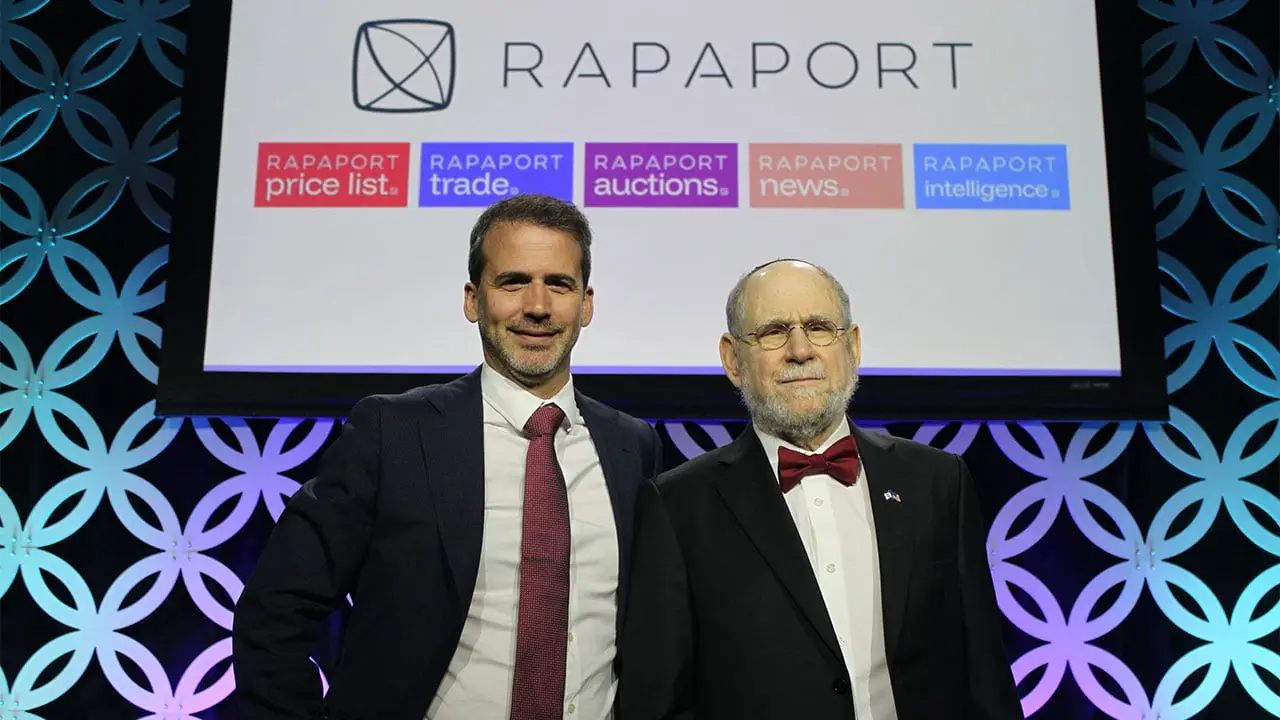
Image (left to right): Dan Mano and Martin Rapaport. (Rapaport News)