
High-quality visual documentation is central to how gemstones are evaluated and sold, and demand for consistent visual output has grown alongside expanding inventories and digital channels. Yet most AI conversations around the trade are consumer-facing: chatbots, image generators, marketing copy. They deal far less with where the bottlenecks actually live. 3D Foundry Labs, an Israel-based R&D firm, has spent the past several years building bespoke automation tools for jewelry brands and retailers, with a particularly deep portfolio in gemstones. Here, the company’s cofounders, CEO Eliran Dahan and CTO Tal Kenig, walk us through the work.
Diamonds and colored gemstones come with a fidelity demand that fashion and general retail do not. How does that shape what AI can and cannot do in this trade?
Kenig: In a gemstone, fidelity is everything. A single hallucinated facet means a rejected render. The image generators that work for fashion or general retail were trained to produce plausible images, not faithful ones. They invent inclusions, shift a color grade, smooth over the very details a buyer is paying for. A scarf draped on a mannequin can survive that. A 5-carat sapphire cannot. So the AI worth building for this trade is not creative AI; it is automation around the steps that have a clear right answer, with the trained eye keeping the final say on the perceptual decisions. That is the constraint every project in our portfolio sits inside.
That logic of automation-around-the-routine plays out in your portfolio in some interesting places. Let’s start with mobile content.
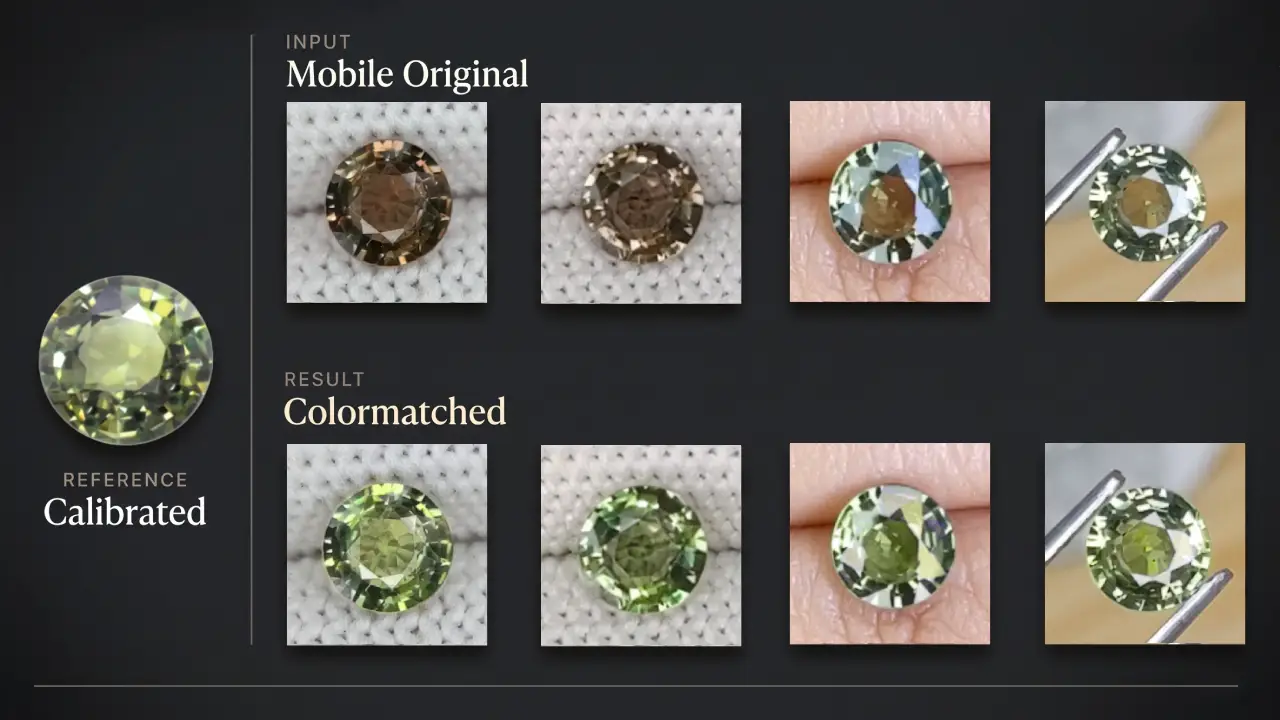
Kenig: That work was for a leading online gemstone retailer producing handheld lifestyle clips of stones outside the studio: footage that brings ambient context a polished turntable video cannot. The catch was that mobile clips drift in color depending on lighting and the device they were shot on, so they were difficult to use as catalog content alongside studio footage. We built an AI-assisted system that finds and accurately delineates the stone in each frame and matches its color back to the studio reference, frame by frame, using a proprietary method we had originally developed for our rendering work. The reference is already correct; the clip just has to agree with it. Furthermore, the system also detects human skin pixels in the video, allowing it to generate the same clip with varying model skin tones. Editing time per clip dropped from hours to minutes while providing added functionality. The human editor always owns final adjustments and export.
You mentioned the studio reference. The work that produces it, the turntable video automation, is older. Walk us through it.
Dahan: That work was built for a high-end retailer whose media team had been manually editing raw gemstone videos for every product: looping the footage, picking keyframes, correcting color, fixing backgrounds. The work was labor-intensive, and quality varied across the catalog. We built a system that takes a raw turntable video and produces a set of standardized stills and clips. The software identifies the smooth periodic rotational segment, picks the cleanest frames at consistent angles, sets orientation and scale, removes the background, and adds a soft shadow. All of this automation is based on state-of-the-art AI models in combination with our know-how and gemstone domain expertise. Color is handled separately, because color is a perceptual judgment, not a rule-based step. The system generates a grid of intelligent exposure and saturation variants. The operator picks the closest match against the physical stone under reference lighting, and that pick is applied across every output for the same stone.
Hands-on time per stone dropped by 90% to 95%, to about two minutes instead of 30 to 40, and quality became more consistent across the catalog. One condition: The system assumes controlled capture — a fixed rig, uniform background, consistent lighting, all in line with the client’s specific studio setup. It does not try to rescue inconsistent footage.
Both of those projects work on new content. What happens when a retailer’s problem is the catalog it already has?
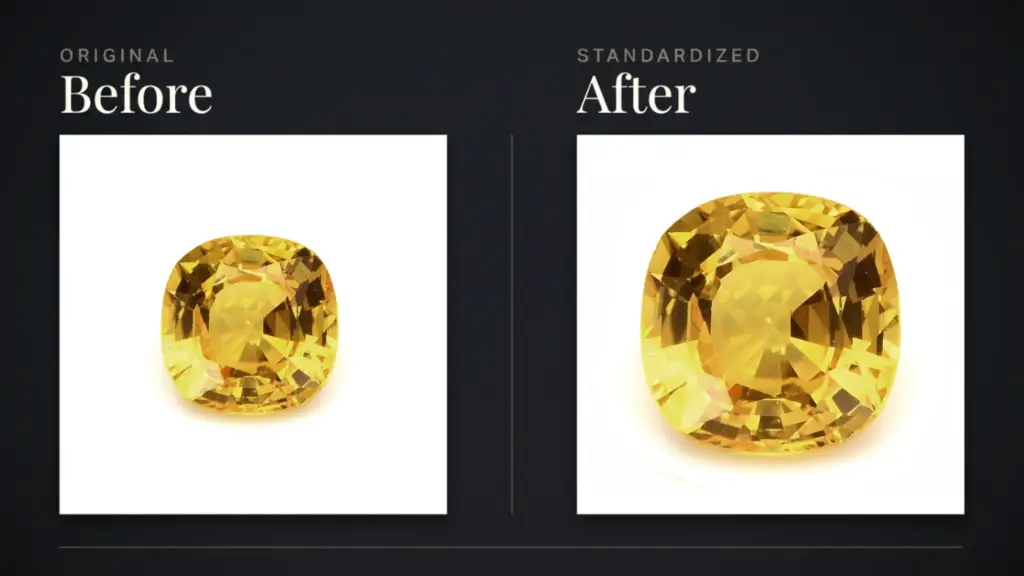
Dahan: A different retailer had years of catalog photos that no longer met what their site needed. The stones were too small in frame, the resolution too low for current layouts, and the original footage long gone. They were not in a position to reshoot the entire inventory. We built a batch system that does two things: a four-times resolution boost using an AI-based super-resolution model, which was tuned to preserve real edge detail rather than invent content that wasn’t in the original, and automatic reframing — software that finds the gemstone in each image and resizes and crops so the stone occupies a defined fraction of the picture frame. Hundreds of pieces could be brought up to current presentation standards in a working day. What distinguishes it from generic upscaling is the use of the right AI model, capable of enlarging the images without blurring and loss of sharpness on one hand, and without hallucinating new details that aren’t there. In gemstones, invented detail is a defect.
Stepping back, what does it actually take for AI to stick in this kind of work?
Kenig: The conversation has moved past whether AI belongs in this work. The harder question is how to bring it in deliberately and smoothly: which parts of an existing workflow are ready for automation, and which still need a trained eye. The implementations that stick are not the most ambitious; they are the most pragmatic. They remove friction that doesn’t help anyone, respect the expertise that does, and scale up what already works. And all of this must be done without introducing additional complexity to existing workflows. The challenge is not keeping up with technology. It is deciding which parts of a workflow are finally ready to let go of manual constraints.
3D Foundry Labs builds custom AI and 3D systems for the jewelry, gemstone and diamond trade. For more information, please email contact@3dfoundry.ai or visit 3dfoundry.ai/rapaport
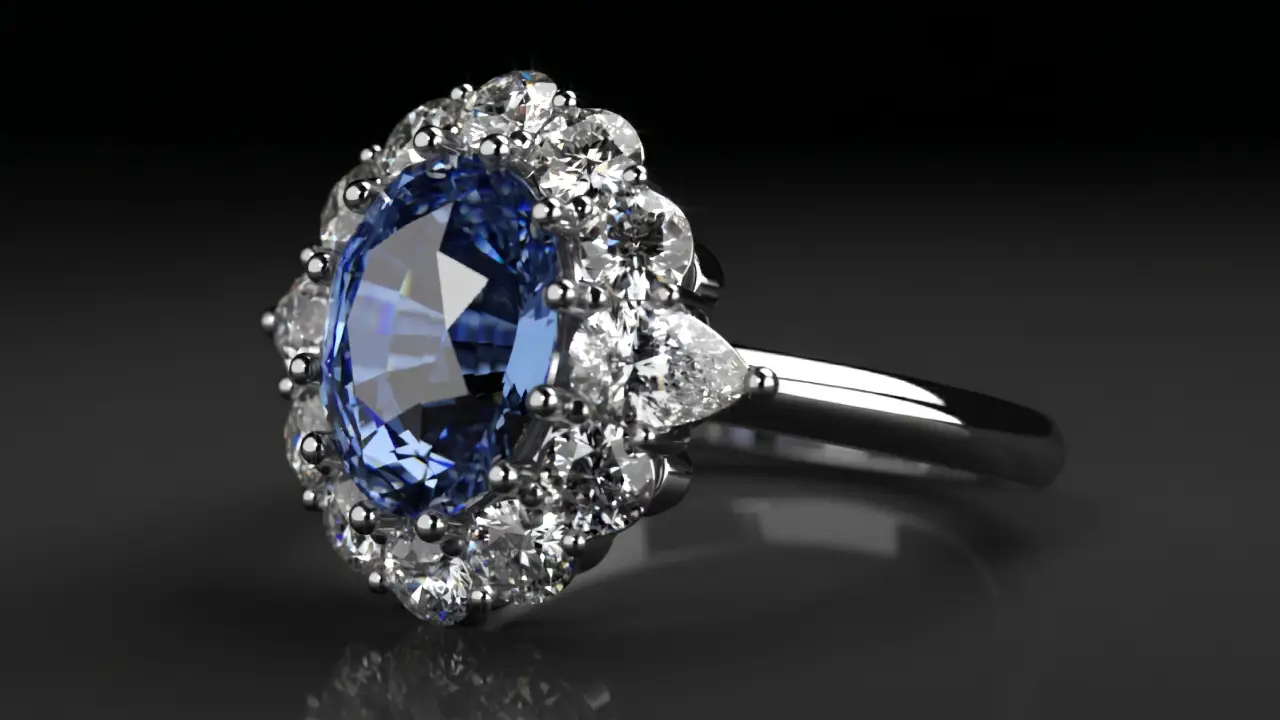
Main image: A rendering from 3D Foundry Labs’ cloud-based rendering pipeline. (3D Foundry Labs)