
The Gemological Institute of America (GIA) recently found that a green stone that appeared to be an emerald was actually a quartz.
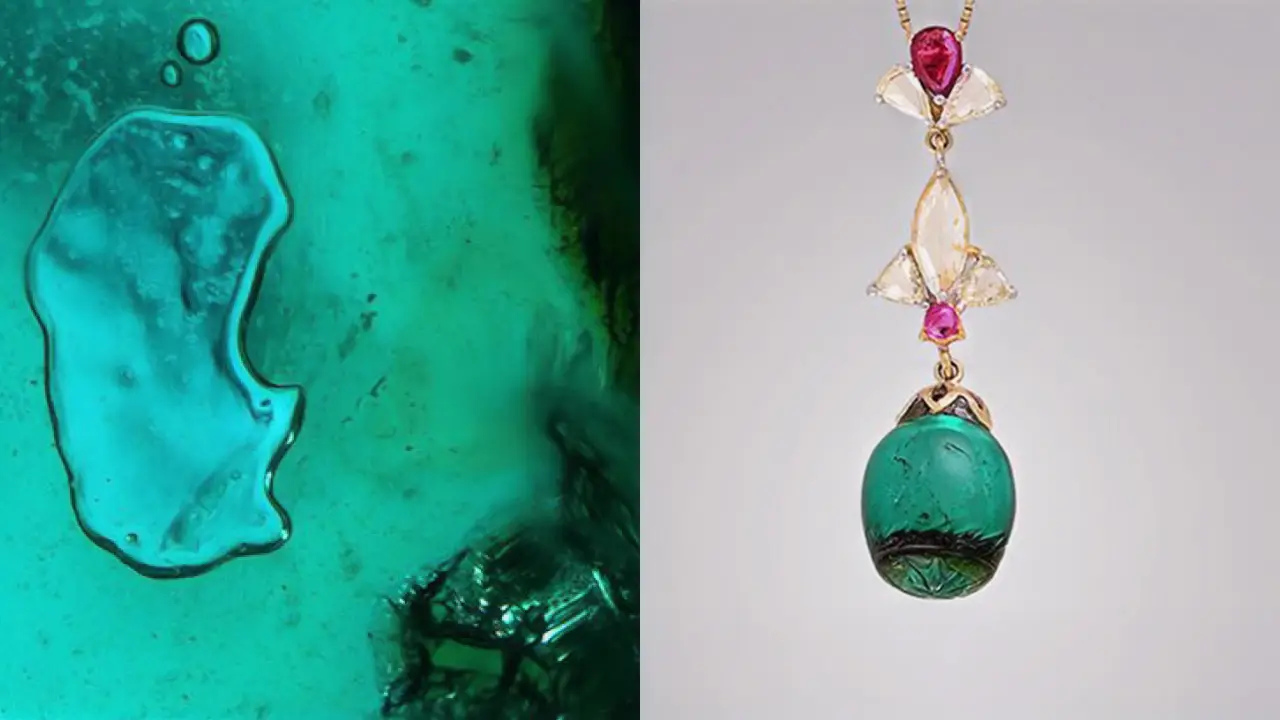
The initial observation suggested the stone was an emerald, until further testing revealed it contained several layers of quartz fused with green cement to imitate the precious gem. The GIA examined the deep-green stone attached to a necklace at its New York laboratory, according to an article in the Fall issue of Gems & Gemology, the institute’s quarterly journal.
A spot refractive index measurement suggested that the 7.84-gram stone was likely a quartz. Exposure to long- and short-wave ultraviolet light revealed a whitish fluorescence, restricted to an internal layer of the stone. Raman spectroscopy further verified that the material was quartz.
Under the microscope, the stone further revealed a separation near the carved top, including gas bubbles and air-filled voids that obstructed cement, leading to the appearance of colorless zones. These voids confirmed that the green color appeared to be restricted to the layer of cement. The inspection revealed that the stone consisted of three-part, colorless natural quartz, surrounded by a green cement and a clearly defined interface.
The examination under the microscope found natural fluid inclusions, concluding the center was a natural rock crystal quartz. Gemstones combined with two or more materials have been used to imitate natural gemstones for many years. The soudé emerald is one of the most commonly seen assembled emerald imitations, which began mass manufacture in the early 20th century. Over the years, its construction transitioned from rock crystal to colorless synthetic spinel, and eventually to colorless beryl or pale aquamarine.
Image: A close-up of bubbles in the boundary between the green cement and the quartz coating (left), and the submitted finished jewelry piece (right). (Gemological Institute of America)