

Angola will limit output of small rough in the coming months, aiming to avoid flooding the market, state-owned diamond miner Endiama has said.
Angola is the world’s fastest-growing diamond-producing nation, with rough exports increasing 70% to 17.7 million carats in 2025.
However, many of those goods are in the smaller categories that have struggled in the past two years, leading to charges the African nation has contributed to a glut in polished under 1 carat.
The next sales of rough from Catoca and Luele, Angola’s two largest mines, will see a “substantial reduction” in availability of small goods, Elton Escrivão, Endiama’s commercial director, told Rapaport News Thursday at the Luxury show in Las Vegas.
“For the next three months, we are going to reduce substantially the volume of diamonds in the small sizes that we are putting in the market, especially when it comes to Catoca and Luele,” Escrivão said.
The country aims to “protect the value of our production and…the market,” he added.
Escrivão announced the move at a Natural Diamond Council (NDC) event about Angola’s mining sector on the sidelines of the show.
“If necessary, we are going to extend this suspension to protect the market,” he told the audience. “So you count on us the same way we count on all of you.”
He declined to define “small sizes” or clarify whether this would entail mining less or building up more inventory. The country will provide more details in the coming days.
“The most important [thing] is that the market will start receiving a substantially [lower] volume of small diamonds,” Escrivão told Rapaport News. “It’s crucial, considering the crucial role that Angola is playing right now in the diamond industry, that we take care of the market.”
Angola’s diamond production jumped 8% to 15.2 million carats last year, with the average price falling 29% to $102 per carat — indicating a shift to lower sizes. The African nation was planning to raise output to 16.2 million carats in 2026 at an average price of $150 a carat, Bloomberg reported last month.
The spike in output since the launch of Luele in 2023 — transforming Angola into the world’s third-largest producer — has coincided with production cuts in Botswana and Russia. This has created challenges as the industry tries to rationalize supply and help the market recover, as the February edition of the Rapaport Research Report (now the Rapaport Intelligence Report) outlined.
De Beers CEO Al Cook applauded Angola’s move at the miner’s breakfast event at JCK Las Vegas on Friday, noting that this was “part of the long-term trend.”
Canada, he observed, will see a sharp reduction in supply with the closure of Rio Tinto’s Diavik mine, the owner of the Ekati deposit filing for creditor protection, and De Beers itself pausing new expansion at Gahcho Kué.
“It’s possible that by this time next year, diamond supply out of Canada will be finished,” Cook added. “That’s a huge amount out of the market. We also expect responsible sales from Botswana and Russia, as well as Angola. Natural diamonds are going to get rarer.”
Meanwhile, talks over De Beers’ separation from current owner Anglo American are at a “very advanced stage,” Cook said. “We expect…Anglo American [and] the government of Botswana to make an announcement on that in the very near future. All the partners that we’re involved with in this sales process have deep ties to our industry. They love diamonds. They have a strong belief in De Beers and a strong belief in natural diamonds.”
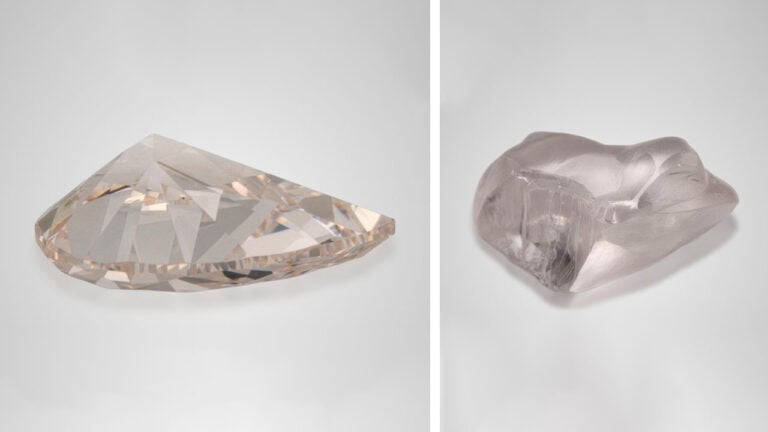
Image: Rough diamonds. (Shutterstock)