
US President Donald Trump’s April 2 tariff announcement shocked the diamond industry and the world. The new import duties will impact every corner of the trade, from mining to retail.
Tariffs of 10% on almost all countries — and virtually all products — went into effect on April 5. On April 9, Trump postponed the implementation of higher reciprocal rates on specific countries by 90 days, just as they were about to come into effect. This gave a reprieve to India, which was facing 26% duties on its goods.
The main exception was China, which Trump has slapped with a 145% tariff. This heated up the trade war with Beijing, and the government reacted with 125% duties on American goods.
The initial response to the tariff policy in the diamond industry was a market freeze. Companies outside the US saw sales come to a standstill. There was some demand from American businesses trying to get their hands on goods before the higher rates came in.
The rough sector started to panic, worried that polished demand would dry up. Manufacturers moved inventory to US branches if they could get it on the plane before the tariff deadline. New York dealers, unsure how to adjust prices, waited for everyone else to make the first move. No one knew how trade shows, memo and grading would work.
Certain points grew clearer over the following days. For instance, the industry became familiar with the Temporary Importation Under Bond (TIB) mechanism for trade shows and shipments to labs. But there is deep concern and confusion about the new regime.
This report goes through the potential impact of the tariffs on each major diamond center, using data to show the exposure to the tariffs and analyzing how the trade is reacting.
United States
Reports from the US were mixed. US dealers continued to do steady business, according to initial reports — as was the case before April 2.
Goods already stateside — or in transit to America — at 12:01 a.m. EDT on April 5 were exempt from the 10% baseline tariff the administration placed on almost all countries. The cutoff for the higher reciprocal rate on select locations, which did not go into effect, was the same time on April 9.
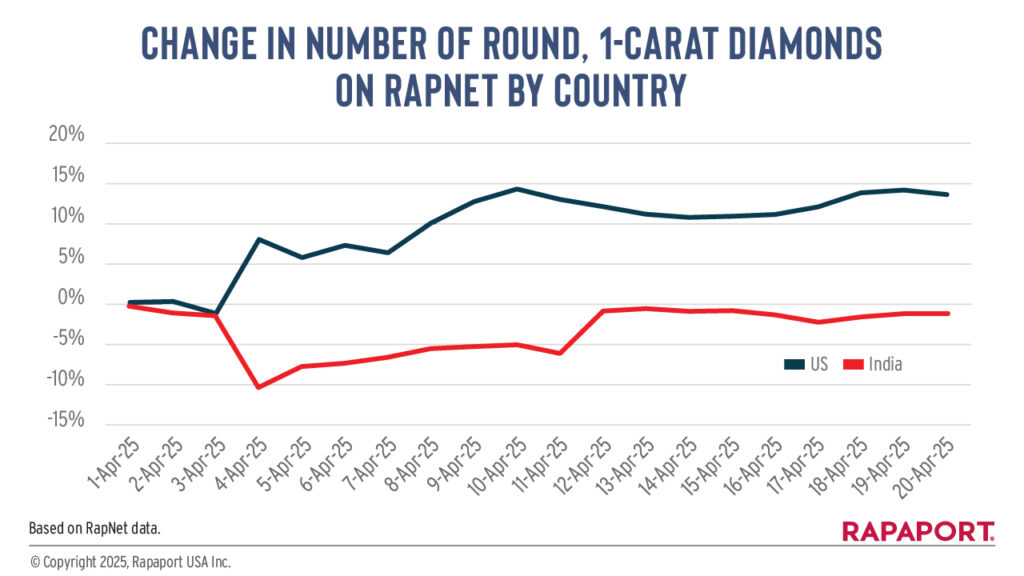
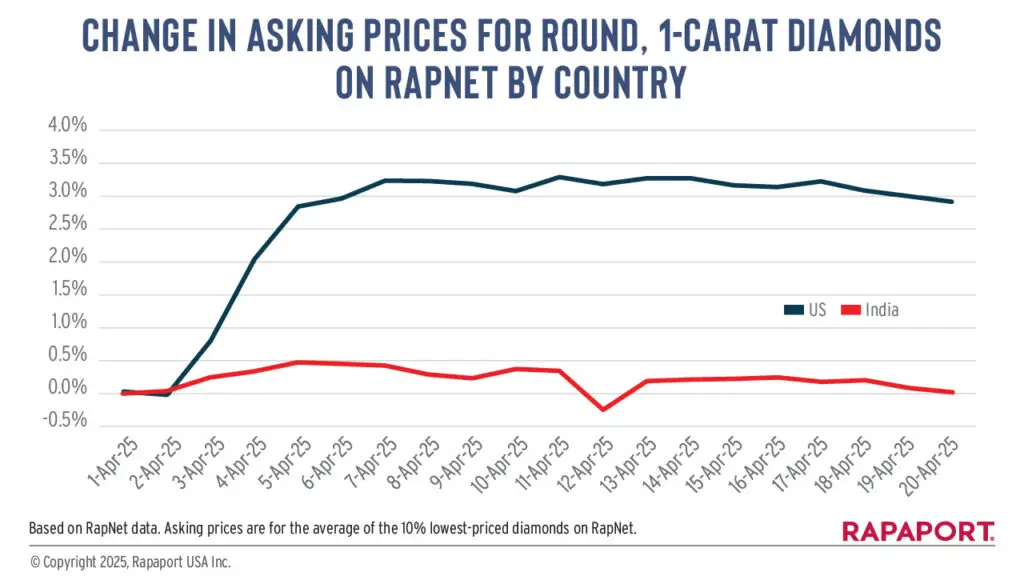
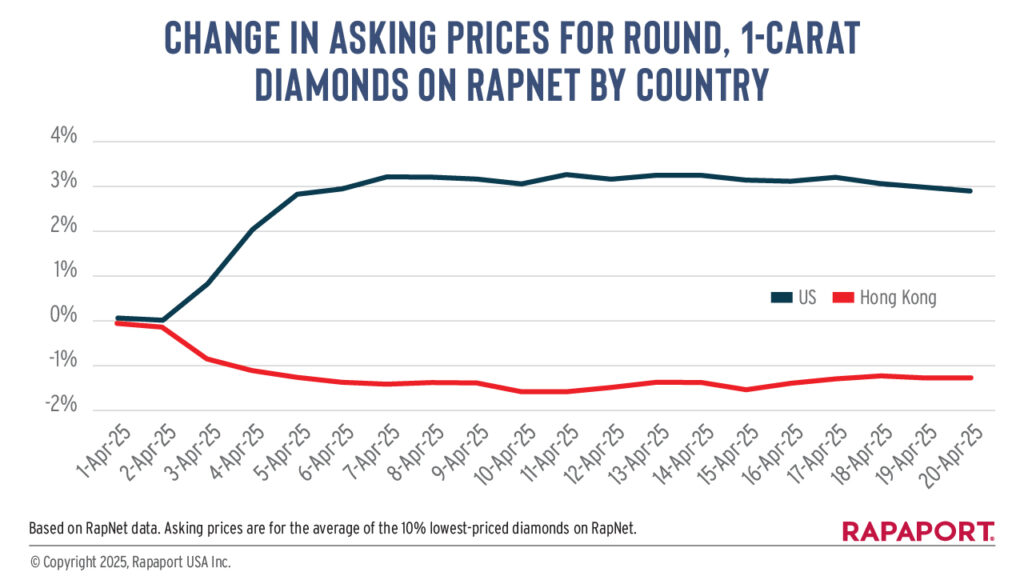
American inventory gained in value as dealers and retailers wanted to get their hands on tariff-free goods. This gave sellers space to charge a few percent more, given the prospect that overseas goods would be more than a quarter more expensive. Average asking prices of US-based round, 1-carat diamonds on RapNet grew 2.9% in the first 20 days of April, according to data from the platform.
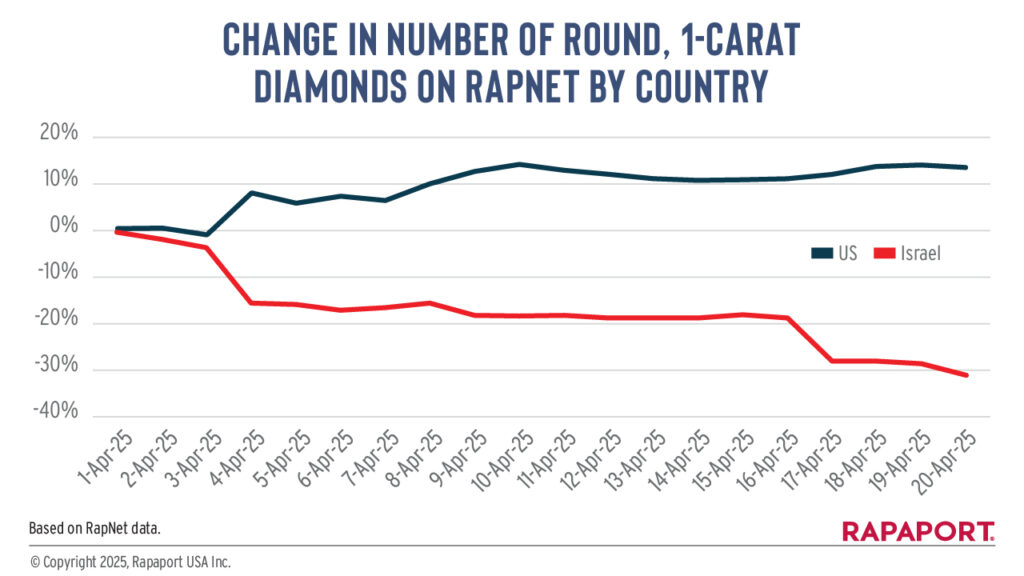
The number of US-based diamonds in the same range of goods on RapNet rose around 15% in the first 10 days of April, mostly reflecting mass shipments by Indian companies ahead of the deadline. This stabilized after Trump announced the pause, with an overall increase of 14% for the first 20 days of the month. The number of goods listed as being in India fell sharply after the announcement and tapered off to an overall decline of 1% for the nine days.
However, inventory of desired goods will eventually run low. It’s hard to say when this will occur, and it largely comes down to consumer demand. There is also the possibility that Trump will have announced additional reversals or delays by the time this happens.
The big question is who will foot the bill. The importer pays but must decide whether to pass the cost on to the customer. Who this importer is depends on the structure of the supply chain; in some cases it will be the retailer, in others it will be the American wholesaler, and in others it will be the overseas supplier. If the consumer ends up taking the full hit, sales volumes will suffer. If the trade absorbs even some of the impact, margins will fall.
US retail giant Signet Jewelers told vendors it would not accept any price changes for previously agreed orders, but it’s unclear what will happen with future purchases.
One major New York wholesaler has essentially suspended its memo program, telling customers they must either buy or return any consignment goods, and it would not offer any discounts given the jump in replacement costs.
“It seems like the Indian companies are going to raise prices, but I haven’t seen it yet,” said another major supplier, before Trump announced the postponement of 26% tariffs. “A couple of New York-based vendors have raised [prices] and are asking for any memo items to be returned or they will be billed at the new, higher rate. What I’m seeing is a fair amount of panic and a lot of waiting to see what the ‘others’ are going to do first.”
Replacement of finished jewelry is going to be especially hard, as much of the mid-market merchandise comes from manufacturers in China and Hong Kong. This will impact sourcing costs. Other Far East countries that produce jewelry also have relatively high rates, should they materialize as planned following the 90-day delay. Vietnam faces 46% tariffs, while Thailand is on course for a 36% hit.
This is devastating for jewelry suppliers that have already committed to purchase orders from retailers, said one such US wholesaler who sources finished pieces from China.
“We went to all these bridal [trunk] shows, worked hard, took orders, and now at the end of the day, we’re actually going to lose a bunch of money on them,” said the wholesaler.
Belgium
When it comes to country-specific tariffs, what matters is the location of production, not the location from which they are shipped to the US. This means that more than 90% of diamonds are taxed as Indian goods, as that’s the place of manufacturing.
This has temporarily become irrelevant, as almost all countries face the flat 10% tariff for the next three months.
If the 26% rate on India comes into effect, this will affect most Belgians selling to the US. The planned 20% rate for the European Union would apply pressure to Antwerp’s small local manufacturing sector, which focuses on large, high-value stones.
Antwerp dealers have the slight advantage of being able to sell to European customers, which constitute a large proportion of their client base.
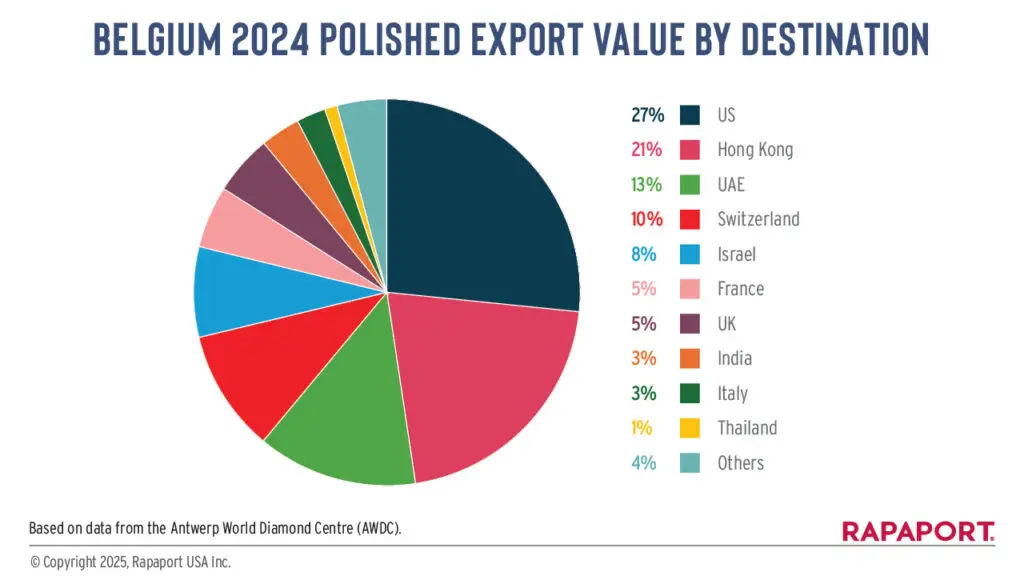
Still, the US is Belgium’s most important market for diamonds. The country’s gross polished exports to America stood at $2.13 billion in 2024, or 27% of its global outbound shipments. Its four biggest European markets — Switzerland, France, the UK and Italy — account for a combined $1.83 billion, with Hong Kong not far behind on $1.68 billion.
The luxury brands are an important market for Antwerp; how they handle the tariff impact will have a major bearing on the trade.
Israel
Israel is an unusual diamond center: The category still accounts for a large proportion of the country’s total product exports, despite its role in the global industry shrinking from a few decades ago. This is partly because Israel is a service-based economy, with limited other physical-export sectors — the largest being technological equipment.
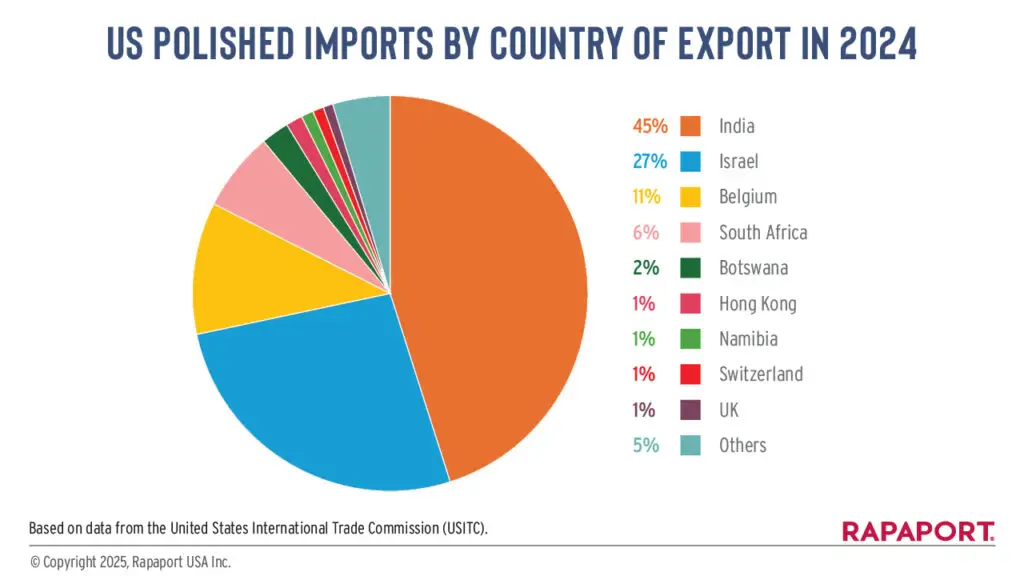
For this reason, tariffs on diamonds would have a major impact on Israel’s export business. The country shipped $3.94 billion of polished to the US in 2024, according to data from the United States International Trade Commission (USITC). That is more than half of Israel’s gross global polished exports; these stood at $5.95 billion for the year, according to data from its Ministry of Economy and Industry.
The US initially placed 17% tariffs on Israel, before reducing this to the standard 10% — despite Israel canceling all customs duties on US goods on April 1. The Israeli industry has been lobbying the government to seek concessions for diamonds, though the fact that most diamonds are of Indian origin means it is not an Israeli problem per se. Most of Israel’s diamond exports to the US will incur taxes based on the tariff figure for India levies, whatever it turns out to be after the 90-day postponement of the 26% rate.
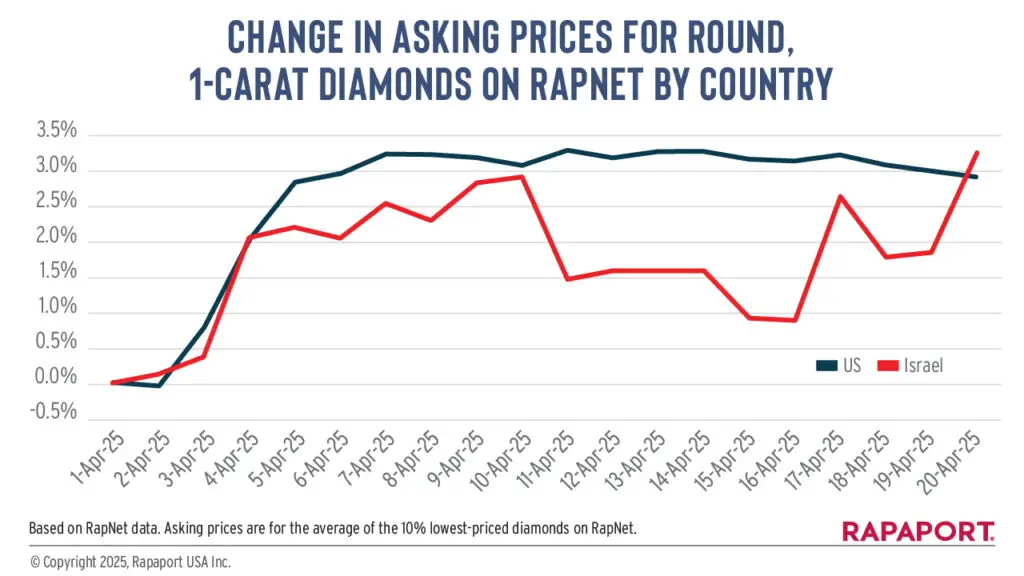
Israel has a small manufacturing sector focused on high-value goods, but this is not the main function of the local industry. Many of the country’s diamond businesses are pure-play global dealers: They buy in India, sell in the US, and merely sleep in Israel. Companies that send traveling salespeople on a frequent basis to the US will face a large tariff bill, even if there are mechanisms to claim back duty on unsold items. Those with US offices have more flexibility; they can stock up on US inventory and are not bringing goods in and out of the US as frequently.
India
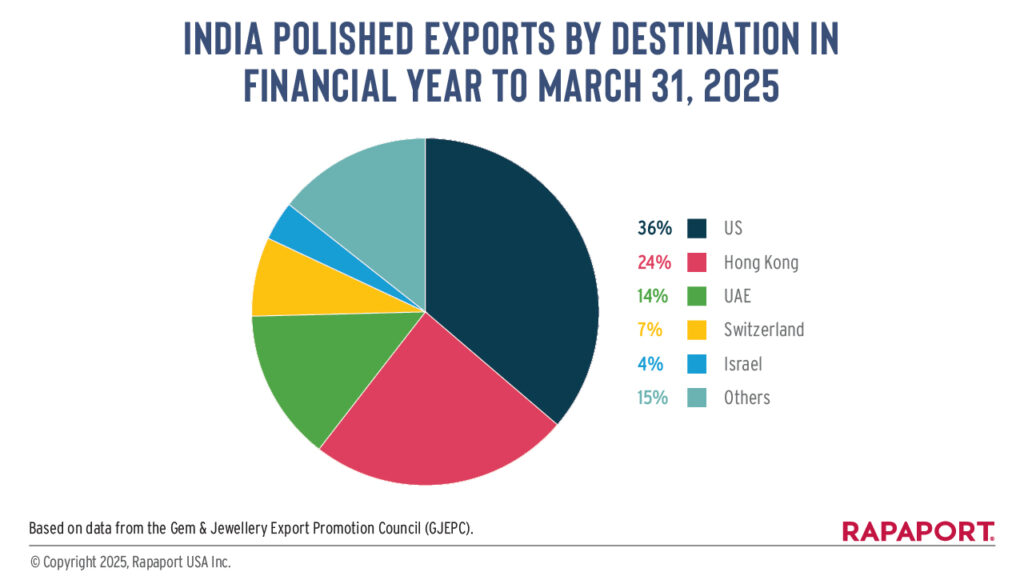
India’s diamond sector stands to lose more than most, given the importance of the US market to its polished exports and the ongoing weakness of China. Gems and jewelry are India’s third-largest export to the US, after engineering and electronic goods, according to the country’s Gem & Jewellery Export Promotion Council (GJEPC).
India’s polished exports to the US totaled $6.69 billion on a gross basis in the 2024 calendar year, according to Rapaport calculations based on data from the USITC. According to the GJEPC’s online data bank, India shipped $4.82 billion of polished to the US in the financial year that ended March 31, 2025. It’s unclear why the gap between the two figures was so big. A GJEPC spokesperson said the reason could be related to whether the USITC includes the cost, insurance and freight (CIF) value, which would give a higher figure; the USITC was not immediately available to confirm whether it used this method.
This means the US accounted for between a third and half of India’s outbound polished trade, which came to a combined $13.29 billion on a gross basis in the 12 months ending March 31, 2025, according to separate data the GJEPC publishes.
Indian companies shipped a large quantity of goods to the US in the first week of April in anticipation of the new rules. The correlation between the decline in RapNet inventory of round, 1-carat diamonds listed as being in India and the increase for the US indicates this trend.
Indian inventory in that range showed steady asking prices, compared with an increase of 2.9% for US-based goods. However, there was uncertainty about future pricing for goods that will incur tariffs.
The Indian government is reportedly in talks with Washington, DC, about a deal to resolve the tariff impasse. The GJEPC has been pressing for quick progress on this.
However, there are also mitigating steps the trade can take, legal firm Economic Laws Practice (ELP) said in a presentation it gave to the trade on April 8 in conjunction with the GJEPC. Avoiding overstated import values can help companies steer clear of unnecessarily high tariff bills, it said. US law, according to ELP, also allows importers to base the valuation on the first in a chain of transactions.
“For example, if goods are manufactured in India, sold to a Dubai-based trader, and then to a US buyer, the India-Dubai sale price may be used for customs valuation, lowering the import-duty burden,” according to a slide it presented.
Importers can also pay less if components of their product were produced or substantially transformed in the US, the law firm added.
The domestic Indian market will become increasingly important and attractive to the country’s business-to-business (B2B) sector. This process was already happening because of China’s slowdown and the expansion of India’s middle class and luxury retail segment.
Hong Kong
Of the five trading centers for which Rapaport tracks data, Hong Kong was the only to see a decline in asking prices for round, 1-carat diamonds following the tariff news, with a 1.3% drop over the first 20 days of the month. Inventory for that range grew 2.5%.
It’s not entirely clear what caused this. Prices of Hong Kong-based inventory have been falling steadily since the start of the year, with a slight improvement after the positive March show that appears now to have unraveled.
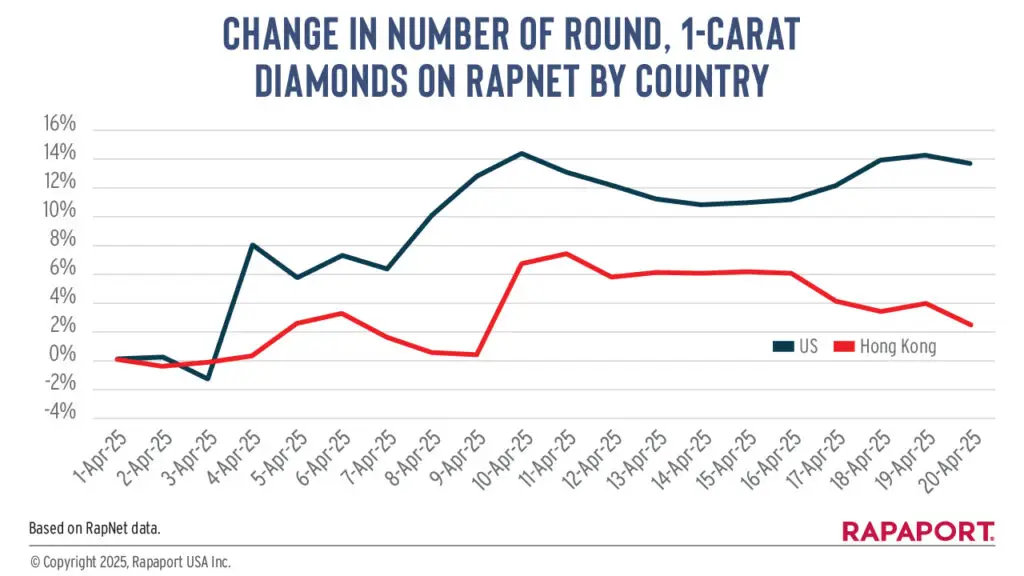
This probably reflects a wider concern about the China and Hong Kong economy in light of the trade war with the US. The American tariff system treats Hong Kong as part of China. The local sector was already under pressure because of the mainland’s slump in diamond demand and restrictions on cash transactions, as we explained in the March 2025 issue of the Rapaport Research Report.
The US became Hong Kong’s biggest export market for polished in 2024, accounting for $2.28 billion out of a total of $10.72 billion and overtaking the mainland.
Hong Kong will need to continue seeking alternative markets. The Indian domestic retail sector is unlikely to need to import much more polished than it already does, given the local trade on its doorstep. (India itself charges what now seems like a miniscule 5% on polished-diamond imports, aiming to protect its manufacturing sector.) Hong Kong’s best bet will be to expand its access to emerging retail markets in southeast Asia, such as Thailand, the Philippines, Indonesia, Cambodia, Malaysia and Vietnam.
But Hong Kong has an added challenge: Many of its diamond sales are to jewelry factories inside the municipality as well as on the mainland and in other southeast Asian countries. These clients now face an uphill task exporting to the US.
“If these tariffs aren’t removed, Hong Kong’s jewelry manufacturing will take a massive hit, because the US is the major market for the companies here,” said a Hong Kong-based diamond dealer.
Other locations
African producer nations were among the most tariffed countries on President Trump’s original list, with Botswana at 37%, South Africa at 30%, Angola at 32%, Lesotho at 50%, and Namibia at 21%.
The direct impact on these countries would have been for rough sales to the US, though tariffs on polished from India and other manufacturing centers would have a trickle-down effect. Petra Diamonds postponed a tender of rough from its Cullinan mine in South Africa scheduled for early April, citing market uncertainty. This was before Trump pushed off the higher tariffs.
The US has collected a 25% levy on Canadian goods since March 4. This does not change as part of the 90-day delay. As a result, rough from Canada’s mines incurs that rate when entering the US, but if manufactured elsewhere, it will become a product of the new countries and is taxed at the relevant rate.
Main image: David Polak/Midjourney.