
The Centurion Jewelry Show in Phoenix, Arizona, is one of the bellwethers of the high-end market. Luxury US brands and retailers attend to buy, sell and network at the invitation-only fair. Its early February timing is perfect for post-holiday stock replacement. Products on display range from the mid-priced to the ultra-expensive.
In all the glumness visible in the natural-diamond industry, trading at this year’s show offered optimistic trends. US luxury retailers are holding their own, attracting wealthier consumers with their emphasis on brands and personal service, exhibitors said. Synthetics, which penetrated the high end, are losing popularity among retailers.
America’s economic challenges of the past three years have affected the rich less than the poor. Inflation has potential benefits for those who hold assets, while high interest rates work in favor of those with savings.
A 2023 study by economist Edward Wolff for the National Bureau of Economic Research (NBER) found that the middle classes and the ultra-wealthy benefited from inflation, while lower earners suffered.
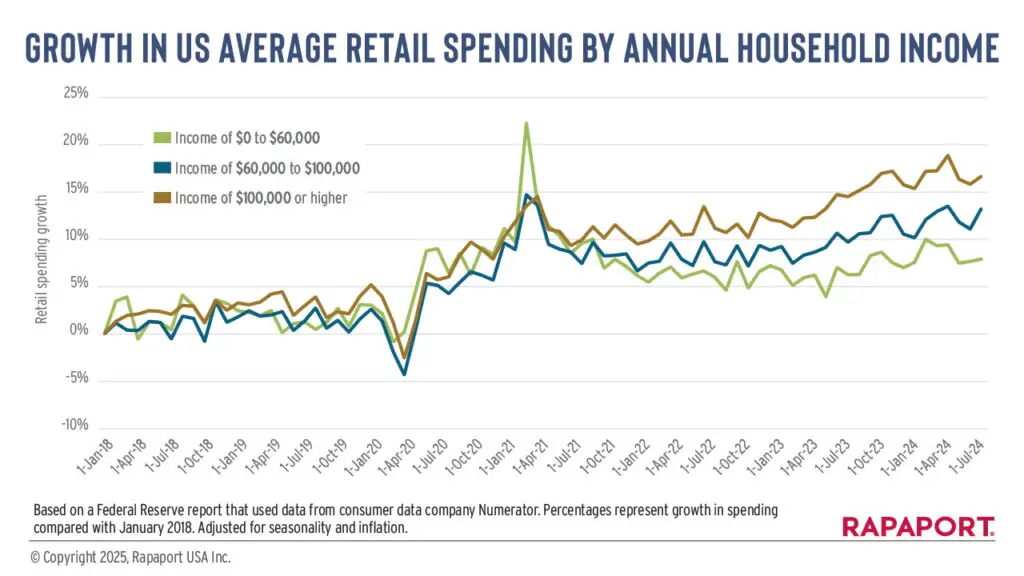
When it comes to consumption, the split between income groups is clearer still. Growth in retail spending by those making $100,000 or more per year outpaced that of middle- and low-income households between July 2021 and August 2024, according to a Federal Reserve report based on figures from data company Numerator (see graph). Spending by those bringing in $60,000 to $100,000 grew at a slower pace, while the trend for shoppers earning less than this was broadly flat.
“The wealthy are doing well, and the wealthy like to spend their money and love to buy beautiful things,” commented Melanie Goldfiner Goldberg, chief marketing and business development officer at Rahaminov Diamonds, which exhibited at Centurion and reported a good show.
The Los Angeles-based company sells its upscale, branded diamond jewelry to retailers. Consumers “appreciate our jewelry for [its] interesting designs,” she added.
“Luxury jeweler” means different things to different people. These operations tend to sell fine jewelry with 18-karat gold, luxury watches, and premium engagement rings. Their focus on fashionable jewelry brands — from David Yurman to Mikimoto — is one of their markers. Examples of such retailers are Connecticut-based chain Lux Bond & Green, Arkansas-based Sissy’s Log Cabin, and Windsor Fine Jewelers, a two-story shop in Augusta, Georgia.
Strong holiday
The recent holiday season was strong for the mid- to high-end sector as consumers felt positive about the economy, said Dustin Lemick, founder and CEO of insurance technology company BriteCo, which tracks sales at jewelers. This consumer confidence offset the ongoing challenges from lab-grown diamonds, he said.
“Some of that bullish spending behavior that was going on might have been too much, but that’s a different conversation,” Lemick noted. “I think when you put together a very bullish spending environment with the lab-grown [impact], they balance each other out.”
Luxury jewelers generally outperformed mid-market players, with wealthy consumers driving overall luxury jewelry sales, concurred Bryon Nelson, chief product and analytics officer at Jewelers Mutual, another insurance provider with a focus on the sector.
“While overall luxury spending dipped slightly, high-net-worth consumers continued to invest in high-end pieces,” Nelson said.
This matches data from Tenoris showing increased overall US spending on jewelry in 2024 despite fewer unit sales.
Lab adjustments
Contrary to some assumptions, lab-grown diamonds did affect the high-end sector, albeit less than the mid-market. But the trend is reversing.
Buyers at Centurion displayed less interest in synthetics than in past years, said Jordan and Allison Peck, the siblings behind jewelry brand Brevani, a line of natural-diamond jewelry known for its appearances on reality TV dating show The Bachelorette.
Many retail jewelers that attended were “basically saying, why am I buying something where the value is just dropping, dropping and dropping, and I’m not going to make the margin that I need to?” said Jordan Peck. “They’re selling luxury. They’re selling experience and timelessness. For them, there’s no question that that is within the natural sector, not [lab-grown].”
Retailers have learned more about synthetics and seen consumers’ disappointment at not getting the exchange value they expected, the duo said. At the show two years ago, “people were shopping around a little bit more and they were probably a little bit more open to lab,” Jordan Peck continued. “This year, they were pretty negative on lab.”
Brand expansion
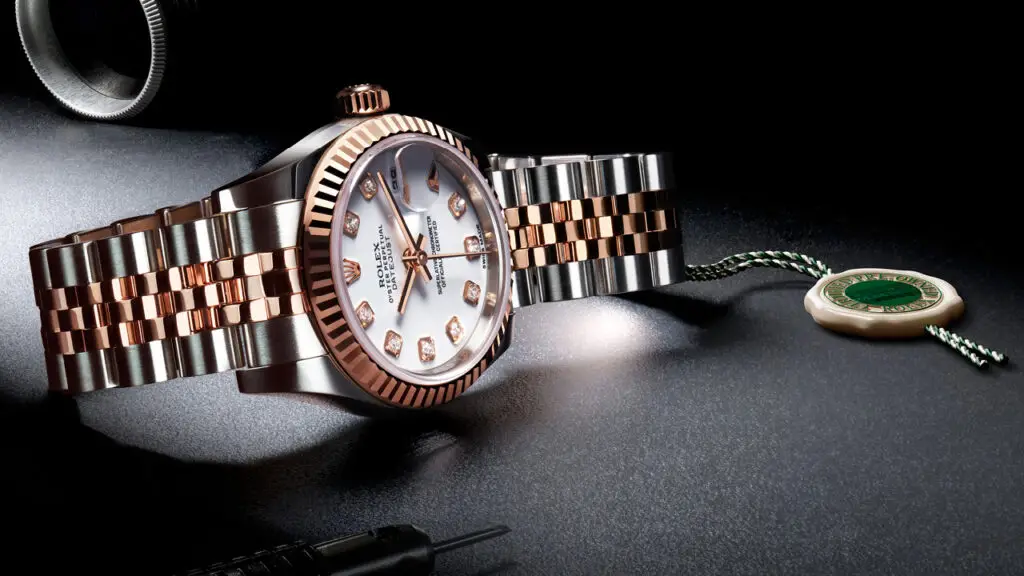
The luxury-jewelry sector has long relied on important brands, be they Hearts on Fire or Forevermark. But unlike in watches, where the likes of Rolex and Patek Philippe bring customers into stores, there are no dominant jewelry brands, especially in the bridal segment.
This gives an opportunity for many smaller designer names to thrive — and it is these labels that have driven much of the success of the high end. The purchaser of a $3,000 to $5,000 engagement ring might not have the budget to be picky about the brand, but the wealthy consumer spending $50,000 does.
“People like to be able to say what brand they purchased, or they like to follow that brand on Instagram and see their new designs,” said Goldfiner Goldberg at Rahaminov, which has used the strength of its brand to differentiate it from other jewelry suppliers. “And they like to tell the story, know the story, meet the designers.”
Pratima Sethi, who runs fine-jewelry company Sethi Couture together with her sister, Prerna, shared the example of a retailer that invested in unbranded, private-label jewelry last year without a lot of commercial success. The store, which she did not name, is now looking to shift back into designer pieces.
The advantage of brands is their story, which evokes emotion and inspires consumers, said Sethi, whose company focuses heavily on diamonds. “This unique storytelling element is something that is not typically found with private-label offerings,” she noted.
However, the growth of the branded sector has created a challenge for retailers. The more consistency there is at stores around the country — as many of them stock the same labels — the harder it is for individual retailers to set themselves apart. The brands also dictate terms such as retail prices.
Therefore, stores that stock brands need to be extra smart about issues such as margins and associate training, said Andrew Rickard, vice president of operations at RDI Diamonds, a polished wholesaler based in Rochester, New York. “They have to really understand the market conditions, because they’re in the most competitive environment,” he said.
Got the memo
Luxury jewelers have also expanded their market power, as weakness in the diamond trade has turned it into a buyer’s market. This has enabled them to take more loose diamonds and jewelry on memo, allowing them to reduce inventory risk — even though consignment is not an ideal way of stocking goods.
Five years ago, a luxury jeweler that wanted a supply of loose stones would need to commit to outright purchases, explained Dan Moran, president of custom jeweler Concierge Diamonds, who attended Centurion as a buyer. “If you wanted to play in that high-end space, you [would] need to make some kind of commitment to buy,” he recalled. “Today, you don’t have to do that. So why would you?”
These retailers are also reluctant to invest in loose diamonds, despite the relatively good holiday season. That’s partly because they have seen polished prices take a hit in the past three years and fear further inventory devaluation. For the Centurion show in particular, there is also the reality that the first quarter is no longer the big restocking season of the year for rough and polished diamonds that it once was. The relatively small De Beers first-quarter sights in recent years prove this.
To this end, memo programs — which Moran described as “rotating finished goods in and out of stores” — garnered interest at Centurion, he said.
“Nobody wants that inventory, and it’s easier for the supply house to shuffle goods from one store to another, keeping every showcase fresh,” Moran added. “I think the big winner in that model is FedEx.”
The changes to the annual purchasing cycle for loose diamonds threaten that side of the Centurion show and other fairs that take place at this time of year. However, some jewelry brands reported robust post-holiday restocking, indicating there was desire to replenish inventory of finished pieces, especially items that sell fast.
Retailers “sold through a bunch of inventory during the fourth-quarter season, and there are certain bestsellers that need to be replenished,” said Pratima Sethi at Sethi Couture. “And then they want to sprinkle in some new [merchandise] for the spring.”
The main focus for retailers now is Mother’s Day on May 11, the second most important season for jewelry after Christmas.
While upmarket jewelers have an eye on Valentine’s Day, the celebration of romance tends to be a time for flowers and chocolate rather than pricey earrings and bracelets. Average spending for the February 14 festival will be around $189 per shopper, the National Retail Federation (NRF) forecast last month.
Personal touch
While sales are strong, the market is competitive. One of the key things that distinguish the successful luxury jewelers is their ability to connect with consumers. The larger the ticket, the more it’s worth it for the store to spend money on this.
“If you look at the way [top luxury jewelers] reach out to their customers, they remember every birthday, every anniversary,” observed Jeff Loots, president of New York-based diamond-jewelry supplier Henri Daussi. “They have their customers’ wish lists. A lot of work goes into that. It’s not just waiting for them to show up in the store. It goes hand in hand with luxury.”
Main image: David Polak/Midjourney.
This article was first published in the February 2025 edition of the Rapaport Research Report.