 WhatsApp
 Email
Email
 Facebook
 Twitter
 LinkedIn

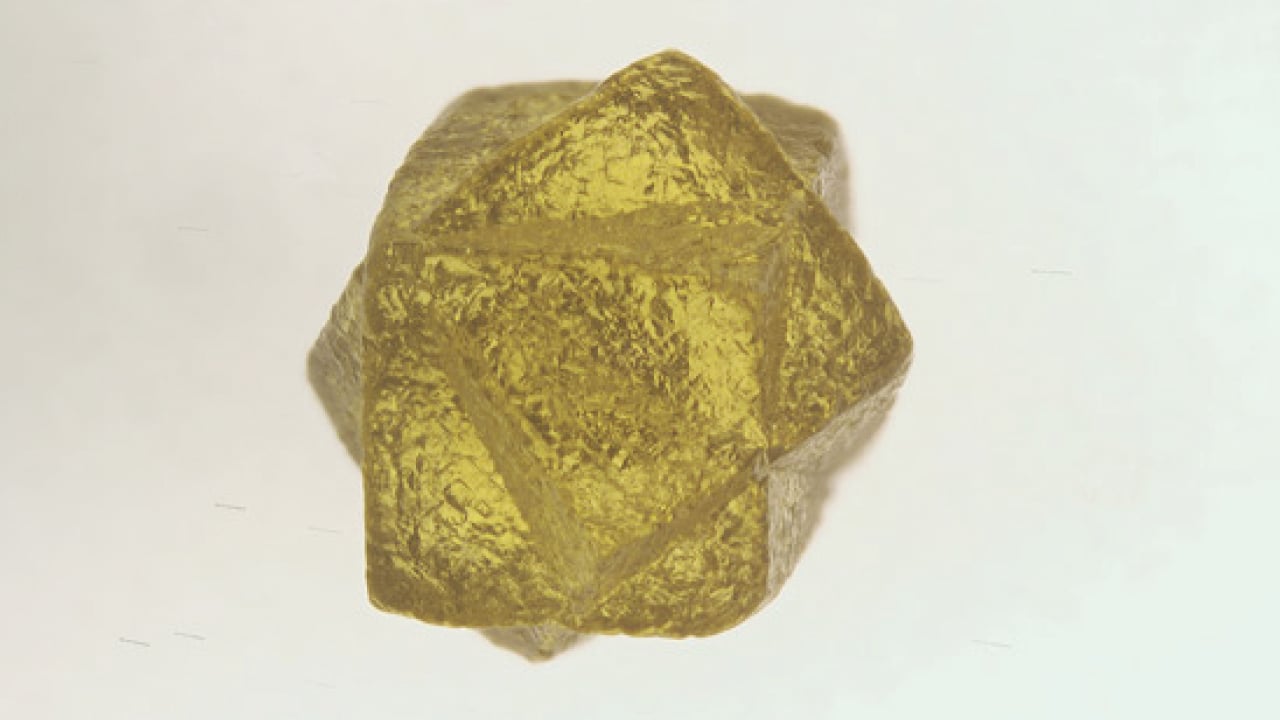
The Gemological Institute of America (GIA) recently analyzed a vivid-orangey-yellow natural diamond that displayed penetration growth twinning.
The 0.37-carat rough was on loan from the GIA Museum. The diamond showed the symmetrical formation of two crystals of the same mineral – a natural process, according to an article in the spring issue of the institute’s quarterly journal, Gems & Gemology.
Diamonds can develop growth twins in two forms: contact twins and penetration twins. Contact twinning is commonly found in octahedral diamonds. By contrast, interpenetrated twinning is much rarer and occurs in cuboid diamonds with fibrous growth, explained GIA.
The institute carried out a spectroscopic examination to investigate the diamond further. Ultraviolet/visible spectroscopy showed broad absorption across the violet-to-blue region of the visible spectrum, a characteristic associated with isolated substitutional nitrogen atoms or C-centers. Fourier-transform infrared spectroscopy confirmed the presence of C-centers alongside A-centers, which consist of paired nitrogen atoms, identifying the diamond as type IaA+Ib.
This natural diamond highlights how unexpected events during crystal growth can produce unusual mineral specimens, the GIA concluded.
Image: The vivid-orangey-yellow diamond examined by the GIA. (Gemological Institute of America)