 WhatsApp
 Email
Email
 Facebook
 Twitter
 LinkedIn

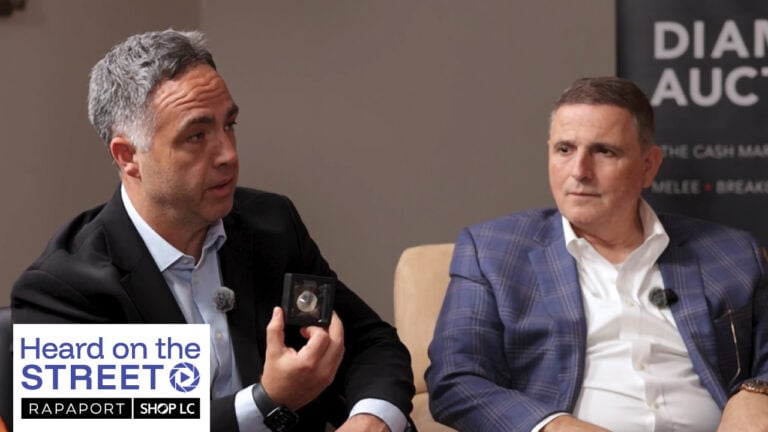
Heard on the Street, a video series that shares raw and unfiltered insights on the natural-diamond and colored-gemstone industries, dropped its third episode on August 5.
In Episode 3, Heather Chambers, the show’s moderator, guided the panelists through a discussion on diamond origin, natural diamond branding and geopolitical uncertainty.
Do consumers care about diamond origin?
Chambers kicked off the episode by asking the panel about whether it’s important to retailers and consumers where the diamonds they are purchasing came from.
Ari Jain, CEO of House of Diamonds, said that consumers do care about origin, but the origin that really matters to them the most is whether the diamond is natural or not. He continued that certain customers prefer a particular origin because it adds to the story of the diamond.
“Consumers do want to know they are helping people,” Jain said. “They do want to know we are helping people in Botswana and South Africa. So origin definitely matters.”
Angelo Palmieri, guest panelist on Episode 3 and president of GCAL by Sarine, asked the panel to think about what advancements in certification came from consumers. He then answered the question by explaining that most of the industry’s latest innovations come from within the industry itself, not consumers.
“Every innovation in diamonds or jewelry comes from the industry,” Palmieri said. “If we wait for a consumer to request a Botswana or a non-Russian diamond, I think that’s going to take a long time.”
Palmieri turned the conversation back to Chambers’s question on how often origin is included in certification and explained it is included “very minimally.” He said this is because there’s a lot of obstruction from the industry. He went on to ask the other panelists how available truly traceable Botswana-origin stones are in the industry today.
Jeff Angel, head buyer for RDI Diamonds, remarked that he can find one in about “five minutes.”
“I literally just had a million-dollar order that I found, so I think I can fine one stone and it [the order] all needed to be from Botswana,” Angel noted.
The panelists then discussed whether wholesalers mix their rough, if wholesalers are able to trace the rough back to the country it was sourced from, and the complications of sourcing from secondary markets.
On this topic, Palmieri explained that through a partnership with Tracr, Sarine can now scan a second-market rough if it came from De Beers and trace it back to the mine that it came from.
“The technology is there, it makes it harder to source…but I think origin has to be one of the stories going forward with natural diamonds,” Palmieri said.
Kerri Lavine, co-owner of Diamanti NYC and social media influencer – known as the “Godmother of Diamonds” – explained that for retailers, when the movie Blood Diamond came out, it “destroyed” business.
“That movie did harm to our industry and it opened up eyes to a lot of things,” Lavine said. “So I think ethically sourced diamonds is very key in having the Kimberley Process…. Having said that, that’s where sometimes people come in asking for a lab diamond, because they think it’s more ethically sourced.”
Is the industry branding natural diamonds effectively?
Jain emphasized that luxury items have never been only about appearance, but how they make consumers feel. He went on to explain the feeling consumers get when wearing natural diamonds, because they are wearing something that came from hundreds of miles underground, that is then polished and hand-set into jewelry.
“No product on earth will ever be that rare, but we do have to do a better job of reminding every one of our customers of that beautiful story,” Jain said.
He then showed the panel a 9.69-carat fancy vivid yellow VVS1 clarity diamond and explained how the million-dollar diamond is a great investment and how it has lifetime value.
Palmieri then posed the question of how much money a consumer will get back if they bought a diamond at retail and then wanted to sell it, say, a month later.
Lavine noted on this that a lot of retailers are telling their clients that they don’t buy diamonds back, which she said is “terrible,” because it means they only care about the first sale.
Palmieri added that any retailer that primarily sells lab-grown diamonds today does not offer a buy-back policy.
“If the whole industry created liquidity in natural diamonds where you could potentially recover close to what you paid or some very high percentage, I think that starts to change the narrative,” Palmieri ventured.
Chambers then asked the panel how this affects people who are buying smaller diamonds such as Gen Z and Millennial consumers, who are getting their first diamond.
Senil Lakhani, president of Kiran Gems USA, noted on the subject that diamonds below 1 carat and up to 1.5 carats are less expensive than ever before and explained that they are selling at prices from the 1990s and early 2000s. He added that the 0.30-, 0.40-, 0.50- or 0.70-carat diamonds are the “bread and butter” for America.
“Not everyone can afford to buy all this high-end stuff – a million dollars, half a million. This [referring to smaller diamonds] is something that we tell somebody that we love you with a special $1,000, $2,000, $5,000 category,” Lakhani said.
How is geopolitical uncertainty affecting the industry?
Chambers explained that various factors such as rising oil prices, wars, tariffs, inflation and even the COVID-19 pandemic have greatly affected the diamond industry.
Lavine shared that, although the industry is going through a lot right now, at Diamanti NYC, they are not feeling it. She attributed this to her social media presence.
“I’m educating people, we’re telling people what the right thing is, how to buy a diamond, what to purchase…. My claim to fame is just being known as the educator for the best consumer out there,” Lavine expressed.
On the other hand, Lakhani explained how the industry is currently navigating fuel costs because of rising oil prices.
Palmieri noted that he heard India’s Prime Minister, Narendra Modi, increased tariffs on gold and silver, asked all of India to not purchase gold jewelry for the next year, to cut back on travel, work from home to conserve fuel and placed restrictions on the amount of gold you can bring into foreign trade zones like SEEPZ (Santacruz Electronics Export Processing Zone).
“India as a country is a net-importer,” Lakhani said on the topic. “We do more imports rather than exports, because of lack of exports. Our rupee is falling down: when the rupee falls down, the economy itself hurts because we are not exporting enough goods.”
What’s not working in branding?
For the rapid-fire round, which is a fast-paced round at the end of the episode, Chambers asked the panelists about what is not working in branding right now.
Jain felt that everyone must get on social media like Lavine and other industry influencers and talk up natural diamonds; that the industry can’t just rely on De Beers to market natural diamonds.
Lavine added to this, that industry professionals can also reach out to influencers like herself and let her be an ambassador for their company.
“I think social media is a great and a free platform to brand your own self and brand your own products,” Lavine explained. “And if you can’t brand your own products, brand them with people like us.”
Lakhani, meanwhile, believed that companies are trying to market themselves, but that the industry needs a more unified marketing approach. He shared with the panel that, two years ago, Kiran Gems created a video on natural diamonds as a whole.
“If as an industry everyone does bits and pieces of content to promote it to the end-consumers, maybe one day it will reach to everyone,” Lakhani said.
Like Lakhani, Angel emphasized the importance of the industry having one unified message.
“As an industry, I wish there was somehow…to get people to understand that when they’re buying diamonds, regardless of who they’re buying from, that they’re getting good quality, good value and nobody is getting hurt,” Angel said.
Like Lakhani and Angel, Palmieri reflected that as long as he’s been in the industry, everyone has wanted to have one voice, although it’s challenging. But he suggested that people can lean into the distinction of each natural diamond.
“I think that people have to offer true differentiation,” Palmieri said. “There’s no answer of what exactly will rekindle this magic of natural diamonds for people. There’s a lot of tools that the industry has, but I don’t see many people taking risks or really trying something different.”
Alongside the panel discussion, the show also included three “Street Interview” segments featuring industry professionals and influencers from New York City’s Diamond District on the same issues.
This episode had an interview with Mike Nekta, co-owner of Leon Diamond, about diamond origin; Benny Ahdoot, known as “Benny the Dealer,” owner of Mazalito NYC, on natural diamond branding; and Julia Azeroual, industry influencer known as “Watchbyjuls” on geopolitical uncertainty.
Heard on the Street is co-produced by Rapaport and Shop LC.