 WhatsApp
 Email
Email
 Facebook
 Twitter
 LinkedIn

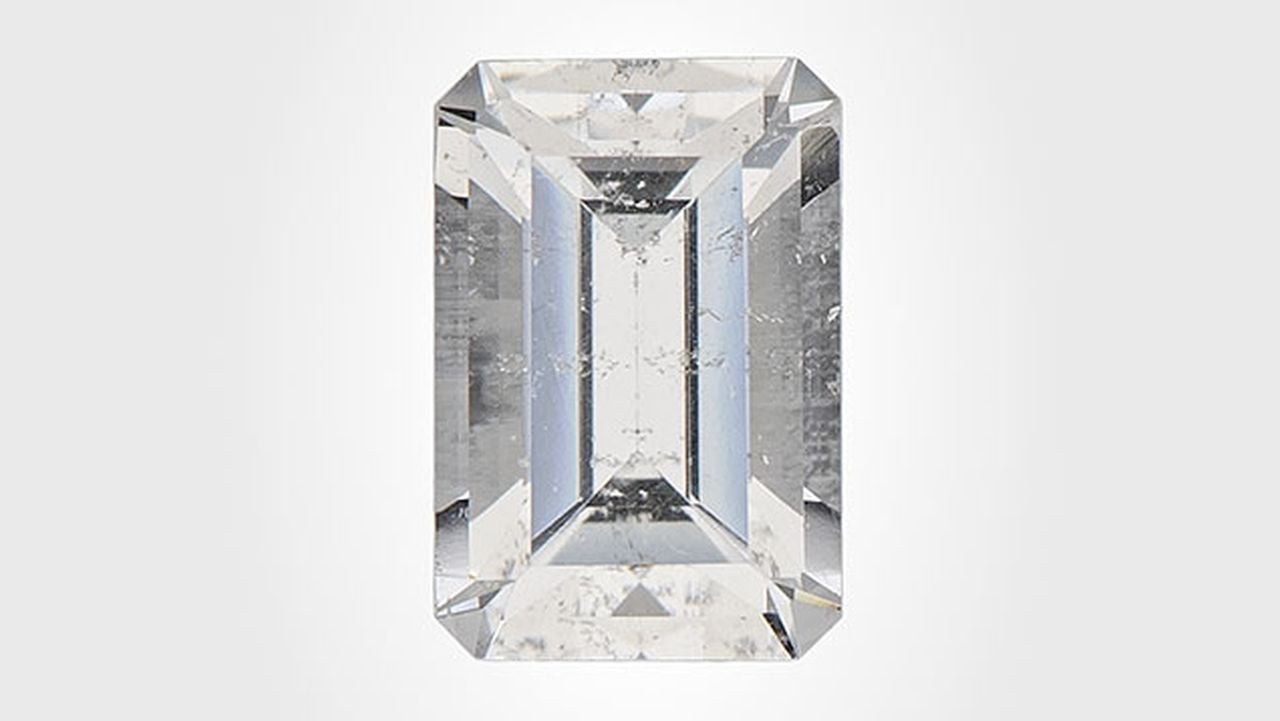
The Gemological Institute of America (GIA) recently examined an exceptionally faceted, 0.59-carat armenite stone.
The GIA received an octagonal step-cut, near-colorless stone at its laboratory in Carlsbad, California, for gemological testing, according to an article in the winter issue of Gems & Gemology, the institute’s quarterly journal.
Under a microscope, the stone displayed negative crystals, colorless inclusions and a small fingerprint reaching the pavilion surface. Standard gemological testing revealed results that were consistent with those previously reported in an armenite.
The lab subsequently compared the gem with a near-colorless armenite reference specimen from the GIA Museum, which exhibited a similar microscopic appearance as well as internal stress fractures. Raman and infrared spectra obtained from both stones were a near-perfect match, further confirming the stone’s identification as armenite.
Armenite is a rare orthorhombic silicate mineral. First identified in Norway in 1939, it has also been reported in Canada, Australia, Scotland, the Czech Republic, Switzerland, the US, and Italy. It typically occurs in veins within igneous and metamorphic host rocks. Data from this initial submission will assist with future identifications, GIA stated.
Image: The armenite stone. (Gemological Institute of America)