 WhatsApp
 Email
Email
 Facebook
 Twitter
 LinkedIn

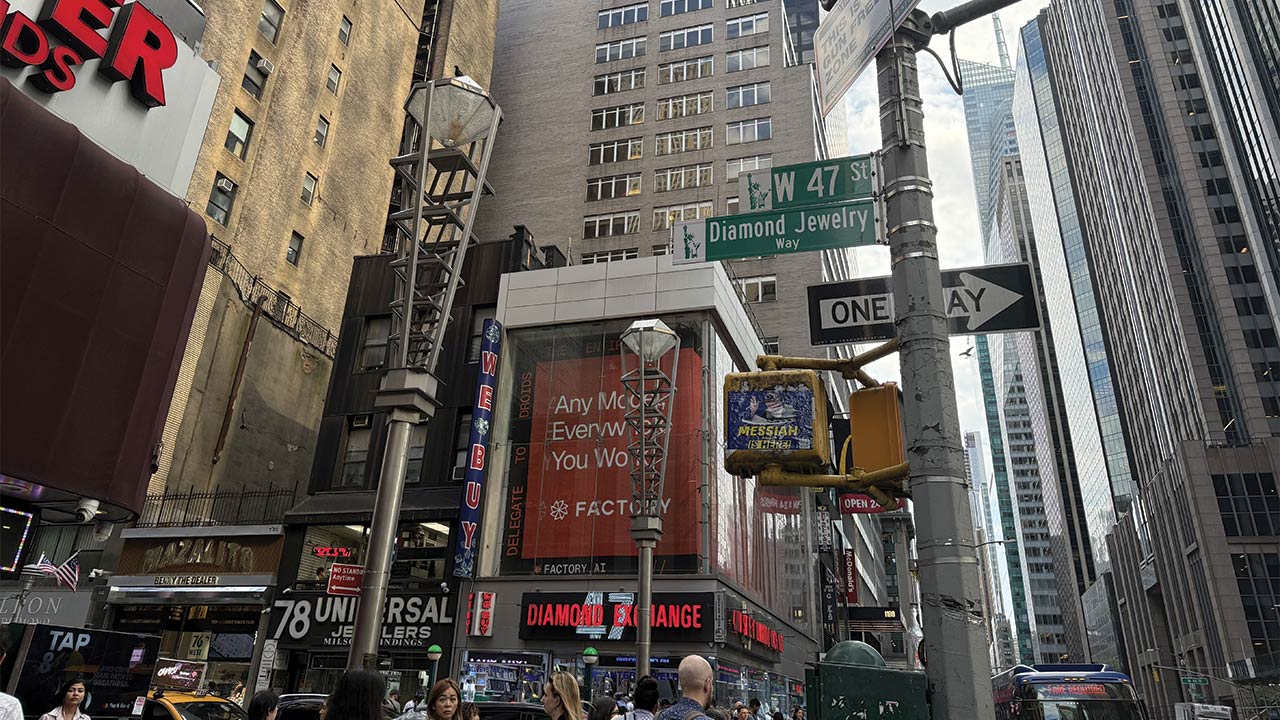
New York’s 47th Street, also known as the diamond district, is a hotbed of activity for consumers looking for great deals and even better jewelry. But what types of stones, metals, styles and cuts are trending?
When it comes to engagement rings, oval, marquise and old mine are the most popular shapes, jewelers selling their wares in the hub shared. Meanwhile, sapphires, emeralds and rubies are the gemstones that are seeing the most interest. Clients are still interested in gold, even though the price of the yellow metal has risen drastically in recent months, the vendors emphasized.
Lab vs. natural bridal jewelry
Jewelers in the diamond district are selling more engagement rings with lab-grown diamonds than with natural, they said.
“For us specifically, about 70% of engagement rings sold are lab-grown,” said David Borochov, a salesperson at R&R Jewelers.
In terms of shape, he is seeing a lot of ovals, rounds and recently, a lot of marquises. Pear shapes and emerald cuts are enjoying positive sales as well.
On average, customers are buying 2-carat natural diamonds and 3- to 5-carat lab-grown for engagement rings, Borochov revealed.
Michael Haniken, managing director of Haniken Jewelers, also reported that a lot of clients were looking for lab-grown diamond engagement rings.
“Lab is taking a large market share from naturals,” he said. “It could be anywhere from 25% to 50% lab these days. But there is a lot of demand for naturals as well, so we hope that it’s coming back.”
Like Borochov, he observed that ovals, cushions, rounds and marquises were some of the most popular shapes right now. The princess is the least sought-after, he believes.
“The square stones are not selling as much as elongated because I think they see that shape [elongated] on celebrities,” Haniken said.
Smaller natural diamonds have “kind of died out,” because for the same money, many customers want to buy a larger lab-grown, he added.
John Magzalcioglu, president of Diamond Club International, related that although his company was selling more synthetic diamonds for engagement rings, customers were still buying larger natural stones.
“I would probably say 60% lab, 40% natural, Magzalcioglu said. “People are looking for large-size natural if they are looking for natural. Smaller sizes are weaker, but the larger sizes are stronger.”
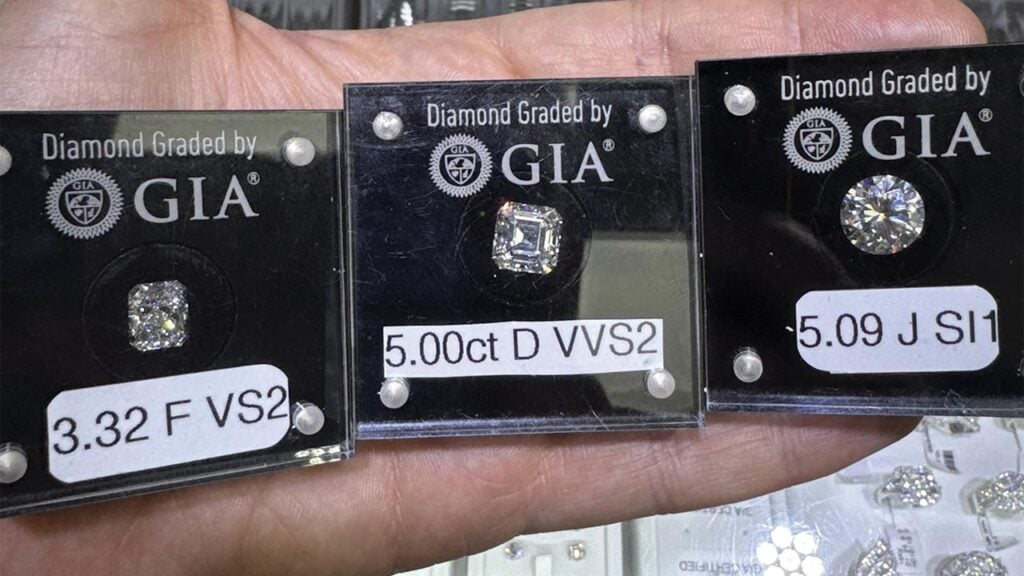
A variety of 3- and 5-carat natural diamonds from Diamond Club International. (John Magzalcioglu)
He sees a lot of elongated shapes, marquises, old mines, elongated old mines and cushions as well. He is also selling some low-color stones right now.
“In the natural-colored stones, yes, there’s interesting demand on J-, K-, L-, M-, [and] N-colored stones,” he said.
Maya McMillan, sales manager at Eric Originals and Antiques, agreed that most customers were opting for larger stones when it came to natural diamonds.
“I see a lot of people that were going to get a 1- or 2-carat stone – they’re opting for lab so they can get a bigger stone,” McMillan said. “Where 3-plus carats [natural] are still very strong for us. So big natural diamonds are still selling really well.”
Sapphires, emeralds and rubies
Many consumers are purchasing sapphires, emeralds and rubies for fashion jewelry. However, sapphires and emeralds are getting more attention right now, Magzalcioglu said, because good-quality rubies can be very expensive.
Some people are even choosing gemstones instead of diamonds for engagement rings, he continued.
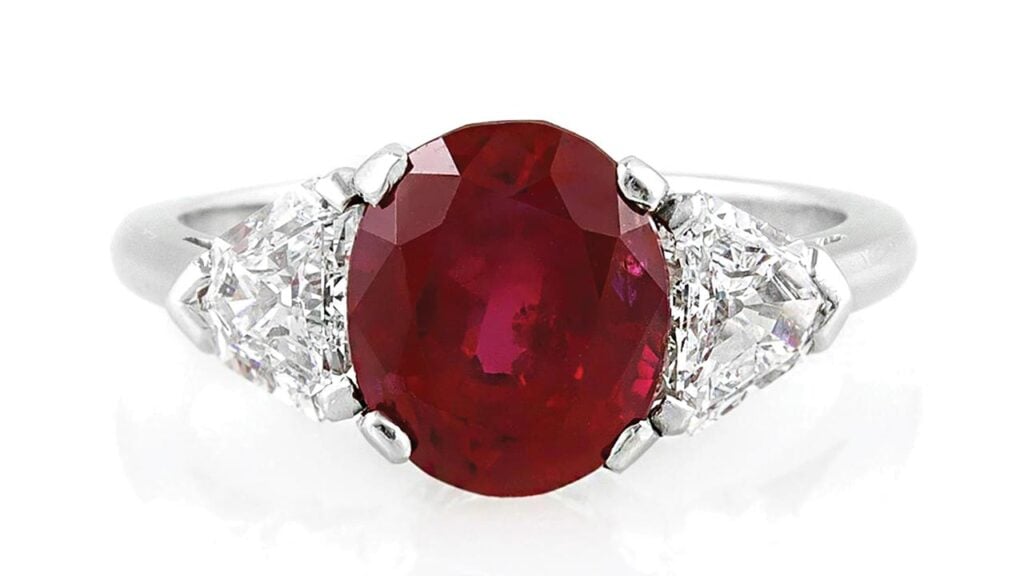
McMillan has also found that sapphires, rubies and emeralds are selling best.
Melisa Kulla, founder of MaMél Lux, said that sapphires were the most popular gemstone at her store right now.
Gold still selling
Although the price of gold has risen in recent months, consumers are still purchasing it, retailers say.
“I thought we would see more of a drop-off, but honestly, people who are going to spend $20,000 on a gold necklace are still going to spend $30,000 on a gold necklace,” McMillan said. “Definitely smaller gold pieces are not selling as much. There is a drop-off there. But very chunky gold pieces are still strong.”
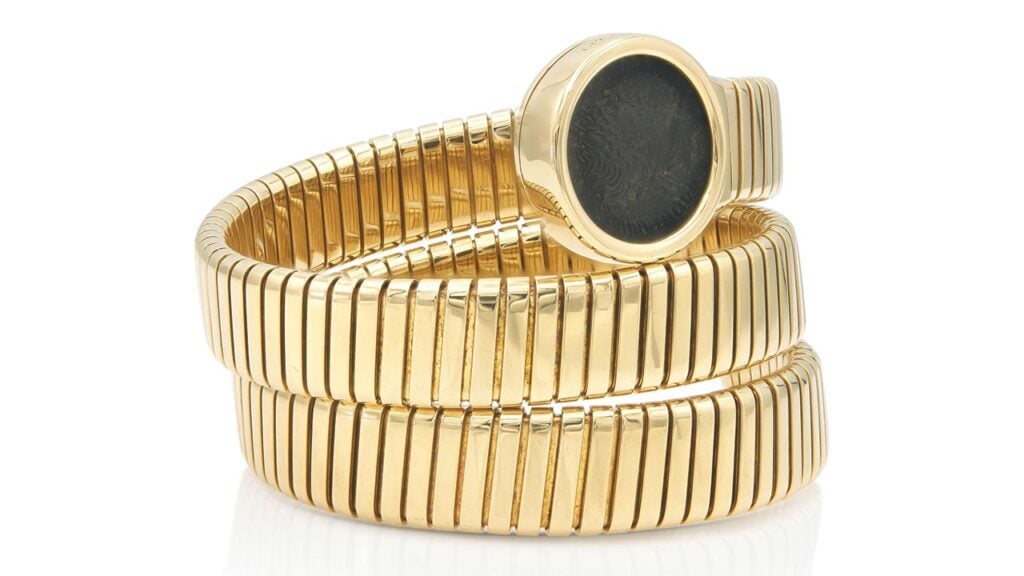
The recent price reversal for gold jewelry has also reinvigorated sales, Borochov added.
“Now that it’s going down again, people are jumping to buy it; just holding hopes that it will go up again,” he stated. They are buying “to enjoy it [but also to] sell it, to have an investment.”
Gold prices falling a little could help the trade, Haniken suggested.
The price spike “makes the cost of goods higher, and that gets passed to down to customers,” he explained. “Customers don’t want to pay so much.”
Main image: The New York diamond district. (Jacklyn Pellegrino)