 WhatsApp
 Email
Email
 Facebook
 Twitter
 LinkedIn

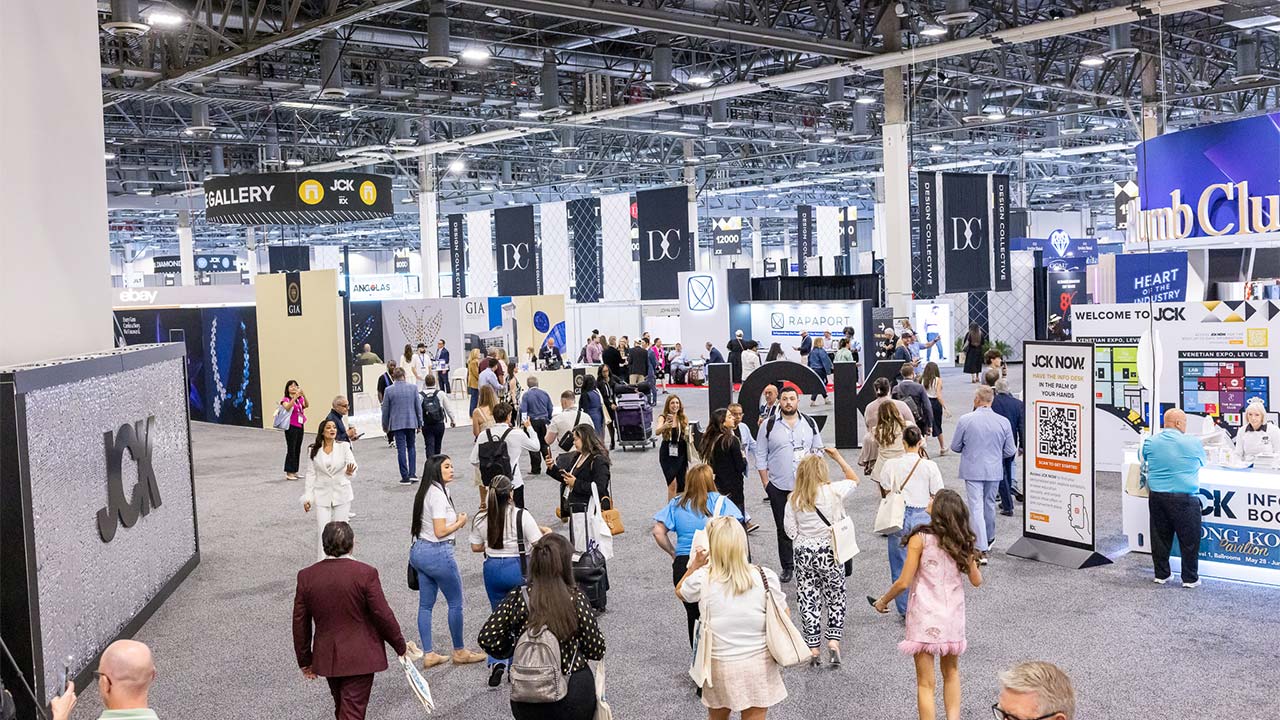
Bifurcation in the diamond market was in sharp focus at JCK Las Vegas, which ended Monday following four days of brisk trading in 2-carat and larger goods.
Activity in the show’s diamond plaza reflected the wider state of play in the US. Vendors with the right inventory closed sales and left with a positive impression of consumer and retailer demand. Those focusing on stones under 2 carats had a mixed or slow show.
This situation is consistent with the “K-shaped” recovery in the economy generally and the diamond sector more specifically. Wealthier Americans have money to spend, whereas those with smaller budgets are more likely to buy lab-grown. Synthetics have also normalized large stones in engagement rings, influencing the natural market. Larger independent jewelers did most of the buying, since they focus more on bigger natural stones than mom-and-pops and large chains.
Supply squeeze
The split appeared more intense than at last year’s fair, possibly because of deepening shortages in certain larger goods following production cuts.
“Scarcity is there in certain goods, especially 2 carats and up,” Shreyans Dholakia, brand custodian at Indian diamond manufacturer Shree Ramkrishna Exports (SRK), said Sunday at the show. “It has been [in short supply] for a year, but still people had inventory in the pipeline. So right now, what we see is real scarcity.”
“Bread-and-butter” goods — classic round engagement-ring center stones of the past, from 0.70 to 1.20 carats — were hard to move, as were smaller items.
Within the sizes that were popular, demand was focused on rounds and, to a greater extent, long fancies in standard American qualities from G to J and VS1 to SI2. Low colors were also sought-after, albeit in smaller volumes, as were unusual shapes, such as movals — long ovals that resemble marquises. Individuality and uniqueness were major themes of the show in loose and finished.
Traffic was heavy on Friday and slowed on Saturday, when many Jewish participants were absent. It picked up on Sunday and then tailed off on Monday, traditionally a quieter day as buyers head home. Buyers who came were serious, exhibitors said.
“Whoever has come here has come with the intention to do business,” said Nilesh Chhabria, chief operating officer at India-based polished producer Finestar Jewellery & Diamonds, which has shifted its business toward 10-carat and larger stones in the past year and a half.
Focused inventory
Exhibitors also arrived with a more focused inventory than in the past.
“I don’t see very much inventory in goods below 2 carats really being displayed,” said Gaurav Khandelwal, chief operating officer at Union Gems, a diamond dealer in Houston, Texas, who attended as a buyer. “At the wholesale level, there’s less margin to be made at the lower price points in absolute dollars, so there’s not as much enthusiasm there altogether.”
The effort and cost of tariff-free provisions also incentivized many overseas exhibitors to bring only the diamonds that were more likely to sell. Companies that shipped to the show through a Temporary Importation under Bond (TIB) or a foreign-trade zone (FTZ) are exempt from tariffs on the initial movement of goods but must return all merchandise to the place of export and resend any sold items back to the US, this time incurring duties.
Far fewer diamond exhibitors from key overseas diamond hubs were present than in past years, reflecting the state of the market and, in the case of Israeli suppliers, uncertainty about the security situation. The positioning of the show straight after GemGenève — at which many Antwerp-based dealers exhibited — also impacted attendance in Las Vegas.
Return to natural
While footfall in the lab-grown section was high, natural-diamond sellers felt consumers and jewelers were slowly returning to the mined product.
This was apparent at the Continental Buying Group (CBG) show in Las Vegas last week, including in slightly smaller sizes, said Jessica Gylsen, vice president of New York-based wholesaler XL Diamonds, which exhibited there.
“We had a wonderful show there, with a lot of our retailers needing to replenish their 1-, 1.50-, [and] 2-carat natural,” said Gylsen, who also had a booth at JCK. “Many of our stores [came] to us who have been so lab-centric, they haven’t invested in their natural-diamond inventory in years, and all of a sudden now with [that] show, they’re like, ‘Wow, we’re starting to see it come back again.’”
Diamonds weighing 2 and 3 carats and larger in elongated fancies were XL’s best categories at JCK, Gylsen added.
Finished-jewelry sellers, especially at the higher-end Luxury sister show, were more satisfied with the results than were loose dealers. This discrepancy might be because jewelry suppliers are “combing through leftover inventory,” said Khandelwal. “Diamond dealers are becoming creative and building jewelry to work through inventory. Otherwise there’s limited liquidity.”
Hong Kong-based diamond manufacturer and dealer Stellar Group has also pivoted to larger stones, said its managing director, Rishi Mundra. “The 2-carat [and] below, 1- carat [and] below segment is definitely moving more towards lab,” he noted.
The situation in the world’s largest retail market raises the question of how the industry can absorb the majority of diamonds coming out of the ground that are under 2 carats.
“You cannot obviously tailor production to ensure that you get out of the ground a specific size of stone,” Andrew Maatla Motsomi, CEO of Debswana, De Beers’ 50:50 joint venture with the Botswana government, said Sunday at the show. “It’s a challenge that we continue to address, but certainly I cannot, at this stage, state any specific solutions.”
Image: Exhibitors at the JCK Las Vegas show. (JCK)